
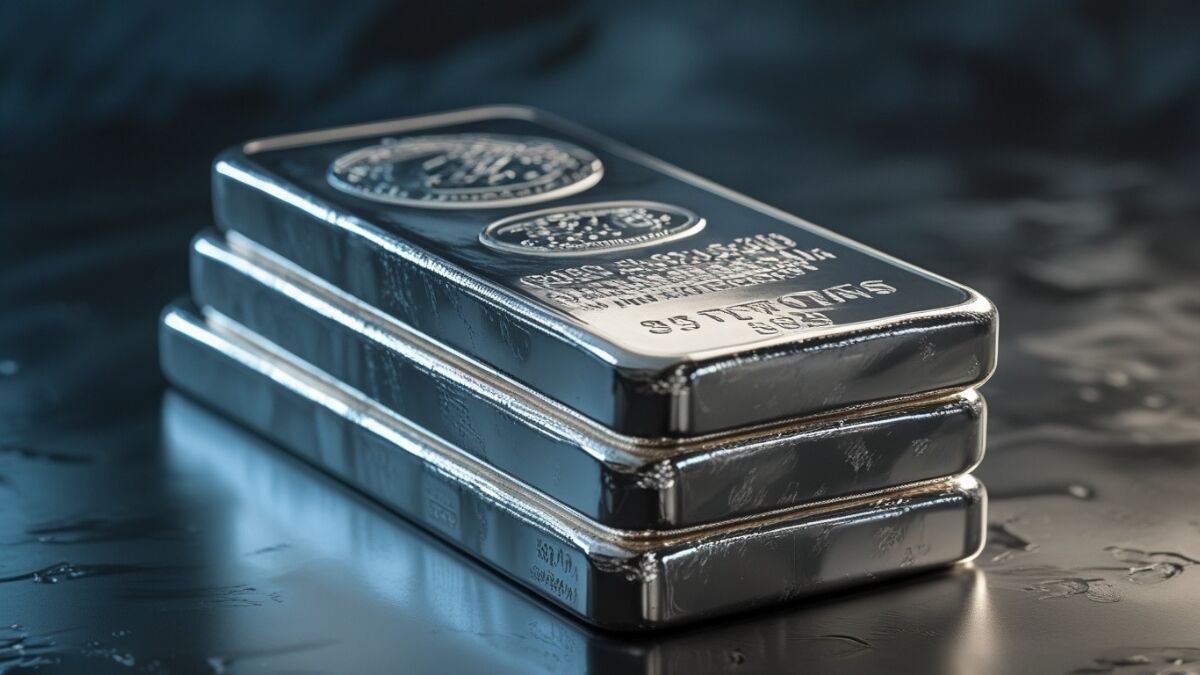
After its worst one-day decline in over five years, silver stabilized as traders booked profits after a strong year-end rise.
Precious Metals Stabilize After Sharp Selloff
Gold had little movement at around $4,340 after dropping 4.4%, while white metal maintained over $71 an ounce on Tuesday after falling 9% in the previous session. Thin market liquidity made recent price swings worse, and technical indications revealed that gains had run too quickly, causing precious metals to collapse.
Gold and silver are still on course for their greatest yearly results since 1979 despite Monday’s decline. High central bank purchases, inflows into exchange-traded funds, and three consecutive rate cuts by the US Federal Reserve have all helped to strengthen the metals. Commodities, which do not pay interest, benefit greatly from lower borrowing costs.
Latest Price Movements
After reaching a record $84.01 in the previous session, spot silver dropped 0.5% to $71.74 an ounce as of 7:15 a.m. in Singapore. Gold increased by 0.1% to $4,336.86. Following Monday’s double-digit percentage falls, platinum and palladium declined. Little has changed at the conclusion of the previous session for the Bloomberg Dollar Spot Index.
Elon Musk Weighs In on Silver Prices
Elon Musk, the CEO of Tesla, responded to the spike in silver prices on X a few days ago, saying, “This is not good.” Numerous industrial processes use silver. It served as a warning that increasing silver prices might jeopardize production costs and that silver is an essential industrial ingredient. Silver prices have increased due to robust investor and central bank purchasing as well as predictions of rate reduction by the U.S. Federal Reserve in 2026, but a deeper and more fundamental mismatch between supply and demand is also driving silver’s surge.
Industrial Demand and Supply Imbalance
A race for actual silver is the key factor driving silver’s price surge, according to a Reuters study, as industrial demand rises and supply growth is still limited. Silver, in contrast to gold, is both an industrial and monetary metal, and its increasing significance in the world’s energy revolution has drastically changed its demand profile.
The industry’s concerns over silver’s extraordinary surge this year were articulated in Musk’s succinct remark. However, the rise has rekindled discussion over whether the silver bubble may be broken by replacement, technical advancement, or demand destruction.
Silver as a Catalyst for Modern Manufacturing
Numerous modern businesses, such as solar energy, electric cars, electronics, electrification infrastructure, and data centers, now depend heavily on silver. It is hard to replace without sacrificing performance because to its remarkable electrical conductivity and dependability. These industries are using more and more silver as the world economy moves toward digitalization, decarbonization, and artificial intelligence.
Industrial demand for silver increased to 689.1 million ounces in 2024 from 644 million ounces the year before, according to LSEG statistics reported by Reuters. In 2024, solar power alone produced 243.7 million ounces, up from merely 94.4 million ounces in 2020 and 191.8 million ounces the previous year. This shows how quickly the implementation of sustainable energy is changing the silver market, with a 158% growth in the usage of silver for solar panels during a four-year period.
Future Demand Outlook
Solar-powered silver demand has a particularly promising future. Around 600 gigawatts of solar power were added globally in 2024, and by 2030, that number is predicted to increase to 1,000 gigawatts. Between 2024 and 2030, the International Energy Agency projects that 4,000 gigawatts of new solar power will be installed globally.
According to Reuters, solar energy alone may increase the demand for silver by around 150 million ounces annually by 2030. On top of the 1.169 billion ounces of actual silver needed in 2024, it would be an extra 13%. The sheer volume of industrial demand indicates that the market will find it difficult to keep up, even if higher costs reduce discretionary applications like jewelry.
The data already shows this disparity. The silver market reported a shortfall of 501.4 million ounces in 2024, according to LSEG forecasts, a sharp increase from only 19.4 million ounces in 2023. This disparity highlights how quickly demand is exceeding supply.
Supply Constraints and Mining Challenges
In contrast to many other commodities, it is difficult to increase the supply of silver in reaction to price increases. Mining for copper, lead, zinc, and gold produces most of the silver that is mined. This indicates that the economics and investment cycles of other metals, rather than the fundamentals of silver itself, have a significant influence on the production of silver.
Silver production may ultimately increase due to favorable attitudes toward copper and gold, but increasing output from current mines or creating new initiatives takes time. Global silver output is predicted to drop to 901 million ounces by 2030 from an anticipated 944 million ounces this year, in part because of scheduled mine closures, according to a July research from the industry website Mining Technology. According to these dynamics, supply limitations are probably going to last long into the next ten years.
Thrifting, Substitution, and Industry Response
Manufacturers are actively looking for methods to cut down on consumption or partly replace silver with less expensive materials like copper, aluminum, or nickel in response to the skyrocketing price of silver. Since the solar industry is the biggest industrial user of silver, research into alternative metallization processes has surged.
Global solar makers are anticipated to reduce their use of silver for the first time in years, according to a September Bloomberg study. Silver demand for solar modules installed this year may drop to 194 million troy ounces, or around 6,028 metric tons, according to BloombergNEF (BNEF), a 7% decrease from the previous year. Still, around 17% of the demand for silver comes from solar.
Silver now accounts for 14% of solar module manufacturing costs, up from only 5% in 2023, according to BNEF analysts. Solar producers, which already operate in a highly competitive market with low module costs, are facing further cost pressures as a result of this dramatic rise.
Can Technology Replace Silver?
Researchers from the University of New South Wales and Germany’s Fraunhofer Institute for Solar Energy Systems contend that, as long as the modifications are well planned, lowering the amount of silver in a product does not always equate to lowering its quality, according to PV Magazine. Silver reduction may maintain cell and module performance provided it is accompanied by appropriate metallization design and process management, according to Ning Song of UNSW, who spoke with PV Magazine.
Similarly, despite significant drops in silver per cell, Andreas Lorenz of Fraunhofer ISE said he does not observe any signs of quality degradation. Both researchers warn, however, that improper thrifting may result in increased electrical resistance, poor soldering, and long-term reliability issues. To solve these technical problems, time, testing, and optimization are necessary.
Despite advancements, it will take years to replace silver widely in all applications due to technological difficulties. According to Reuters and industry estimates, copper can not completely replace silver in many applications without sacrificing durability or efficiency, while being less expensive (though it is also rising). As a consequence, despite the exploration of alternatives, the market for silver continues to be robust. Additionally, BloombergNEF analysts caution that while copper-based process innovation is progressing, commercial-scale implementation is taking time. The price volatility of silver will continue to affect the solar industry and other high-growth industries in the foreseeable future.
Outlook: Can the Silver Rally Be Stopped?
Thrifting and substitution are unlikely to reduce silver prices in the near future, but they may limit the rate of demand increase at the margin, according to the research. Long mine development timeframes and diminishing production projections continue to limit supply, while structural demand from solar, electrification, EVs, and data infrastructure keeps growing.
Even if increased output of copper and gold ultimately helps the silver supply, it will take time for those advantages to become apparent, according to Reuters. Strong industrial demand, few alternatives for replacement, and structural supply shortages will probably keep silver prices high until then, confirming worries of Elon Musk‘s on growing input costs in the technology and clean-energy industries. Although technology could blunt the edges of silver’s rise, it is unlikely to stop it anytime soon.
