
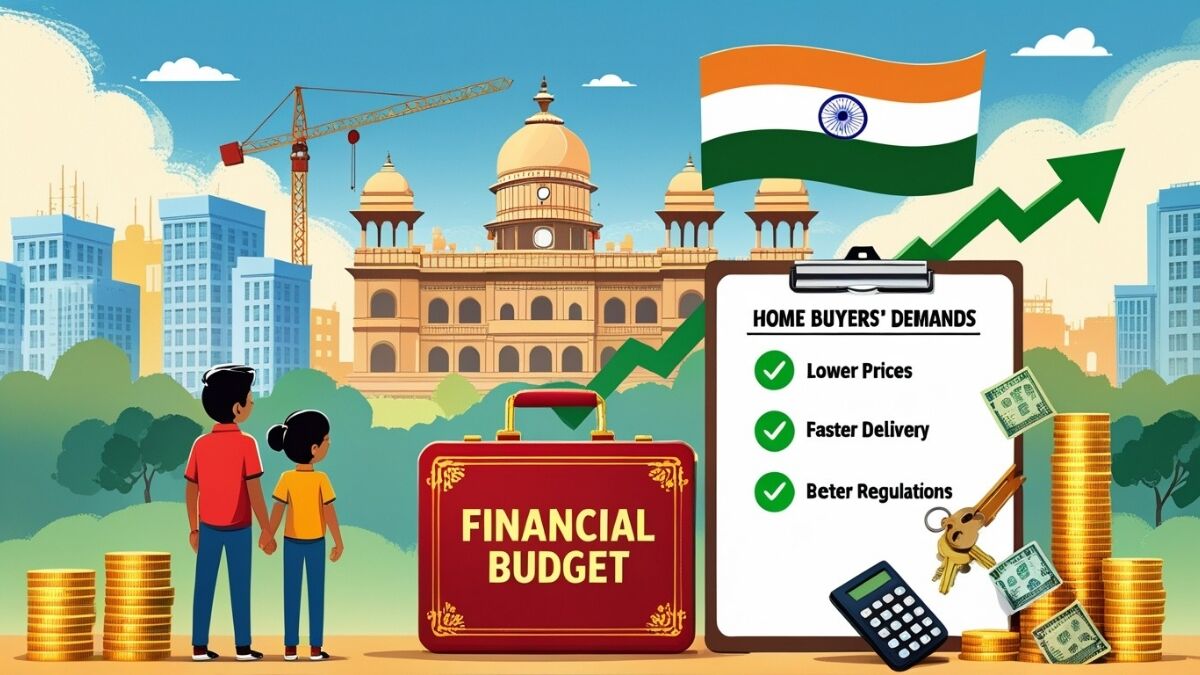
On February 1, Finance Minister Nirmala Sitharaman will deliver the Union Budget 2026. Although markets are now in the negative, investors are anticipating a rebound before to the budget announcement.
Market Performance Ahead of Union Budget 2026
On January 13, the Sensex closed at 83,627.69, down more than 250 points (0.3%). The Nifty 50 ended the session at 25,732.30, down around 58 points (0.22 percent).
Before Budget 2025, there were no significant shocks and the markets stayed mostly stable. On January 9, 2025, the Nifty 50 reached its monthly high of 23,689.50 after completing 2024 at 23,644.80. This was merely a little rise from the closing level on December 31, 2024. Before Finance Minister Nirmala Sitharaman unveiled the Union Budget 2025 on February 1, the index concluded January 2025 with minor losses overall.
Sensex and Nifty Historical Trend
The Sensex, which dropped 0.8 percent in January 2025 before to the Budget presentation, also almost tracked the Nifty’s trajectory throughout the month.
“The Indian market usually underperforms in January before a budget, according to historical patterns; profit-booking and policy uncertainty have caused the Nifty to decline in four of the previous five years. Santosh Meena, Head of Research at Swastika Investmart, said that current data support this cautious attitude.
Volatility During Pre-Budget Phase
According to Siddharth Maurya, Founder & Managing Director of Vibhavangal Anukulakara, the pre-Budget times are marked by greater levels of market volatility rather than the typical straight-line advance to the upper side as the market attempts to price in its opinions on fiscal expenditure.
Investors should anticipate some pre-Budget positioning in the markets, according to Swapnil Aggarwal, Director at VSRK Capital, however this is probably going to be a selective rather than a widespread bounce.
📊 Pre-Budget 2026 Market Snapshot
- Budget Date: February 1, 2026
- Sensex Level: 83,627.69
- Nifty 50 Level: 25,732.30
- Market Mood: Cautious with selective buying
- Key Drivers: Capex, fiscal discipline, global cues
Selective Buying and Sectoral Bets
However, Maurya said that there can be spikes in purchases in some industries, including manufacturing, infrastructure, and consumption, which are the government’s key areas. He went on to say that it is impossible to anticipate a widespread shift based just on expectations. He continued, “The market will have to wait for the Budget measures to guarantee that worries on growth are addressed with and budgetary discipline is observed.”
As the Union Budget draws near, sentiment usually improves on expectations of growth-supportive measures, particularly around capital expenditure, infrastructure push, and incentives for emerging sectors, according to Aggarwal. “Recent market action suggests cautious optimism, with participants closely tracking macro signals, global cues, and fiscal discipline,” he said. In areas where policy stability and profit visibility are anticipated, additional purchasing may appear even if volatility may continue in the short future, according to the expert.
Near-Term Market Outlook
Aggarwal added that the near-term trend points to consolidation with sporadic rallies as investors balance Budget optimism with valuation concerns and global uncertainties. However, markets are unlikely to price in aggressive outcomes ahead of the Budget, and any upside may remain measured until there is clarity on actual announcements.
According to Santosh Meena, Head of Research at Swastika Investmart, the market is focusing more on industries that stand to gain from a government drive for economic development ahead of the Union Budget 2026, especially via capital spending and rural revitalization.
🏗️ Budget-Sensitive Sectors in Focus
- Infrastructure: Capex push, strong order books
- Defence: Make in India & localization themes
- Renewables: Energy security & green transition
- Agriculture: Rural revival & farm support
- Banks: Credit growth & economic recovery
Infrastructure and defense
Infrastructure and defense: Meena advises investors to pay particular attention to infrastructure and defense, as these sectors continue to have high expectations for continuous funding to support “Make in India” programs. Strong order books make businesses like HG Infra Engineering and Larsen & Toubro (L&T) excellent choices in the infrastructure sector, while localization policies in the defense industry provide chances in Bharat Electronics (BEL), Hindustan Aeronautics (HAL), and Mazagon Dock.
Renewables and vital minerals
Renewables and vital minerals: As the world moves toward green energy and energy security, renewables and critical minerals are also becoming more popular, with stocks like National Aluminium Company (NALCO), Tata Power, and GMDC in the spotlight.
consumer and agriculture
consumer and agriculture: Expectations of fiscal stimulus to alleviate rural suffering have made the consumer and agricultural sectors important issues this year, according to Meena. The market expects policies like increased subsidies or tax breaks to increase disposable income, which would directly help the rural economy.
According to the analyst, “stocks including UPL, Dhanuka Agritech, Fertilisers and Chemicals Travancore (FACT), and Coromandel International are positioned to benefit from farm assistance initiatives, making agricultural inputs an important sector to monitor.” Mahindra & Mahindra (M&M) is a powerful stand-in for both auto and rural demand, while FMCG behemoths like Hindustan Unilever (HUL) and ITC are defensive bets in this rural recovery story.
Banks
Banks: According to Meena, financial institutions, especially State Bank of India (SBI) and HDFC Bank, continue to be key players in the overall credit development narrative.
“Selective upside in budget-sensitive industries cannot be ruled out, even if a strong, widespread rise ahead of the budget seems improbable. The analyst came to the conclusion that any pre-Budget rise would probably be limited, stock-specific, and motivated by expectations over defense spending, capital expenditures, and rural support rather than a long-term shift in the market as a whole.
Wealth1’s founder and CEO, Narender Agarwal, said that investors should steer clear of aggressive positioning based only on expectations and instead concentrate on fundamentally sound companies, since any rise ahead of the budget is likely to be moderate rather than exuberant.
Instead of concentrating just on short-term volatility, investors should see the Budget as a chance to match portfolios with India’s long-term growth themes. According to Tushar Badjate, Director of Badjate Stock & Shares, “a growth-oriented budget supported by strong economic momentum may enable larger market participation and create the basis for sustained profits beyond the Budget event.”
Frequently asked questions
1. Before Union Budget 2026, will there be a significant pre-Budget rally?
Analysts do not anticipate a robust, widespread surge. Any gains are probably going to be selective and confined to certain industries rather than the market as a whole.
2. Why do markets often experience volatility before to the Budget?
Due to profit-booking, policy uncertainty, global signals, and investors attempting to price in anticipated fiscal measures, pre-budget times often see volatility.
3. Before Budget 2026, which industries could attract purchasing interest?
Infrastructure, defense, manufacturing, renewable energy, agriculture, rural consumption, and some banking stocks are industries that are expected to draw selective purchasing.
4. Before the Budget, should investors take bold stances?
The majority of experts suggest concentrating on long-term themes and fundamentally sound companies rather than taking an aggressive stance based only on anticipation.
Conclusion
In general, market analysts predict that a significant pre-Budget rally across the board is unlikely to occur before the Union Budget 2026. Rather, investors could see selective, stock-specific moves motivated by assumptions for policy continuity, rural assistance, capital expenditure, and defense expenditures.
Until real budget announcements provide clarity, the overall market is anticipated to be range-bound with sporadic rises. Instead of chasing short-term budget-related volatility, long-term investors are recommended to align portfolios with India’s fundamental growth themes.
Disclaimer
This material should not be interpreted as financial or investment advice; it is just meant to be informative. Investments in the stock market are vulnerable to market hazards. Before making any investing choices, readers are encouraged to speak with a certified financial adviser.
