
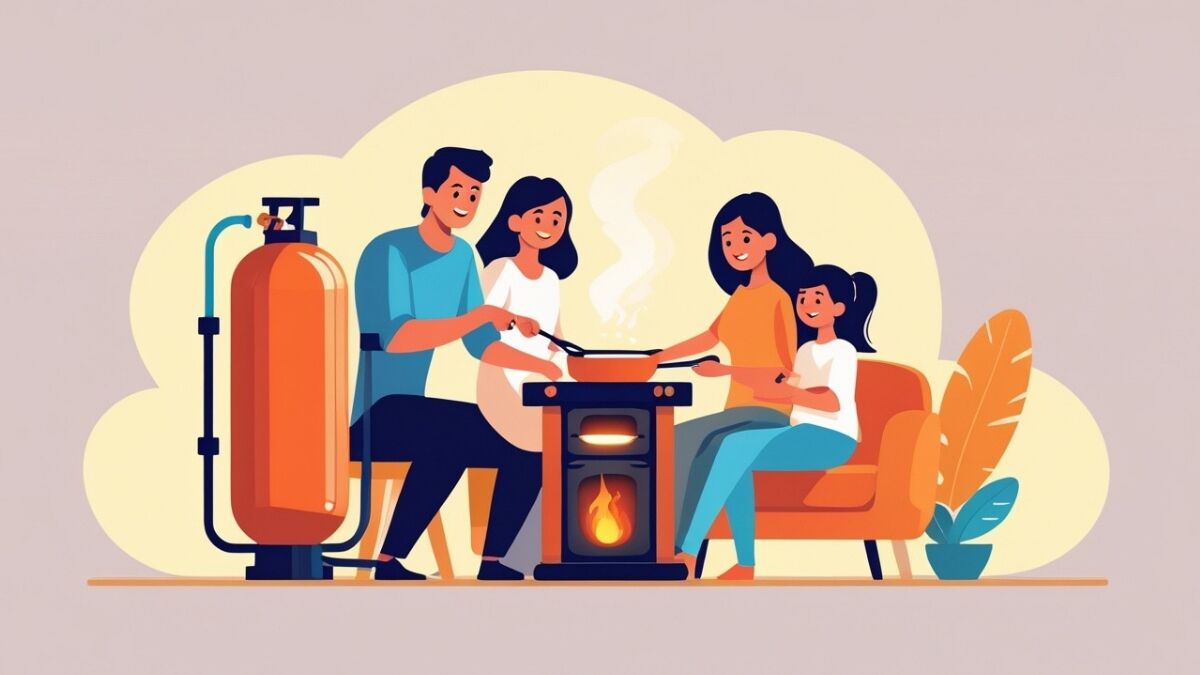
Many homes in Lambra Kangri hamlet in Punjab’s Hoshiarpur district have found a sustainable solution that not only powers their kitchens but also lowers family energy costs and provides a useful method of handling livestock waste.
Lambra Kangri Village Uses Biogas Instead of LPG
44 households here have been utilizing biogas made from animal dung instead of expensive LPG cylinders for over ten years.
The Lambra Kangri Multipurpose Cooperative Society established a community biogas plant in 2016 that has been processing up to 2,500 kg of cow manure per day. It collects methane gas and pipes it straight into 44 households for everyday usage including cooking. Compared to approximately Rs 700 for a single LPG cylinder, families now pay an average of only Rs 200 to Rs 300 per month on biogas.
South Korea Inspired Punjab’s Biogas Model
South Korea served as an inspiration for Punjab.
Jaswinder Singh Saini, a native of Lambra Kangri, saw South Korea’s effective waste-to-energy systems while on a study visit, which inspired the concept. He decided to modify the model at home.
When Saini returned, he was troubled by the waste management problems and choked drains caused by livestock manure in his hamlet.
Government Support and Cooperative Effort
He requested technical support from the Punjab Pollution Control Board and the Punjab Agricultural University, Ludhiana. Saini assisted in the establishment of the community biogas plant in 2016 with a significant investment from the Lambra Kangri Multipurpose Cooperative Society and a minor government grant of Rs 2 lakh from the Union Ministry of New and Renewable Energy.
The system operates via a straightforward, community-driven procedure. The biogas facility receives the door-to-door collection of cow poo and transforms it into clean cooking gas. This gas replaces pricey LPG cylinders and is delivered to households via a system of underground and overground pipes.
Transparent Billing and Sustainable Operation
Each household’s consumption of biogas is digitally metered and billed, guaranteeing efficiency and transparency. The strategy is sustainable since it sells the plant’s leftover slurry as nutrient-rich biofertilizer.
This makes the system financially feasible and simple to operate in addition to improving the village’s cleanliness.
Why Biogas Is Important for Rural India
Particularly in rural India, where fuel prices and pollution are significant issues, biogas provides a clean and reasonably priced substitute for LPG and firewood. It improves cleanliness, lowers methane emissions, and converts waste into electricity.
Lambra is unique because of its strong sense of community. The hamlet demonstrates how biogas may assist India in achieving energy self-reliance in an easy and sustainable manner by using local resources and cooperating.
🌱 Lambra Kangri Community Biogas Project
- Location: Hoshiarpur district, Punjab
- Households Connected: 44
- Plant Started: 2016
- Daily Cow Dung Processing: Up to 2,500 kg
- Gas Usage: Cooking via pipeline
- Monthly Cost: ₹200–₹300 per family
♻️ Environmental and Economic Benefits
- LPG Replacement: Reduced dependence on costly cylinders
- Clean Energy: Methane used instead of firewood
- Waste Management: Proper handling of livestock manure
- Extra Income: Sale of nutrient-rich biofertilizer slurry
- Lower Emissions: Reduced methane release into atmosphere
Biogas: What is it?
The decomposition of organic materials, such as food scraps and animal manure, produces biogas, a sustainable energy source that is good to the environment. Learn how biogas is made and how it can be used to heat our homes, power cars, and create energy.
How is biogas made?
In the absence of oxygen, microbes break down organic materials, such as food or animal manure, to generate biogas, a sustainable fuel. Anaerobic digestion is the term for this process.
The waste material must be contained in an oxygen-free environment for this to occur. Biogas may be produced purposefully as a fuel via industrial processes or organically.
Environmental Value of Capturing Biogas
Since the organic matter used to make biogas will naturally decay, it is less harmful to the environment to capture the gases created by this decay and utilize them as an energy source than to let them escape into the atmosphere.
Biogas production is a primarily cyclical process that fits within a larger sustainable cycle of agricultural waste management. For instance, biogas generated from farm animal waste may be used to power agricultural equipment.
Materials Used to Produce Biogas
Animal manure, municipal trash or waste, plant material, food waste, or sewage are just a few of the many waste materials that decompose into biogas.
Methane and carbon dioxide make up the majority of biogas. Additionally, it may include trace levels of siloxanes, hydrogen sulfide, and moisture. Depending on the kind of waste used to produce the final biogas, they have different relative amounts.
Biogas as an Alternative Fuel
Compressing biogas may make it suitable for use as a car fuel.
As an alternative to natural gas, biogas that has been cleaned up and improved to natural gas standards is referred to as biomethane and may be used similarly to methane, such as for heating and cooking.
Six amazing facts about biogas
1. There are many names for biogas.
The most popular name for biogas is biomethane. In the US, it is also known as swamp gas, sewage gas, compost gas, and marsh gas.
The decomposition of organic matter produces biogas, a naturally occurring and sustainable energy source. It is important to distinguish biogas from “natural” gas, which is a non-renewable energy source.
🌱 Biogas at a Glance
- Main Component: Methane
- Produced From: Organic waste and animal manure
- Energy Type: Renewable and sustainable
- Common Use: Cooking, heating, electricity
- Environmental Impact: Reduces methane emissions
2. The similarities and differences between biomass and biogas
Both biomass and biogas are biofuels that may be burned to generate electricity. However, biomass is the organic, solid substance. Since humans first found fire, biomass has been used as a source of energy by burning wood, plants, and animal excrement.
Nowadays, a lot of power plants burn compressed wood pellets, a byproduct of the production of wood and furniture. Biomass allows the production of renewable power by taking the place of fossil fuel coal.
Biogas is created when biomass breaks down organically or industrially in an anaerobic digester. Another way to conceptualize the distinctions is that biogas is the final product while biomass is the raw ingredient.
3. The finding of biogas is not new.
Even before fossil fuels, the anaerobic process of organic matter decomposition, often known as fermentation, has been occurring in the natural world for millions of years and is still going strong now. The industrial process of turning organic waste into electricity in biogas plants today is only accelerating nature’s capacity to recycle its valuable resources.
It is believed that the Assyrians in the Middle East utilized biogas to heat their baths as early as 3,000 BC.
Jan Baptist van Helmont, a chemist from the 17th century, found that decomposing organic materials may produce combustible gasses. Additionally, it was Van Helmont who introduced the term “gas,” which comes from the Greek word chaos, into the scientific lexicon.
In 1859, a leper colony in Bombay established the first sizable anaerobic digestion factory.
John Webb, a creative Victorian engineer from Birmingham, invented the Sewage Lamp, which turned sewage into biogas for city lighting. Located on Carting Lane, or Farting Lane as some wags would have it, just off The Strand, is the sole Webb Sewer Lamp still standing in London.
Prior to chemical treatments, municipal wastewater was treated by anaerobic digestion. The anaerobic technique is still acknowledged as a low-cost, natural substitute for chemicals and the decrease of dysentery bacteria in underdeveloped nations.
Not to mention that in Mad Max Beyond Thunderdome, a pig-farm biogas system powers the cars that chase the desert in the post-apocalyptic community of Bartertown, which is governed by Tina Turner’s scary Aunty Entity.
4. China now uses the most biogas worldwide.
With an estimated 50 million homes utilizing biogas, China has the most biogas facilities. These are mostly small-scale household and village plants in rural settings.
🌍 Global Biogas Usage
- China: Around 50 million homes using biogas
- UK: 109 operational biogas facilities
- USA: Over 2,200 active biogas sites
- Major Sources: Farms, landfills, food waste
- Climate Impact: Significant emission reduction potential
5. There are now 109 biogas facilities operating in the UK, compared to more than 2,200 sites in the US.
In 2011, the government launched the Renewable Heat Incentive program, which led to the construction of the first biogas plant in the United Kingdom. According to the Anaerobic Digestion and Bioresources Association, growth peaked in 2016 with the construction of 33 new units.
In 2020, Biocow’s Somerset dairy farm became the first to directly connect its biogas output to the nation’s transmission network.
According to the American Biogas Council, there are more than 2,200 active sites in the US that produce biogas across all 50 states: 250 anaerobic digesters on farms; 1,269 water resource recovery facilities that use anaerobic digesters; 66 standalone systems that break down food waste; and 652 landfill gas projects.
They estimate that the US biogas business has enormous development potential, producing 103 trillion kilowatt hours of power annually while lowering emissions equal to taking 117 million passenger cars off the road.
6. There is enough food waste from holidays to use biogas to heat 25,000 dwellings.
According to WRAP, around 10 million tons of food waste are produced annually in the UK by homes, the hotel and food service industry, food manufacturing, retail, and wholesale sectors. The sector could produce 11 TWh of biogas—enough to heat 830,000 homes—and reduce emissions by 8.8 million tonnes of CO2 equivalent, or 2% of the UK’s yearly emissions, if this was completely processed by anaerobic digestion.
The UK wastes 270,000 tons of food only over the Christmas season. These leftover Christmas puddings, roast vegetables, and mince pies would save carbon dioxide emissions by 236,000 tons and produce 300 GWh of biogas, which could heat 25,000 homes.
Over 70 billion pounds (5000000000 stones) of food waste are dumped in landfills annually, according to estimates from the US Environmental Protection Agency (EPA). Food makes up more solid waste in landfills than any other substance, accounting for 24% of all solid garbage. Food waste accounts for a big portion of the 23% increase in waste in America that occurs over the Christmas season alone. Reducing food waste is crucial to lowering biogas emissions since landfills are the third-largest source of human-related methane emissions in the US.
Frequently asked questions
1. Why did the community of Lambra Kangri cease to use LPG?
In order to manage cow dung waste, lower the high cost of LPG, and switch to a cleaner, renewable energy source, the hamlet switched to biogas.
2. How does the community manufacture biogas?
Every day, domestic cattle manure is gathered and fed into a communal biogas plant, where it breaks down to generate cooking methane.
3. How much does the use of biogas save families?
Compared to around ₹700 for a single LPG cylinder, households only pay ₹200–₹300 on biogas each month, which results in huge savings.
4. Who oversees and keeps up the biogas system?
With community involvement, the Lambra Kangri Multipurpose Cooperative Society oversees the plant, guaranteeing efficient operation and upkeep.
5. What happens to the trash that remains after the manufacturing of gas?
Farmers may increase soil fertility and earn extra money by selling the remaining slurry as biofertilizer.
Conclusion
An effective illustration of how locally generated renewable energy solutions may improve rural living is Lambra Kangri hamlet. The hamlet has lowered expenses, improved cleanliness, and developed a sustainable revenue source by converting livestock excrement into clean cooking fuel.
This simple yet successful biogas project demonstrates that energy self-reliance in rural India is not only feasible but also scalable with collaboration, creativity, and local resources.
Disclaimer:
This article is for informational purposes only. The facts and figures mentioned are based on publicly available information and reports. Readers are advised to verify details independently before making decisions based on this content.
