
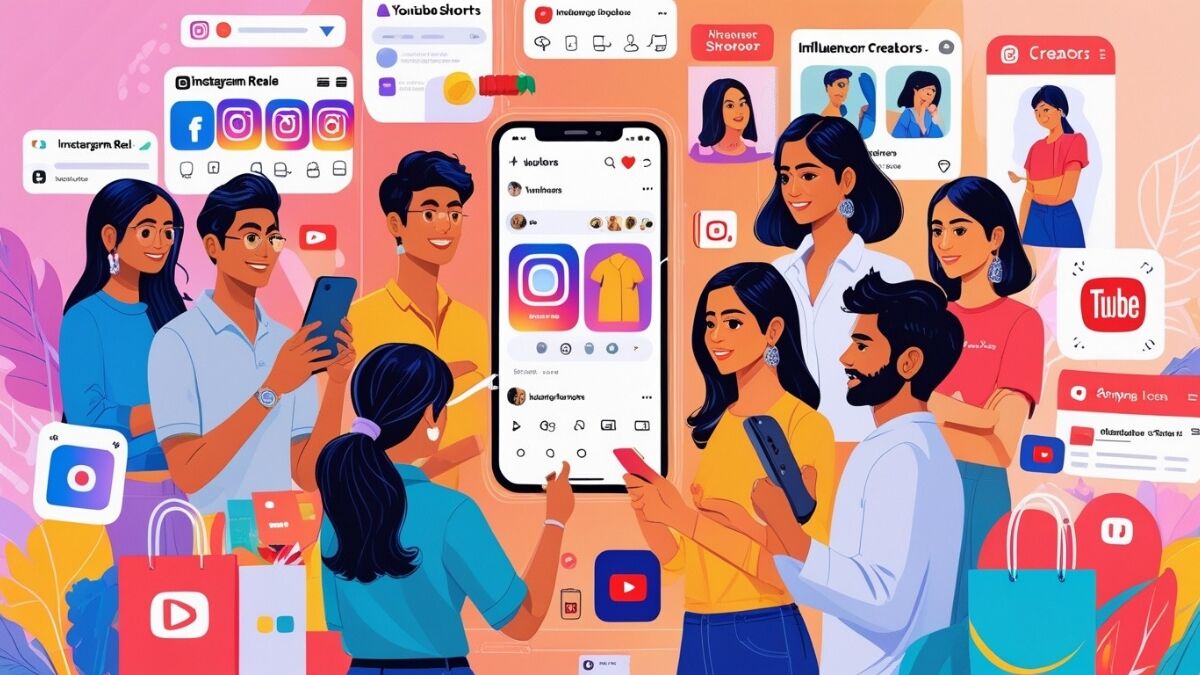
In India, social commerce is making a comeback after a painful initial wave as younger consumers increasingly use feeds, videos, and artists instead of search bars.
Social Commerce Makes a Comeback in India
Two people acquainted with the situation informed Mint that Fundamentum-backed Wishlink is in negotiations to fund ₹20–25 million from both current and potential investors.
The conversations take place as major e-commerce companies start to generate significant revenue from creator-driven discovery and as investor interest in content-led commerce platforms resumes after a number of early bets failed or exited.
Investor Interest Returns to Creator-Led Platforms
One of the individuals mentioned above with firsthand knowledge of the situation stated, “The company has developed fast and is anticipating other investors to join the round,” adding that it is probably going to close shortly. At the time of publication, Wishlink had not responded to any queries.
Wishlink is not by itself. Nikhil Kamath’s fund Gruhas provided LehLah with a $1.5 million seed round last year. After their initial seed rounds, other platforms, like Hypd, have also been expanding in the market.
Second Wave After Early Social Commerce Failures
Following the demise or consolidation of a previous generation of social commerce businesses, like Trell, Bulbul, and SimSim, which were either inactive or purchased by bigger companies like YouTube and the Good Glamm Group, there is a resurgence of interest.
These businesses, which were established between 2016 and 2018, failed to scale despite raising more than $100 million in early-stage capital. According to Ashish Kumar, co-founder and general partner at Fundamentum, an early supporter of Wishlink, “if you look back eight to ten years, the difficulty in commerce was supply.” “We have now resolved the issue.”
From Supply Scarcity to Discovery Overload
According to Kumar, Indian e-commerce has transitioned from scarcity to excess. Today, curation is the issue. The supply is excessive. Customers typically ask for assistance in determining what they want.
Newer platforms are concentrating on creator-commerce infrastructure, in contrast to the initial wave of social commerce businesses that tried to create full-stack shopping apps by controlling discovery, checkout, and logistics.
How Social Commerce 2.0 Works
They work as a bridge between creators, brands, and marketplaces, enabling influencers to categorize products, generate affiliate links, monitor conversions, and route transactions to websites that already have fulfillment or platforms like Myntra or Amazon.
The founders contend that the timing is also favorable to them. According to Ashna Ruia, co-founder of LehLah, “influencing is becoming popular.” “That wave is what we are riding.” Established in December 2022, LehLah collaborates with electronics and direct-to-consumer businesses, including Samsung and various FMCG labels, as well as marketplaces like Myntra, Meesho, Nykaa, and Ajio.
📊 India’s Social Commerce Boom
- Market Size (2025): $29.27 billion
- Projected Size (2030): Nearly $144 billion
- Growth Rate: 37.5% CAGR
- Key Drivers: Creators, short videos, mobile-first discovery
- Consumer Shift: Search-based shopping → Feed-based discovery
Influencers Replace Search as Discovery Engine
While better digital payments, logistical networks, and the emergence of direct-to-consumer (D2C) firms have decreased online purchase friction, short-form video platforms like YouTube and Instagram have taught customers to find things through creator content.
Simultaneously, marketers are reallocating their spending to performance-linked influencer commerce due to growing expenses associated with digital advertising. According to major e-commerce companies, this change is now producing quantifiable business results.
Myntra Validates Creator-Led Commerce
“Today, inspiration shapes fashion discovery just as much as intent,” stated Sunder Balasubramanian, chief marketing officer of Myntra. Conversion on the site has increased by 10% as a result of engagement with social commerce content. What started out as a marketing tool has now developed into a significant business motivator.
According to the company, approximately 10% of Myntra’s platform revenue comes from creator-led commerce. In 2020, Myntra introduced its Studio platform. Unit economics, according to investors supporting emerging platforms, is the most obvious break from previous models.
🚀 Why Social Commerce 2.0 Works
- Customer Acquisition Cost: Almost $0
- Traffic Source: Instagram & YouTube creators
- Business Model: Affiliate + tech layer
- Logistics: Handled by Amazon, Myntra & others
- ROI: Higher than traditional digital advertising
Improved Unit Economics Power New Platforms
According to Kumar, “Wishlink’s customer acquisition cost is basically nothing because traffic originates from Instagram and YouTube.” “Content commerce is more efficient in terms of return on investment.” He stated that although content commerce platforms profit from distribution already established by producers, traditional marketplaces need substantial resources to spur growth.
According to market research and intelligence firm Mordor Intelligence, India’s social commerce market reached $29.27 billion in 2025 and is expected to grow at a 37.5% compound annual rate to nearly $144 billion by 2030 due to the quick spread of digital payments, creator-led purchasing behavior, and mobile-first product discovery.
Wishlink and LehLah Growth Story
IIT Delhi grads Shaurya Gupta, Chandan Yadav, and Divyansh Ameta founded Wishlink in January 2022. To date, it has raised about $10.1 million from investors, including Elevation Capital, Trifecta Capital, Wellfound, and over 70 angel backers.
Ruia of LehLah stated that despite the company’s youth, the platform has also seen consistent growth. “Over the past year, our revenue has increased by around five times,” Ruia stated. “Our portfolio of brands has grown considerably.”
Scaling Without Losing Efficiency
However, the majority of platforms are still little. The true test will be if they can grow without sacrificing efficiency and whether investors are still interested after this round. Previous initiatives, according to founders and investors, encountered fundamental mismatches between content and commerce.
According to Kumar, “they come for amusement or knowledge with content commerce.” “Traditional conversion metrics do not function when you overlay commerce on top.” Execution made the issue worse. Few teams successfully handled both content and commerce, which require quite distinct operational strengths.
Quality Emerges as the Biggest Risk
Quality becomes the most significant limitation as platforms grow. According to Ruia, “India has no scarcity of brands or inventors.” “Quality is the primary danger.” “The main difficulty is scaling with the right brands and the right creators without compromising experience,” she continued.
Important Lessons
Wishlink is looking for up to ₹25 million in social commerce finance.
Instead of focusing on logistics and fulfillment, new businesses are serving as a tech/affiliate layer for established behemoths like Amazon and Myntra.
10% of Myntra’s overall revenue comes from social commerce, which also provides 10% higher conversion rates.
Startups are obtaining almost $0 customer acquisition expenses by utilizing influencer audiences on YouTube and Instagram.
Influencers serve as the essential filter for overloaded customers, and the market has transitioned from a supply problem to a discovery problem.
Frequently asked questions
1. What distinguishes Social Commerce 2.0 from the initial wave?
Instead of developing full-stack commerce apps, Social Commerce 2.0 concentrates on creator-led discovery. Newer platforms serve as affiliate and software layers that drive customers to already-existing marketplaces like Amazon and Myntra, in contrast to the initial generation, which attempted to handle logistics and fulfillment.
2. What is the reason behind the revival of social commerce in India among Gen Z?
Instead of using searches to find things, Gen Z likes to use social media feeds, short videos, and artists. Influencer suggestions are becoming more reliable and interesting thanks to social media sites like YouTube and Instagram.
3. What caused the failure of previous social commerce startups?
Because they attempted to integrate content, commerce, and logistics—all of which require distinct operational strengths—earlier players had difficulties. Their collapse or acquisition was caused by incorrect conversion expectations, high customer acquisition expenses, and poor unit economics.
4. How are new platforms like LehLah and Wishlink improving their economics?
By utilizing creator audiences, they profit from almost $0 client acquisition costs. These firms rely on performance-based rewards instead of large marketing expenditures because traffic comes naturally from social media.
5. Why are social commerce firms attracting investors once more?
Improved unit economics, demonstrable creator-led conversions, and quantifiable revenue impact have restored investor trust. The approach is validated by the fact that major platforms like Myntra currently make over 10% of their income from social commerce.
Conclusion
In India, social commerce has developed into a lean, creator-driven discovery engine from a logistics-heavy experiment. Influencers are becoming the best filter for overwhelmed customers as e-commerce moves from a supply issue to a curation issue.
Social Commerce 2.0 is evolving from a marketing add-on to a primary source of income due to its low acquisition costs, increased conversion rates, and excellent alignment with Gen Z behavior. Scaling responsibly while preserving quality among creators and brands is the true challenge that lies ahead.
Disclaimer:
This article is for informational purposes only and does not constitute financial, investment, or business advice. Views expressed are based on publicly available information.
