
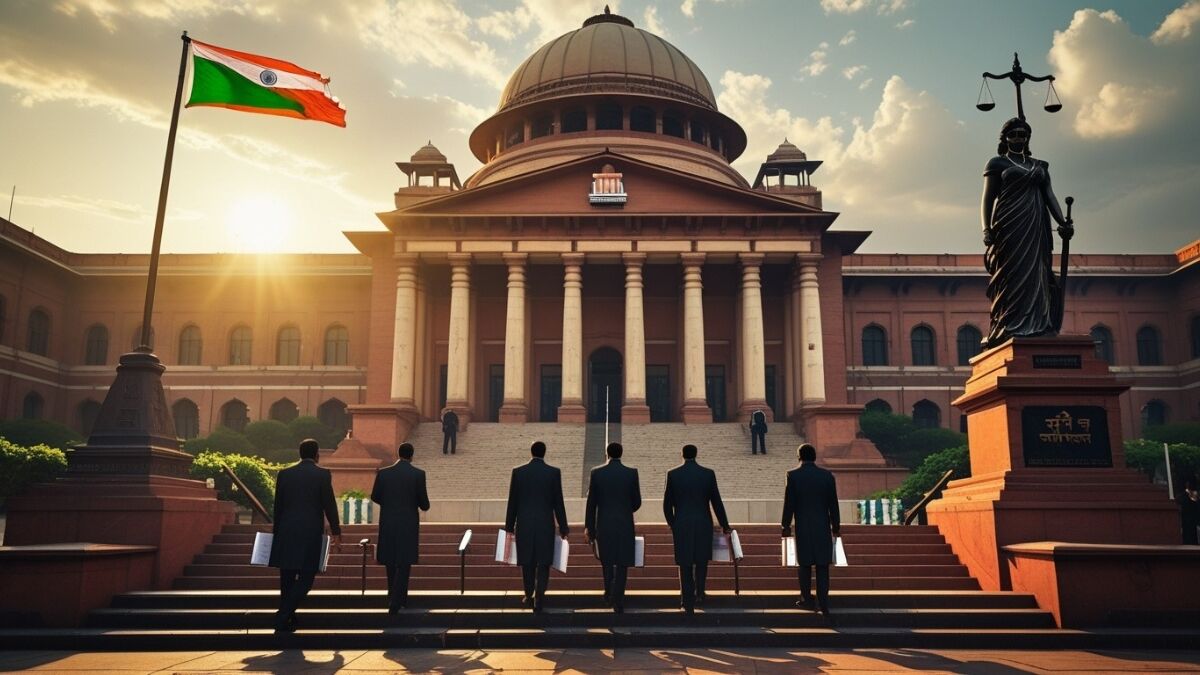
The NGO Association for Democratic Reforms (ADR) submitted one of several cases contesting the Special Intensive Revision (SIR) of Bihar’s election rolls, and the Supreme Court postponed its decision on Thursday.
Supreme Court Review on Bihar SIR Electoral Rolls
The top court is reviewing the arguments that the poll panel lacks the authority to conduct the SIR on such a broad scale under Article 326 of the Constitution, the Representation of the People Act, 1950, and the Rules adopted under it.
The first phase of the SIR was carried out in Bihar. Nine states—Chhattisgarh, Goa, Gujarat, Kerala, Madhya Pradesh, Rajasthan, Tamil Nadu, Uttar Pradesh, and West Bengal—as well as three UTs—Andaman and Nicobar, Lakshadweep, and Puducherry—are participating in the second phase of the electoral roll revision. In Assam, a different “special revision” of the electoral rolls is underway.
Key Legal Arguments and Representation
Following arguments by a number of attorneys, including Kapil Sibal, Abhishek Singhvi, Prashant Bhushan, and Gopal Sankaranarayan, a bench consisting of Chief Justice Surya Kant and Justice Joymalya Bagchi ended the final hearing.
Senior attorneys Maninder Singh and Rakesh Dwivedi represented the poll panel. Before rendering a decision, the bench considered rebuttal arguments made by the petitioners.
ECI Authority and Voter Exclusions
On August 12 of last year, the court began its last arguments in the case and noted that the Election Commission of India (ECI) has constitutional authority to add or remove individuals from electoral lists.
The names of 65 lakh individuals who were eliminated from the draft electoral registers released as part of the SIR operation were released by the poll panel.
🗳️ Bihar SIR Voter Exclusions
- Total Excluded: 65 lakh individuals from draft electoral rolls
- Verification: 11 documents identified as proof
- Affected States: Bihar first phase; 9 states & 3 UTs second phase
- ECI Authority: Can add or remove voters under constitutional provisions
- Concern: Petitioners claim “NRC-like process”
Voters who were not on the rolls in 2002 or 2003 must demonstrate ancestral ties to someone who was on the rolls at that time, according to the SIR notification. The survey panel identified eleven documents as potentially useful for identity verification.
Aadhaar and voter identity cards cannot be regarded as definitive proof of citizenship, according to the ECI, which has supported the SIR effort.
Petitioners’ Concerns and NRC Comparison
The petitioners claimed that the modification of the electoral rolls was a “NRC-like process” in which the poll panel was confirming citizenship, an authority that belongs to the central government. The bench previously stated that the EC’s electoral roll modification process includes both additions and removals.
Regarding the admission of the Aadhaar card as one of the proofs, the Supreme Court ruled unequivocally that the 12-digit biometric identification cannot be rejected due to the potential for fraud.
ECI Clarifications on Documents
It stated, “If a document is recognized by statute, it cannot be dismissed just because a private firm is engaged in its issuance,” pointing out that even passports are processed by private organizations carrying out public obligations.
Singhvi accused the EC of “presumptive exclusion” of five crore people in the SIR while speaking on favor of one of the petitions. “The Election Commission has the authority to include and exclude citizens and non-citizens from the electoral rolls, but Parliament must adopt legislation granting or revoking citizenship,”
The bench had told Singhvi that if anything strange was found to make them invalid, the court could compel all of them to be added to the electoral rolls.
⚖️ Supreme Court Legal Arguments
- Petitioners: ADR, Kapil Sibal, Abhishek Singhvi, Prashant Bhushan
- Bench: CJI Surya Kant & Justice Joymalya Bagchi
- Main Issue: EC’s authority for SIR on broad scale
- Contention: SIR resembles NRC; citizenship verification
- ECI Defense: Weeding out ineligible voters enhances election integrity
Questions on Timing and Data Accuracy
Speaking on behalf of ADR, advocate Prashant Bhushan questioned the timing for the exercise’s completion as well as the information regarding the 65 lakh voters who were either registered in different constituencies, declared dead, or migrated.
Yogendra Yadav, a political activist, questioned the poll panel’s figures, claiming that there were 8.18 crore adults in the country rather than 7.9 crore voters and that the SIR exercise’s purpose was to eliminate votes.
By “weeding out ineligible persons” from the electoral records, the EC affidavit defended the SIR in Bihar, claiming it enhances the election’s cleanliness.
Frequently Asked Questions
1. What is the Special Intensive Revision (SIR) of Bihar electoral rolls?
The SIR is an operation by the Election Commission to update and verify electoral rolls, including adding new voters and removing ineligible ones.
2. Why are petitioners contesting the SIR?
Petitioners argue that the SIR process resembles an NRC-like exercise, exceeding EC’s authority, and potentially excludes eligible voters.
3. How many voters were excluded in the draft electoral rolls?
The poll panel reported that 65 lakh individuals were removed from the draft electoral registers during the SIR.
4. Can Aadhaar be used as proof of identity in SIR?
Yes, the Supreme Court ruled that Aadhaar cannot be rejected as proof, even if issued by private agencies, because it is recognized by statute.
5. What is the Supreme Court’s current position?
The Supreme Court has postponed its final decision and is reviewing arguments from both petitioners and the Election Commission.
Disclaimer: This article is based on public information and is for informational purposes only. It does not constitute legal advice.
