
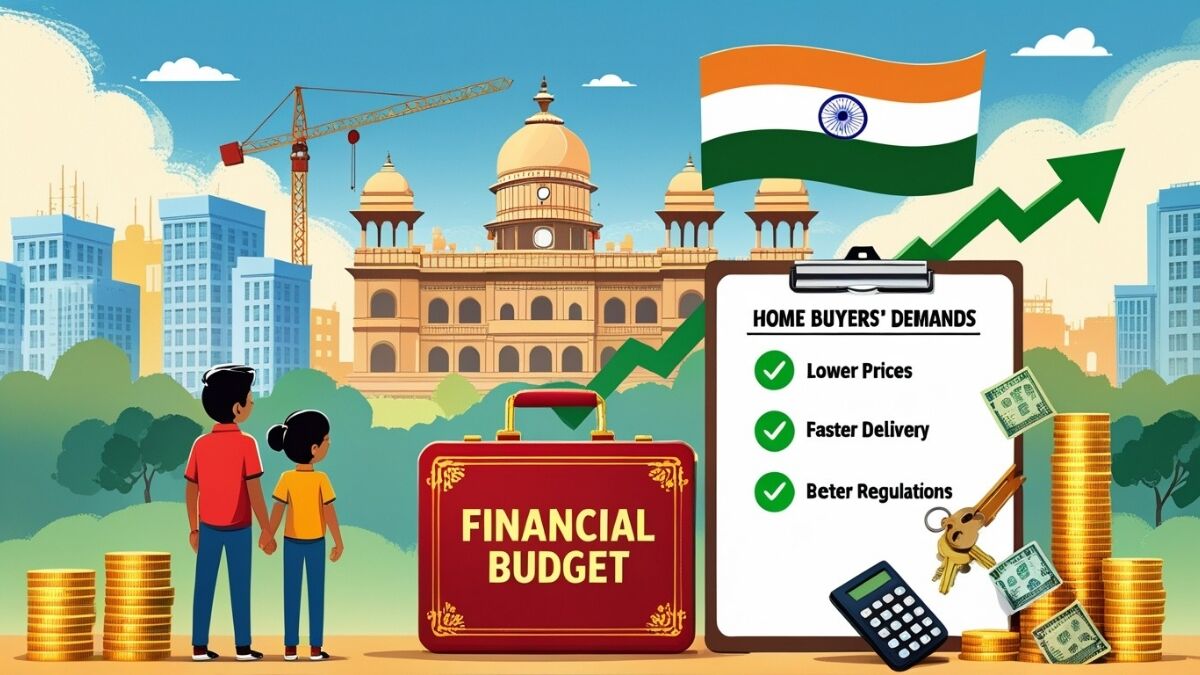
The Union Budget 2026–2027 is financially responsible and emphasizes infrastructure and manufacturing, which will continue to be essential for expansion and job generation.
Union Budget 2026–2027: Fiscal Prudence Amid Global Uncertainty
Global supply chains are shattered and there is massive disruption occurring around the globe during this period of extreme global unrest. In the middle of all of this, it is crucial that we maintain fiscal responsibility in order to reduce the debt to GDP ratio to 65.6% and the budget deficit to 4.3%, Kant said.
Kant emphasized the need of examining the Budget 2026’s approach to the US tariff problem.
Employment-Focused Growth Strategy
According to Kant, the budget’s emphasis on industries like textiles, footwear, leather, and the maritime sector—all of which have an impact on employment—will ultimately provide urbanization a significant boost, which is crucial for the nation’s economic development.
The goal of the Union Budget 2026 is to improve the nation’s infrastructure. In FY 2026–2027, the government boosted public capital expenditures to Rs 12.2 lakh crore.
Infrastructure Investment and Risk Mitigation
🏗️ Union Budget 2026 Infrastructure Push
- Capital Expenditure: Rs 12.2 lakh crore in FY 2026–27
- Focus Areas: Manufacturing, logistics, urban development
- Fiscal Target: Deficit reduced to 4.3%
- Debt Ratio: Debt-to-GDP at 65.6%
- Objective: Long-term economic stability & job creation
In order to boost private developers’ trust about risks throughout the infrastructure development and construction phase, the government will also establish an Infrastructure Risk Guarantee Fund.
Private Sector as the Growth Engine
Kant pointed said that the private sector must be the main driver of India’s long-term development. In order to become Viksit Bharat by 2047, India’s long-term task is to expand at a rate of 8–9% during the following 22 years. Public expenditure cannot support such, according to Kant. Public expenditure, he said, has already peaked. “In the long term, the private sector is what will propel India’s economic narrative.”
Declaring the budget “on track for Viksit Bharat 2047,” he emphasized the need for more foreign direct investments (FDI) and said that the private sector must invest in infrastructure.
📈 Amitabh Kant’s Growth Vision
- Target Growth: 8–9% annually
- Timeline: Next 22 years
- Key Driver: Private sector investment
- FDI Focus: Strong global promotion of India
- Goal: Viksit Bharat by 2047
“We need to work on the consumer narrative a little more, and we need to significantly increase foreign direct investment.” “We must sell and promote India in a much more comprehensive way,” Kant said.
Vision Behind Budget 2026
Finance Minister Nirmala Sitharaman presented the Budget 2026 on February 1. She stated that the three kartavyas—accelerating and sustaining economic growth, fulfilling people’s aspirations and building their capacity, and ensuring that every family, community, region, and sector has access to resources, amenities, and opportunities for meaningful participation—are the inspiration behind the budget.
Amitabh Kant’s Government Career
Did Amitabh Kant leave the government after 45 years to work in the private sector?
On Monday, Amitabh Kant announced his resignation as the G20 Sherpa. His departure follows 45 years of government service in a variety of capacities, including Secretary of the Department for Industrial Policy and Promotion, CEO of NITI Aayog, and G20 Sherpa.
Relationship Between Amitabh Kant and NITI Aayog
What is the relationship between Niti Ayog and Amitabh Kant?
Later, Kant spearheaded programs including “Make in India,” “Start Up India,” and “Ease of Doing Business” while serving as Secretary of the Department of Industrial Policy and Promotion (DIPP). From 2016 till 2022, Kant served as NITI Aayog’s CEO.
Amitabh Kant Committee Report
What was the report of the Amitabh Kant Committee?
The committee came to the conclusion that the “lack of financial sustainability,” which had resulted in cost overruns and schedule delays, was the primary cause of the stress in these projects. The committee said that increasing the projects’ internal rate of return in order to secure financing would be the solution to the issue.
Views on Sustainability and Urbanization
What does Amitabh Kant think about sustainability?
According to Amitabh Kant of Raisina Dialogue, sustainable urbanization is essential to India’s future development. Amitabh Kant, a former CEO of NITI Aayog and G20 Sherpa, emphasized on Wednesday the critical need to create sustainable cities since urbanization is a major obstacle for policymakers.
Priority Sectors Before Budget 2025
Which areas are anticipated to get priority prior to the 2025 budget?
There are great hopes for reforms and strategic investments in a number of industries as India anticipates the Union Budget 2025. With substantial funding and an emphasis on modernization, sustainability, and increasing exports, the defense, railway, telecom, infrastructure, and energy sectors are all well-positioned for expansion.
Frequently asked questions
1. What made Amitabh Kant refer to Budget 2026 as financially prudent?
Because Budget 2026 lowered the budget deficit to 4.3% and the debt-to-GDP ratio to 65.6%, guaranteeing macroeconomic stability in the face of global economic uncertainties, Amitabh Kant referred to it as financially responsible.
2. Does Amitabh Kant think India needs to expand its private sector?
Indeed. Kant underlined that private investment, particularly in manufacturing and infrastructure, is necessary to support India’s long-term growth of 8–9%.
3. Did Amitabh Kant quit his job with the government to help the private sector?
No, after 45 years of government service, Amitabh Kant resigned as G20 Sherpa. However, his support for development driven by the private sector is a part of his long-standing economic vision, not a move to the private sector.
4. How does Amitabh Kant relate to NITI Aayog?
From 2016 until 2022, Amitabh Kant was the CEO of NITI Aayog, where he was instrumental in initiatives including Make in India, Startup India, and enhancing India’s business-friendliness.
5. According to Amitabh Kant, which industries are essential for creating jobs?
He emphasized the importance of infrastructure, textiles, footwear, leather, and the marine industry in creating jobs and promoting urbanization, all of which are essential to India’s economic development.
Conclusion
Amitabh Kant’s evaluation of the Union Budget 2026–2027 emphasizes striking a balance between economic aspirations and budgetary restraint. The Budget is in line with India’s long-term objective of Viksit Bharat 2047, with a heavy emphasis on infrastructure, manufacturing, and private sector involvement.
Kant’s focus on increased foreign direct investment, sustainable urbanization, and private investment is indicative of a strategic plan in which the private sector propels long-term economic growth while state expenditure establishes the framework.
Disclaimer:
This article is for informational purposes only and is based on publicly available statements and reports. It does not constitute financial, investment, or policy advice.
