
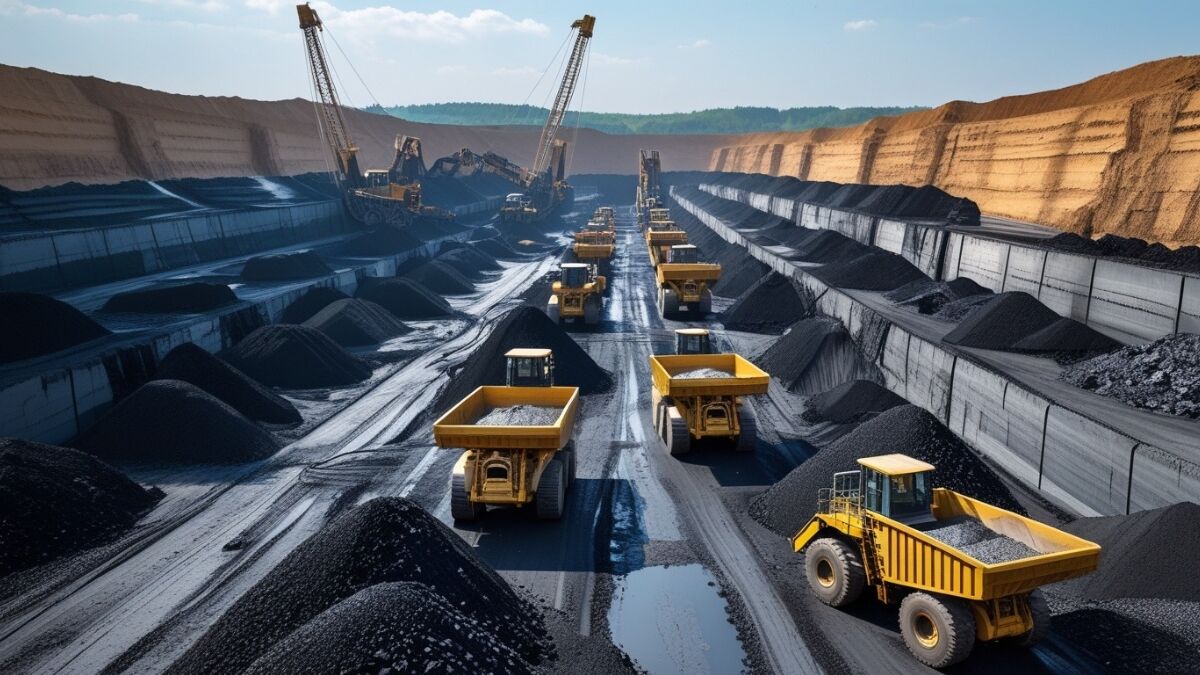
Following the Niti Aayog’s recommendations, 136 coal blocks have been successfully auctioned since 2020, according to the government on Monday. Future allocations will also be made through a participatory bidding procedure.
Government Reaffirms Auction-Only Coal Block Policy
In response to supplementary questions during the Rajya Sabha’s Question Hour, Minister of State for Coal Satish Chandra Dubey stated that the government is prepared to review the Telangana state government’s proposal to administratively assign the Tadicherla coal block to state-owned Singareni Collieries.
“However, the Telangana state government must submit a written proposal explaining how this block differs from other blocks.”If such a proposal emerges, the government would take a decision in the interests of the people of Telangana as per law and after keeping the recommendations of the Niti Aayog in mind,” the minister informed the parliament.
Conditions for Special Coal Block Consideration
⛏️ Coal Blocks Auction India Snapshot
- Total Blocks Auctioned: 136 since 2020
- Policy Basis: Niti Aayog recommendations
- Revenue Potential: ₹43,000 crore
- Employment Impact: 5 lakh jobs expected
- Participants: 44 new companies
- Eligibility: Private players & PSUs
“Then, why does it not engage in the auction process? The government has auctioned a total of 136 coal blocks following the recommendations of the Niti Aayog in 2020, and Singareni has generated a profit of Rs 6,000 crore,” he said. Now, Coal India and other PSUs also participate in the auctions and take the Coal blocks. The government is prepared to review and make a decision if the state government submits a new application and explains what makes that specific coal block unique,” Dubey stated.
Parliamentary Debate on Singareni Collieries
Telangana Congress MP “When there is an enabled provision in law, why is the government not allotting the Tadicherla coal block to Singareni Collieries?” Anil Kumar Yadav Mandadi questioned why Singareni is not receiving the allocation despite the state government repeatedly submitting proposals.
The minister retorted that the government had previously given Singareni three blocks: Naini, Penagadapa, and New Patrapada. “In 2022, the government could not work on them and gave them back to the Government of India.” Only Coal block Naini is working. Many years have passed since the letter from 2013, and they ought to submit a new proposal outlining the unique qualities of that coal block. In the best interests of the Telangana people, the idea will be reexamined,” he declared.
Revenue, Jobs and Auction Outcomes
The minister informed the parliament that after 2020, 136 blocks had been assigned following successful auctions, and the central government will earn Rs 43,000 crore once coal production began. This would also bring employment prospects to 5 lakh people, he added, adding that 44 new businesses have participated in the coal block auctions.
M Thambidurai (AIADMK) also queried why public sector undertakings were not being awarded coal blocks. The minister stated that all state governments are qualified to participate in the auction process. “If there is any unusual scenario, then too the blocks would be sought to be distributed through a participative method. Anyone generating greater revenue and more price, we would give the coal block to them only,” the minister stated.
Official Policy Clarification by Coal Ministry
📜 Coal Blocks Auction India Policy Framework
- Policy Shift: Direct allotments closed post-2020
- Committee: Niti Aayog-led High-Level Committee
- Objective: Transparency & commercial mining
- PSU Role: Allowed via auction participation
- Exception: Only under rare circumstances
- Focus: Domestic production & lower imports
“All the coal blocks are being offered for allocation by way of auction for sale of coal,” stated G Kishan Reddy, Minister of Coal and Mines, in his written response. No coal block has been assigned to Public Sector Unit (PSU) through allotment process after June 2020″.
“This is being done in the context of the High-Level Committee (HLC) on Mines, Mineral, and Coal sectors, headed by Vice-Chairman Niti Aayog, which was constituted on March 29, 2019, to provide recommendations for improving exploration, domestic production, lowering imports, and achieving rapid growth in coal exports.”The Ministry of Coal has adopted the suggestions made in the HLC report that all concessions for exploration and mining will be gradually moved for commercial reasons.
All auctions and allocations would be made for (i) commercial purposes only after a year of the aforementioned report’s acceptance; (ii) the direct allotment route would be closed after a year, unless there were extraordinary circumstances that the Ministry of Coal would decide upon; and (iii) PSUs could also take part in coal block auctions,” the minister stated.
Frequently asked questions
1. Why has the government chosen to use only auctions to distribute coal blocks?
In response to the Niti Aayog’s 2020 proposals, the government moved to an auction-based system to guarantee openness, equitable competition, increased income collection, and effective use of coal resources.
2. Since 2020, how many coal blocks have been up for auction?
Since 2020, the participatory bidding mechanism has successfully sold 136 coal blocks.
3. Are coal blocks still available to state-owned PSUs like Singareni Collieries?
Indeed. Public sector companies, including state-owned entities like Singareni Collieries, are authorized to participate in coal block auctions. Direct allotments are granted only under rare conditions.
4. Why does Singareni Collieries not receive the Tadicherla coal block directly?
In accordance with legal and policy criteria, the Telangana government has been requested by the federal government to submit a new proposal outlining why the Tadicherla coal block should be treated differently from others.
5. What economic advantages are envisaged from auctioned coal blocks?
The auctioned blocks are anticipated to increase domestic coal output and decrease imports by generating ₹43,000 crore in income and employing close to 5 lakh people once coal production starts.
Conclusion
The government’s unwavering position on awarding coal blocks solely through auctions signifies a significant change in India’s coal industry toward economic efficiency, competitiveness, and transparency. This policy, which is supported by the Niti Aayog’s recommendations, maximizes public revenue and job creation while ensuring equitable participation for both private and public sector endeavors.
Although special circumstances, like the Tadicherla coal block, are still possible, participative bidding is unquestionably the preferred method. The auction-led strategy is expected to be vital in bolstering India’s energy security and coal production ecology, with 136 coal blocks already up for sale and substantial revenue and job creation on the horizon.
Disclaimer:
This article is for informational purposes only and does not constitute legal, financial, or investment advice. Readers should verify details from official government sources before drawing conclusions or making decisions.
