
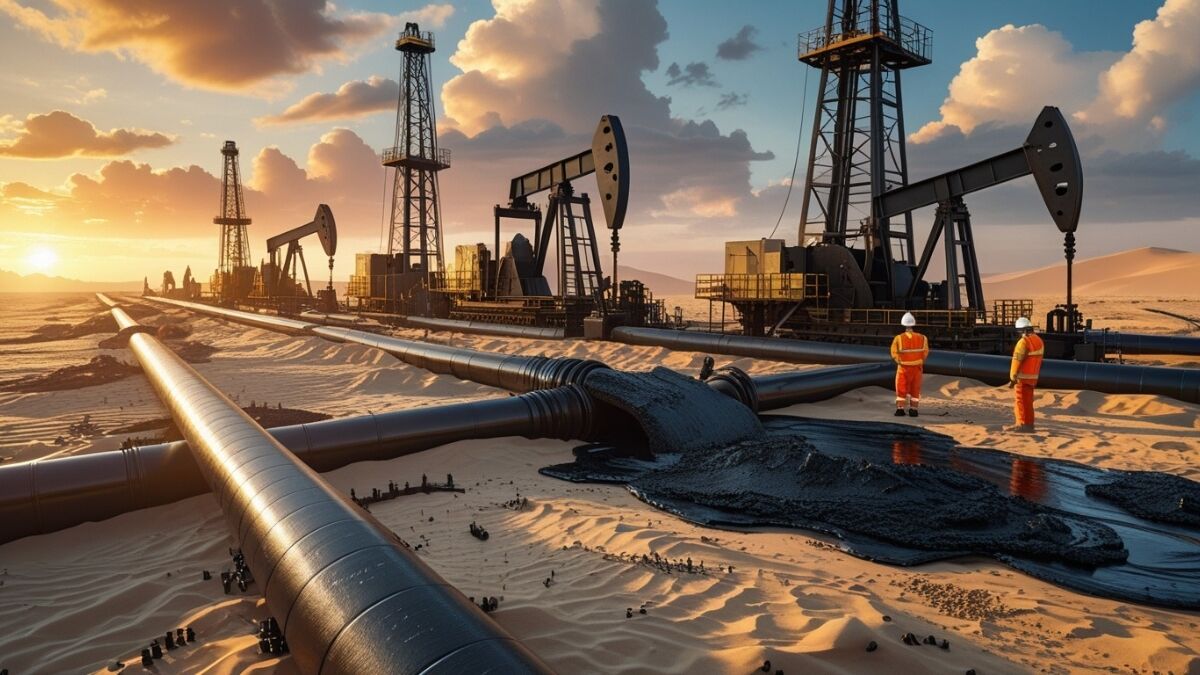
As the US-Israeli war with Iran intensifies, fuel shipments are disrupted, and concerns about additional disruptions to the Middle East’s oil and gas supply are growing, crude oil benchmarks increased by almost 7% on Tuesday, surging for a third session.
After reaching its highest level since July 2024 at $85.12, Brent crude futures were up $5.70, or 7%, at $83.44 a barrel by 1326 GMT. After reaching its highest level since June at $77.58, US West Texas Intermediate crude increased $5.03, or 7%, to $76.26. Before the attacks began, the two contracts had increased by as much as 17% and 16%, respectively, since Friday’s closing.
Since Israel’s initial attacks on Lebanon on Saturday, the US and Israeli air war against Iran has expanded, with Iran retaliating with strikes against energy infrastructure in Gulf nations and tankers in the Strait of Hormuz, which normally transports a fifth of the world’s oil and LNG.
Following the cancellation of vessel insurance and the sharp increase in the cost of delivering oil and gas worldwide, tankers and cargo ships are steering clear of the channel. “While there are concerns about oil flows through the Strait of Hormuz, a greater risk to the market would be Iran targeting additional energy infrastructure in the region,” the Iranian media said on Monday after a senior Iranian Revolutionary Guards official declared that the Strait of Hormuz is closed and threatened to fire on any ship attempting to pass. This may result in longer interruptions, according to a note from ING analysts.
According to official media on Tuesday, authorities in the United Arab Emirates are battling a significant fire in the port of Fujairah. According to a shipping source who spoke to Reuters, Iraq’s Kirkuk crude oil loadings at Turkey’s Ceyhan port ceased on Tuesday.
Many countries have shut down their oil and gas infrastructure due to damage or as a precaution since the attacks began around the area. Saudi Arabia closed its largest refinery, Qatar has stopped producing LNG, Israel has halted production at several gas resources, and output in Iraqi Kurdistan has essentially stopped.
Benchmark Dutch contracts, British gas prices, and LNG prices in Europe and Asia all increased in the gas markets. As markets concentrate on the effects of the intensifying conflict, analysts predict that oil prices will stay high for the next few days.
On Monday, Bernstein increased its estimate of the price of Brent oil in 2026 from $65 to $80 per barrel, but stated that in an extreme scenario of protracted conflict, prices may reach $120–$150. Because processing facilities in the Middle East are at danger, refined product futures are also rising.
After hitting a two-year high on Monday, U.S. ultra-low-sulfur diesel futures were up 15% at $3.32 per gallon. At $2.50 per gallon, gasoline futures were up 6%. After rising 18% on Monday, European gasoil futures increased 16% to $1,025 a metric ton.
