
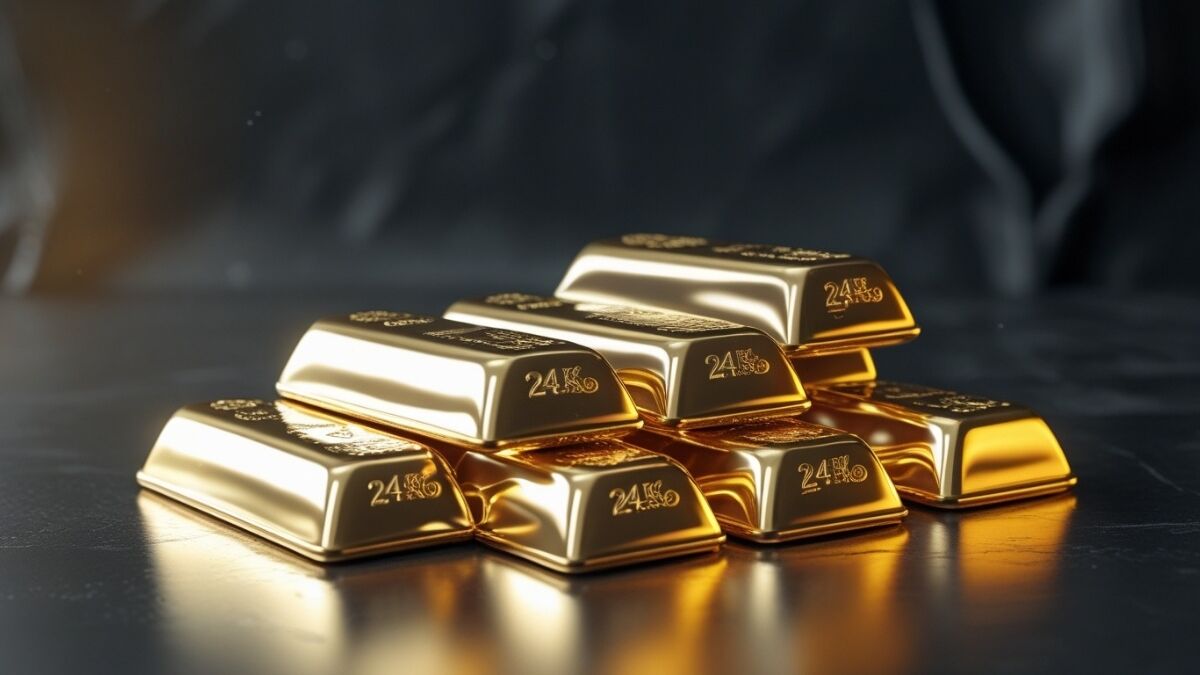
Global financial markets are experiencing volatility as rising geopolitical tensions in the Middle East push oil prices higher while putting pressure on gold. Investors are carefully watching the US dollar, inflation risks, and Federal Reserve policy signals as these factors continue to influence commodity prices worldwide.
As the Middle East conflict continued into a second week and oil prices increased, gold fell under pressure from a stronger US dollar and worries about the possibility of higher interest rates.
Gold Prices Fall as Dollar Strengthens
Before reducing losses, bullion fell as much as 3% to almost $5,015 per ounce. Oil prices surged as producers in the Persian Gulf region reduced output due to the US-Israeli war with Iran showing no signs of ending, with Brent futures at one point approaching $120 per barrel before the rise subsided. A dollar gauge increased by up to 0.7%.
Bullion has been under pressure as the US’s concerns about inflation are heightened by the rise in petroleum, increasing the possibility that the Federal Reserve would either hike or maintain interest rates for an extended period of time. Since precious metals do not pay interest, higher borrowing costs and a stronger dollar are usually detrimental. Additionally, gold has provided liquidity throughout a worsening decline in global stock prices.
📊 Gold & Oil Market Snapshot
- Gold Price Drop: Fell nearly 3% at one point
- Recent Gold Level: Around $5,083 per ounce
- Oil Surge: Brent crude approached $120 per barrel
- Dollar Movement: Dollar index rose up to 0.7%
- Main Trigger: Middle East geopolitical tensions
- Market Concern: Higher inflation and interest rates
Inflation Concerns and Federal Reserve Policy
“Investors occasionally sell assets like gold to get cash during periods of geopolitically driven market stress,” stated Christopher Wong, a strategist at Oversea-Chinese Banking Corp. “Geopolitical uncertainty usually continues to support demand for safe havens on falls after that phase ends.”
The tenth day of the Middle East conflict has finally begun. While Israel attacked fuel tanks in the Iranian capital and threatened the Islamic Republic’s power grid over the weekend, Tehran chose a new supreme leader and continued its attacks in the Persian Gulf. Crude and natural gas prices have increased as a result of attacks on energy infrastructure and a halt to shipping through the Strait of Hormuz, which typically handles a fifth of the world’s oil.
Impact of Middle East Conflict on Energy Markets
In a report published on March 7, Ed Meir, an analyst at Marex, stated that while a protracted battle would see the US currency and Treasury yields rise in expectation of greater inflation and interest rates, a relatively quick end to the conflict would probably see the dollar weaken and gold gain. He stated, “There are times to purchase, times to sell, and times to just wait.” “At this time, the latter is the recommended course of action.”
Gold has gained almost 18% so far this year despite erratic trading and stagnant upward momentum. Assets seen as havens have mostly benefited from US President Donald Trump’s disruption of international trade and geopolitics, as well as challenges to the Fed’s independence. Growth has also benefited from increased central bank purchases; in February, the People’s Bank of China increased its gold purchases to 16 months.
⚠️ Key Drivers Behind Gold Market Volatility
- Geopolitical Conflict: Ongoing tensions in the Middle East
- Energy Price Spike: Oil approaching $120 per barrel
- Stronger Dollar: Higher US currency pressures gold
- Interest Rate Concerns: Possible Federal Reserve tightening
- Central Bank Buying: Strong purchases by global central banks
- Safe-Haven Demand: Investors shifting during uncertainty
Central Bank Gold Purchases and Market Trends
As of 10:03 a.m. in New York, spot gold had dropped 1.7% to $5,083.98 per ounce. Silver fell 0.6% to $84.03. Both palladium and platinum decreased. After gaining 1.3% the previous week, the Bloomberg Dollar Spot Index increased by 0.2%.
Frequently Asked Questions
1. What caused the recent decline in gold prices?
A stronger US currency and worries that rising oil costs may increase inflation and raise the likelihood that the Federal Reserve would maintain interest rates high for an extended period of time caused gold prices to drop.
2. What impact are rising oil prices having on gold?
Inflation concerns are raised by the spike in oil prices, especially with Brent crude approaching $120 per barrel. Since gold does not produce interest, higher inflation might result in higher interest rates, which typically lower demand for the metal.
3. How are markets affected by the turmoil in the Middle East?
Oil, currency, and commodity markets are volatile as a result of the continuous tensions between Israel, Iran, and the United States, which have impacted energy markets and shipping lanes like the Strait of Hormuz.
4. In times of crisis, why do investors occasionally sell gold?
Even though gold is typically seen as a safe-haven investment, investors may temporarily sell it to raise money or offset losses in other assets during periods of extreme market turmoil.
5. Does gold continue to do well this year?
Indeed. Gold has increased by almost 18% this year despite the current decline, thanks to significant central bank purchases, geopolitical unpredictability, and purchases by organizations like the People’s Bank of China.
Conclusion
A stronger dollar, rising oil prices, and concerns that the Federal Reserve would keep interest rates higher have all contributed to the recent decrease in gold prices. However, if global uncertainty continues, gold may still be a crucial safe-haven asset due to persistent geopolitical tensions and ongoing central bank purchases.
Disclaimer: This article is for informational purposes only and should not be considered financial or investment advice. Commodity prices and global markets can change rapidly due to geopolitical and economic developments.