
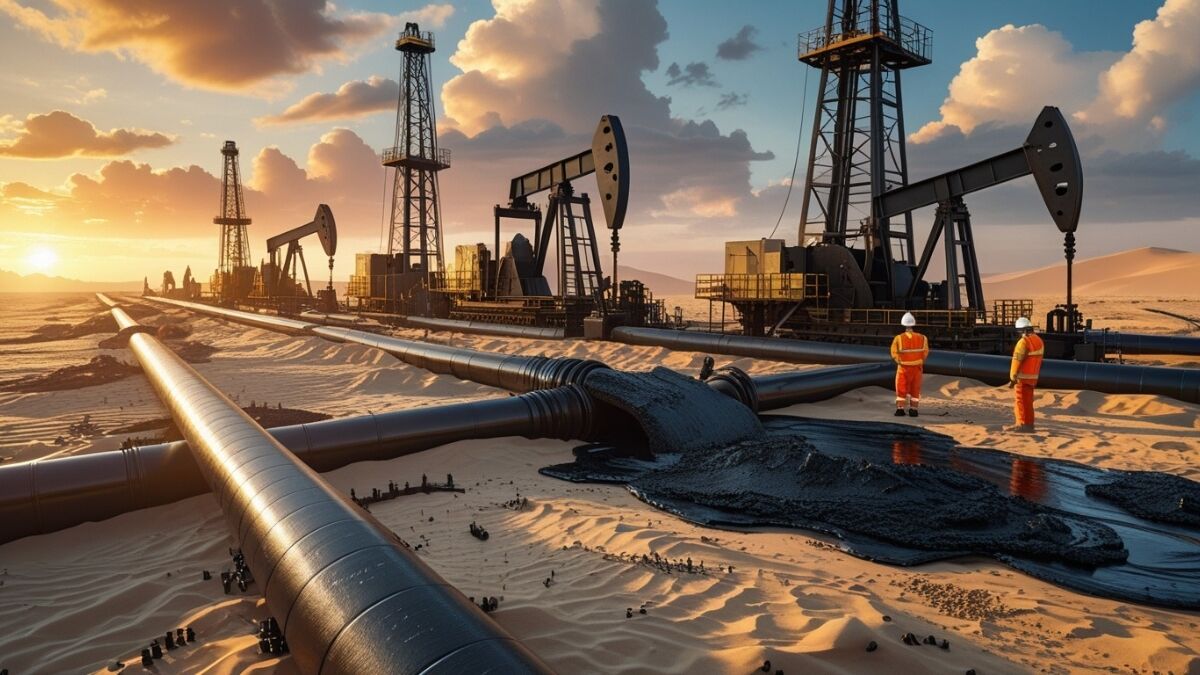
The ongoing geopolitical crisis involving Iran has created major disruptions in global energy markets. With oil prices surging and supply routes under threat, both the United States and global economies are facing uncertainty. This report highlights the impact of these developments on energy supply, pricing, and economic stability.
The crisis in Iran is causing chaos in the world’s energy markets. Despite being the world’s largest producer of gas and oil, the United States has few choices for easing supply constraints.
Global Energy Crisis and Oil Market Disruptions
Global oil and gas prices have plummeted as a result of the US and Israeli military assaults on Iran. The Strait of Hormuz, a tiny waterway through which massive amounts of crude oil and liquefied natural gas (LNG) travel, is the focus of interest worldwide as oil prices hover above $100 per barrel. Iranian threats to vessels have stopped the flow of gas and oil across the strait.
Benchmark US crude prices are currently close to $95 per barrel (bbl), a considerable increase from prewar values in the low to mid-$60/bbl range. Although this increase has no direct impact on US customers, LNG prices have increased by more than 50% internationally.
Rising Prices and Global Economic Concerns
In order to comprehend the effects of these events on the US and global economies and how policymakers might react, we outline a number of themes that we will be closely monitoring in the next weeks and months.
We realize the great suffering that millions of people in the Middle East and worldwide are currently going through due to a combination of direct violence, trauma, and exposure to hazardous air pollution, even if our focus here is on energy markets.
🛢 Strait of Hormuz Crisis Impact
- Key Route: Strait of Hormuz
- Oil Flow: ~20 million barrels/day
- LNG Transport: Major global shipments
- Current Oil Price: Around $95 per barrel
- Main Issue: Iranian threats disrupting supply
- Global Effect: Price surge & supply constraints
Myth of Energy Independence
US administrations have set the goal of energy “independence” for decades. Energy independence does not exist, especially when it comes to oil, as we have previously stated. Because the world’s oil markets are so interconnected, a disruption in one region of the world (like the Strait of Hormuz) will cause crude oil prices to rise globally regardless of how much oil the US produces.
Due to the fact that the price of crude oil is the primary factor influencing the cost of gasoline and diesel, and because crude oil prices have skyrocketed, US drivers are now paying more at the pump. Disruptions in the Strait of Hormuz have also impacted LNG commerce, although natural gas markets are more dispersed, which mitigates the impact on US customers’ pricing.
Renewable Energy and Supply Chain Risks
As Resources for the Future (RFF) board member Catherine Wolfram put it, “you can not weaponize the sun.” Some experts have accurately claimed that wind and solar energy are not susceptible to the same kind of price volatility.
However, supply chain interruptions brought on by geopolitical conflicts can still affect sustainable energy technologies like wind, solar, batteries, and electric cars.
Global LNG Trade Disruptions
One of the best examples of how energy independence is not a necessary byproduct of a shift to a low-emission future is China’s export restrictions on essential minerals. Instead of focusing on the illusion of “independence,” governments should prioritize energy security and supply chain diversification.
Natural gas production and shipping in the Persian Gulf are also experiencing interruptions, despite the focus on oil problems. International trade accounts for about 30% of natural gas usage, with two thirds coming through pipelines and one third coming by ship as LNG. The war has interfered with the latter.
📊 LNG Market Shock
- Qatar Production: ~10 billion cubic feet/day
- Global LNG Drop: Around 20%
- Main Markets: Asia & EU
- Price Impact: Nearly doubled
- Cause: Drone attacks & war disruptions
- Supply Issue: Limited shipping routes
US Role in Global LNG Supply
Drone attacks forced Qatar, a significant LNG producer and exporter of about 10 billion cubic feet per day, to halt production, resulting in a 20% reduction in global LNG commerce. The majority of LNG produced in Qatar was sent to Asia and the EU, where prices have nearly doubled in recent weeks.
How can we lessen the implied shortage and this massive price shock? As the largest LNG exporter in the world and a significant supplier to the EU, the United States might increase supplies. Although work is in progress to increase US export capacity, the majority of these facilities will not be operational for weeks or months, but rather in the upcoming years.
Limits to Increasing Supply
Given the significant price premium, US producers and exporters may wish to increase exports from existing facilities, but there is not much space for expansion because LNG export facilities usually run close to capacity. Long-term contracts, which are necessary to secure finance for multibillion-dollar LNG projects, frequently dictate LNG trade far in advance, while other large exporters like Australia might be able to help a little.
On spot markets, this dynamic restricts the quantity of cargo available. LNG contracts, however, have given buyers and sellers greater flexibility during the last ten years, indicating greater freedom to move shipments as needed than was previously feasible.
European Energy Challenges
The European Union’s own natural gas reserves, which are normally depleted in the winter due to heating demands and then refilled during other times, could be another approach to lower EU natural gas prices.
Large withdrawals are unlikely, though, because EU gas storage levels are mostly exhausted and much below their historical averages. Depleted natural gas supplies put Europeans in a particularly difficult situation, as ties to Russia have been broken since 2022.
Does an Increase in Oil Prices Help or Hurt the US Economy?
Global oil price rises over the first ten years of the new millennium clearly had a detrimental effect on the US economy. The nation consumed more than 20 million barrels per day (mb/d) while producing five or six mb/d.
Since the US was the world’s biggest importer of crude oil, rising prices caused more money to leave the US and go to exporters like Saudi Arabia, Canada, and Mexico.
US Energy Export Transformation
The United States is currently the biggest producer of gas and oil in the world and a significant exporter of both fuels. The United States bought 21 QBtu and exported 28 QBtu of natural gas, refined petroleum products, and crude oil in 2024. (For comparison, Saudi Arabia produced roughly 27 QBtu of energy overall in 2024.)
This level of exports represents a significant shift from decades before, when the United States imported far more goods than it exported, as Figure 1 illustrates. Overall, these findings point to the possibility that rising natural gas and oil costs could increase rather than decrease net domestic GDP.
Inflation and Economic Pressure
However, there is ambiguity and subtlety here. Even in cases where the US is a net exporter, higher oil prices increase expenses for people and companies nationwide and impair the economy’s daily operations.
In addition to driving up the cost of gasoline, rising diesel prices also drive up the cost of shipping, driving up product prices and adding to inflationary pressure. In fact, several prediction markets claim that the likelihood of a US recession this year has increased significantly in recent weeks.
Regional Impact Across States
However, not everyone will experience the same effects of rising prices at home. While large consumers like New York, Florida, and Illinois will suffer the most, major oil and gas-producing states like Texas, New Mexico, North Dakota, Oklahoma, Alaska, and Wyoming will benefit from rising prices. States will also have different effects.
For instance, while many inhabitants of Kern County, a significant oil producer in the state’s Central Valley, may embrace the windfall, Californians as a whole will suffer from rising oil costs.
Political and Economic Pressures
Revenue from severance taxes, leases on publicly held land, property taxes, and other sources directly related to oil and gas production will also increase for tribal, state, and local governments where large-scale oil and gas production takes place. High gas costs are political poison regardless of how they affect distribution inside the United States.
High gas costs are political poison regardless of how they affect distribution inside the United States. Large digital signs at crossroads and interstates serve as a continual reminder of petrol costs for drivers from coast to coast. Additionally, people prefer to blame incumbent presidents when fuel prices skyrocket, despite the fact that presidents typically have little influence over gas prices.
Why US Cannot Act as Swing Producer
Can the US serve as the “swing producer” to bridge the gap caused by the disruption in the Strait of Hormuz, given that its production is at an all-time high? For a number of reasons, this situation is unlikely. First, the United States produces close to 14 million barrels of crude per day, despite being the top producer. It is a tremendous amount, to be sure, but even if it doubled overnight, it would not be enough to replace the 20 million barrels of daily supply that are no longer passing through the Strait of Hormuz.
Second, and perhaps more importantly, unlike certain other producers, especially Saudi Arabia, US producers cannot just “open the taps” to boost production at will. Increased production necessitates investments in new wells, which can take months or years to produce oil due to the time required to drill, frack, and finish wells. This is because existing oil wells in the United States often function at full capacity.
Production Delays and Market Constraints
According to RFF research, although the shale revolution has made the US oil supply far more price sensitive, the system’s inertia suggests that significant supply adjustments to price variations may take six months to two years—far too slowly to act as a “swing producer.”
Third, US drillers are unlikely to undertake fresh investments unless they anticipate that the current high prices will continue. By selling oil futures for delivery when they anticipate that their drilling will eventually produce oil—for example, in six months—oil and gas producers can either lock in hedges or take a chance on the spot market.
Backwardation and Oil Market Signals
However, only spot prices and the first few months of the futures strip have seen an increase in crude oil prices, which means that prices for near-term delivery are higher than prices for delivery farther in the future. “Backwardation” is the term for this peculiar price timeline.
While prices for West Texas Intermediate crude delivered in the coming weeks (also known as front-month prices) swung wildly between $80 and $120 per barrel on March 9, the price for delivery in September has stayed relatively stable at about $75–$80 per barrel, possibly in anticipation that the supply disruption will be relatively short-lived.
Limited Increase in US Drilling Activity
A spike in US drilling or supply is unlikely, even though this $75–$80 price range is somewhat higher than prewar levels and may result in some more oil production. In fact, the US rig count from Baker Hughes increased by just three rigs, from 550 to 553, a 0.5 percent rise, in the two weeks between February 27 (the day before strikes on Iran started) and March 13.
What about strategic oil reserves if US supply is not likely to close the deficit anytime soon? These reserves, which are kept by the US and other countries, are intended to act as a safety net in the event of an emergency.
Strategic Reserves and Market Response
According to RFF research, the aforementioned backwardation in the crude oil futures strip reinforces the case for using strategic reserves as an emergency release by demonstrating that market participants anticipate oil supply shortages to be temporary.
The United States and the International Energy Agency have announced releases of about 400 million barrels in recent days. Even though this is the biggest release of its kind in history, it is equal to around four days’ worth of world supply or almost 20 days’ worth of the amount now disturbed in the Strait of Hormuz (20 million barrels per day). The fact that oil markets did not react aggressively to the news may not come as a surprise given these volumes.
Long-Term Energy Strategy and Risks
Higher global oil and gas prices continue to be a political liability rather than an asset for any federal administration, despite the fact that the United States is a major exporter of these commodities. The worldwide integration of oil markets and the US transportation sector’s high reliance on gasoline, diesel, and jet fuels are the main causes of this pessimistic view.
Moving away from petroleum products can help protect the US from short-term fluctuations in fuel prices. However, the energy system will still be susceptible to geopolitical influences notwithstanding this transition to zero- and reduced-emission energy systems.
Rather, this shift will require diversifying supply chains, collaborating closely with allies, and creating innovative technologies that can improve energy security while guaranteeing US consumers access to reasonably priced, dependable energy.
Frequently Asked Questions
1) What makes the Strait of Hormuz so significant?
About 20 million barrels of oil and large cargoes of LNG pass through the Strait of Hormuz every day, making it an essential route for the world’s energy commerce. Conflict interferes with this limited supply, which rapidly tightens the world’s supply and drives up the price of gas and oil globally.
2) Why can not the United States, the world’s biggest oil producer, control prices?
Despite producing more oil than any other nation, the United States is unable to quickly boost supply to counteract interruptions. Expanding production necessitates drilling additional wells, which can take months or even years. The majority of wells are already operating close to maximum capacity. Furthermore, market situations like backwardation discourage significant new investments by signaling that high prices would not endure.
3) What is causing the US to see an increase in gas prices?
The price of gasoline is not solely dependent on domestic production levels, but also on the price of crude oil globally. Fuel prices rise generally when supply disruptions cause crude prices to rise substantially, increasing transportation costs and creating wider inflationary pressures in the economy.
4) What impact is the war having on the markets for LNG and natural gas?
LNG trading has been severely hampered by the conflict, particularly with big producers like Qatar producing less. Because LNG is mostly dependent on shipping routes, any disruption causes limitations in supplies right away. Although the impact on U.S. consumers is more restricted because of regional market arrangements, this has led to price increases in places like Europe and Asia.
5) Is it possible for strategic reserves to resolve the supply crisis?
By adding more supply to the market, strategic reserves—managed in part by the International Energy Agency—can offer short-term respite. Even significant releases, however, only cover a few days’ worth of worldwide demand, so while they can temporarily stabilize prices, they are unable to completely end a protracted disruption.
Conclusion
The protracted dispute highlights how intricately linked the world’s energy markets are. Even a nation with as much energy as the United States is unable to protect itself from global disruptions, especially when vital chokepoints like the Strait of Hormuz are involved.
Strategic reserves and flexible LNG trade are examples of short-term solutions that can reduce strain, but they are not long-term fixes. Since no system is totally immune to geopolitical dangers, true energy security requires diversification, robust supply chains, and a gradual shift to alternate energy sources.
Disclaimer: This article is for informational purposes only and is based on global energy market analysis. It should not be considered financial or investment advice.
