
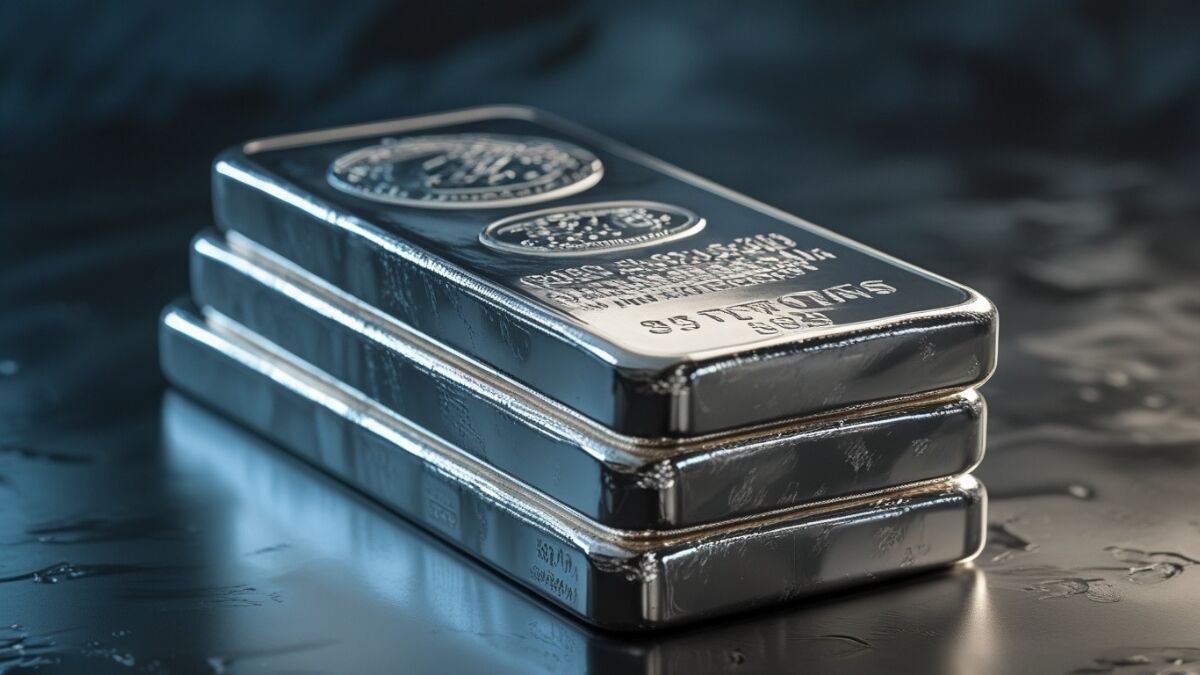
In addition to being a necessary household item, silver is still a valuable white metal that is also an important investment and industrial metal. However, there are hazards involved. Silver has a volatile price, and it carries a number of dangers.
Silver Hits Record High
The price of silver reached a record high of $58.68 per ounce of 999 purity a few days ago due to rising expectations that the US Federal Reserve will slash interest rates again at the FOMC (Federal Open Market Committee) meeting next week.
On December 3, the domestic price of silver reached an all-time high of Rs 1,84,743. At 2:24 PM IST on December 4, the price was just above Rs 1,79,041.
Silver Market Surges Ahead
Over the last several days, weeks, and months, silver prices have skyrocketed. The supply-side lag and demand-side drag are mostly to blame. The market experienced extreme pressure and shortages throughout Diwali. Naveent Damani, Head of Research (Commodities) at Motilal Oswal Financial Services Ltd., said that while the market has loosened since then, it is still tighter, hovering between $0.50 and $1 (per gram), or more.
The market is pursuing silver, but why? What does the bullion rally’s price trend indicate as 2026 draws near? What additional types of silver are available for investors to contribute? Is it better for investors to purchase, hold, or sell the yellow metal? Let us investigate.
Silver yields greater returns than gold
In general, investors are receiving 80% returns from silver, compared to 50% from gold. Therefore, it is no longer a safe-haven asset or an industrial metal. People are pursuing it in this way because it is really an asset that provides returns to you, according to Damani.
Silver Exchange Traded Funds (ETFs) have outperformed a number of assets, including their real metal equivalents, according to recent statistics. For example, as of October 31, 2025, investors in the ICICI Pru Silver ETF received returns of 36.01 percent for a three-year investment, compared to 29.11 percent for the real white metal.
“At this time, both locally and globally, ETFs are also significant purchasers of silver. The purchases made via an ETF are kept in a vault rather than being used.
However, if material is absorbed by ETFs in a scarcity market, it will become unavailable for trading and cause another round of shortages. And that would be an issue if too much money was still trading and chasing too few assets, creating some kind of momentum or upward rise, according to Damani.
Investors rushed into silver ETFs during this year’s Diwali, even if it meant paying greater premiums above the indicated net asset values (NAVs).
What effects does the devaluation of the rupee have?
Silver prices increased when the US Federal Reserve reduced interest rates by 25 basis points in September 2025. Fed rate decreases often result in a decline in the value of the dollar, which promotes increased demand and silver prices. In the meanwhile, the rupee is at its lowest point ever. At 12:59 pm IST on December 4, it was 90.114 vs the US dollar, up 0.84 percent from the previous week.
Investors are somewhat negatively impacted by the rupee depreciation aspect, which forces them to pay more for domestic purchases. However, because the rupee has already crossed the $54–$55 barrier and is holding comfortably above it, it seems that the rupee will continue to linger around 90–91. Additionally, the speed of the Comex rise may ultimately start to grow a bit higher, according to Damani.
Purchasing dips might provide a chance
Investors may begin investing 25 percent in a phased way in four distinct tranches towards a downside of 1,60,000 to 1,65,000 during a 3 percent drop, according to Damani. The potential for growth is between 2,25,000 and 2,40,000. From a 6–12 month view, the overall bias is still favorable.
As 2026 draws near, it seems that the momentum and rally are just halfway over, and the other half may be aligning. Buyers are still quite optimistic, and we still anticipate that buying on dips may provide a chance. Investors who want to invest now or who lost out on the surge should wait for fair declines and do so gradually. Since it has already increased by 85–86% so far this year, there is no need to purchase it all at once, according to Damani.
