
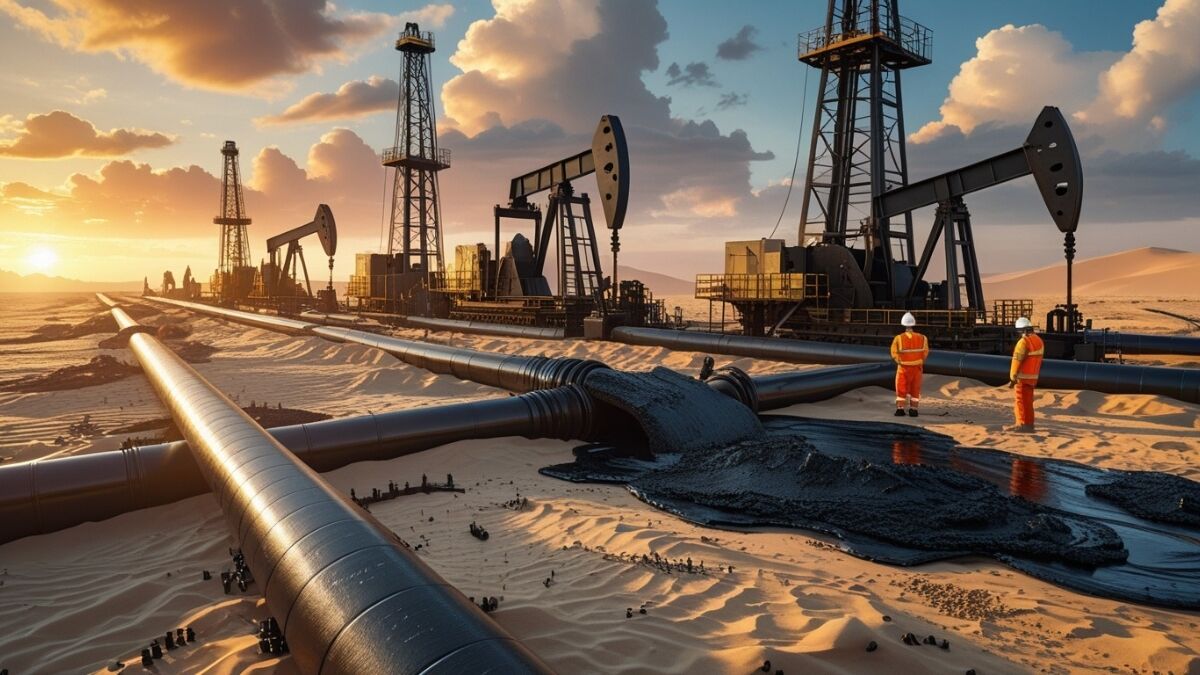
Despite global crude oil prices crossing $100 per barrel due to rising geopolitical tensions, fuel prices in India have remained stable. This is largely due to a strategic “shock absorber” system where oil marketing companies and government policies work together to protect consumers from sudden price spikes.
Due to a system where oil marketing corporations absorb variations, fuel prices in India stay steady despite rising global tensions pushing Brent crude prices close to $108 per barrel.
Why Fuel Prices in India Remain Stable
India’s fuel prices are steady despite the world’s crude prices rising beyond $100. This is how government action, taxation, and OMCs serve as shock absorbers for consumers.
Global Oil Surge vs Domestic Stability
Rising geopolitical tensions have shaken the world’s energy markets, causing Brent oil to approach $108 a barrel this week. However, the cost of gasoline has not changed much in India.
The government and oil marketing firms (OMCs) use a calibrated “shock absorber” system to reduce global volatility, protecting consumers in the near term but at the expense of trade-offs.
⛽ Fuel Price Stability System
- Crude Price: Near $108/barrel
- India Prices: Stable
- OMCs Role: Absorb fluctuations
- Government: Controls taxes
- Goal: Protect consumers
- Trade-off: Reduced company margins
An increase in oil prices immediately results in increased gasoline expenses for the majority of nations. For example, according to AAA Fuel Prices, a retail fuel price tracker from the American Automobile Association, a gallon of standard gasoline in the US currently costs $3.58, a 20% rise from the average of $2.94 in February.
On the other hand, in recent weeks, fuel prices in places like Mumbai have remained stable at around ₹103 per litre. State-run oil marketing corporations (OMCs) like Hindustan Petroleum and Indian Oil are at the heart of this stability.
Role of Oil Marketing Companies (OMCs)
These businesses often absorb price increases from outside markets rather than immediately passing them on to customers.
Madan Sabnavis, chief economist of Bank of Baroda, states that “domestic oil marketing organizations frequently maintain consistent product pricing even when global crude costs grow in the interest of societal stability and to insulate the average citizen from abrupt inflationary shocks.”
Until international benchmarks hit more crucial levels, usually over the $100 per barrel mark for a longer length of time, perhaps two to three months, this crucial buffer stays in place.
Pricing Mechanism Breakdown
Practically speaking, OMCs may suffer a loss on profits in order to maintain steady retail pricing even if refinery expenses climb dramatically—from around ₹55 per litre to much higher levels. On the other hand, when oil prices decline, these businesses keep some of the profits to make up for previous losses. In India, fuel prices are multi-layered.
Crude processing costs, or the Refinery Transfer Price, serve as the foundation. Dealer commissions, which are paid to gas pump operators and usually range from ₹2 to ₹4 per litre, come next.
Excise tax, a national government-imposed set fee, follows next. Lastly, state-level VAT, which varies by area and explains pricing discrepancies between cities like Delhi and Mumbai.
Government Control and Tax Strategy
Excise tax does not automatically increase in tandem with oil prices since it is fixed. This allows the government to control price volatility, either by requesting OMCs to cover expenses or by changing tariffs.
Retail prices may not necessarily drop correspondingly when global oil prices drop, say to $60 per barrel. Alternatively, to boost income, the government can raise excise taxes.
Revenue vs Consumer Benefit
According to PwC partner Deepak Mahurkar, “The government periodically tends to hike excise charges, using the windfall to buttress the exchequer and support important infrastructure and social welfare projects.” This strategy guarantees that the savings from reduced global oil prices are allocated into long-term national development, even if consumers may not experience a one-to-one cut in gasoline expenses.
In a nation where gasoline costs affect everything from groceries to school bus fees, this regulated strategy helps minimize abrupt surges in inflation. Customers are shielded from abrupt price increases even if they may not completely profit from worldwide price reductions.
📊 Economic Impact
- Inflation: Controlled
- Consumers: Protected short-term
- OMCs: Profit pressure
- Taxes: Major price factor
- Economy: Stability maintained
- Trade-off: Slower price drop benefits
In India, fuel prices are mostly controlled by the government and OMCs, who strike a balance between corporate profits, consumer stability, and budgetary requirements.
Frequently Asked Questions
1. Why do fuel prices in India not increase right away?
Because oil marketing firms like Indian Oil Corporation absorb short-term increases in crude costs and the government avoids abrupt rises to shield consumers from inflation and economic upheaval, petrol prices in India do not instantly rise.
2. How does the government affect the cost of fuel?
The government allows freedom to stabilize gasoline prices by controlling excise charges and influencing pricing choices. To balance revenue and economic stability, it might raise levies when petroleum prices decline or lower or maintain taxes during price increases.
3. Do lower crude prices assist consumers?
Because the government may raise excise taxes or oil corporations may recoup past losses, consumers may not always completely profit when crude prices decline. This indicates that, in contrast to global crude decreases, retail fuel prices fall more slowly or less dramatically.
4. What is gasoline price stability crucial for India?
Because gasoline and diesel affect transportation, food costs, and general inflation, fuel price stability is essential. Maintaining constant pricing contributes to the nation’s social stability and economic balance since abrupt rises may have an impact on family budgets and economic activity.
5. If crude remains high, would fuel prices finally increase?
Yes, if crude oil prices stay high for a long time, gas prices may go up. The government may ultimately permit price increases in order to preserve financial viability and avoid long-term burden on public sector firms, since oil corporations cannot sustain losses permanently.
Conclusion
Through government involvement and changes made by oil companies, India’s gasoline price structure strikes a compromise between local stability and the volatility of the global crude market. As a trade-off between market-driven pricing and economic stability, it protects consumers against abrupt price increases but also restricts advantages during price decreases.
Disclaimer: This content is for informational purposes only and should not be considered financial or policy advice.
