
The ongoing conflict between the United States, Israel, and Iran has entered a dangerous new phase, impacting global energy markets, military strategy, and geopolitical stability.
This week, the “war” that began with the US-Israeli assaults on Iran on February 28 witnessed a dramatic escalation when Israel attacked a vital gas field. Tehran responded with a series of powerful retaliations that seemed to even compel US President Donald Trump to step back.
Conflict Escalation and Initial Retaliation
Iranian Supreme Leader Ayatollah Ali Khamenei was killed in the US-Israeli strikes over the weekend, and the drone and missile exchange that has shaken the entire Gulf region has been going on since February 28 itself. However, Tehran responded forcefully to Israel’s attack on Iran’s South Pars gas field on March 18, including what the Islamic nation claims was the world’s first hit on a US F-35 jet. Follow the most recent Iran-US conflict here.
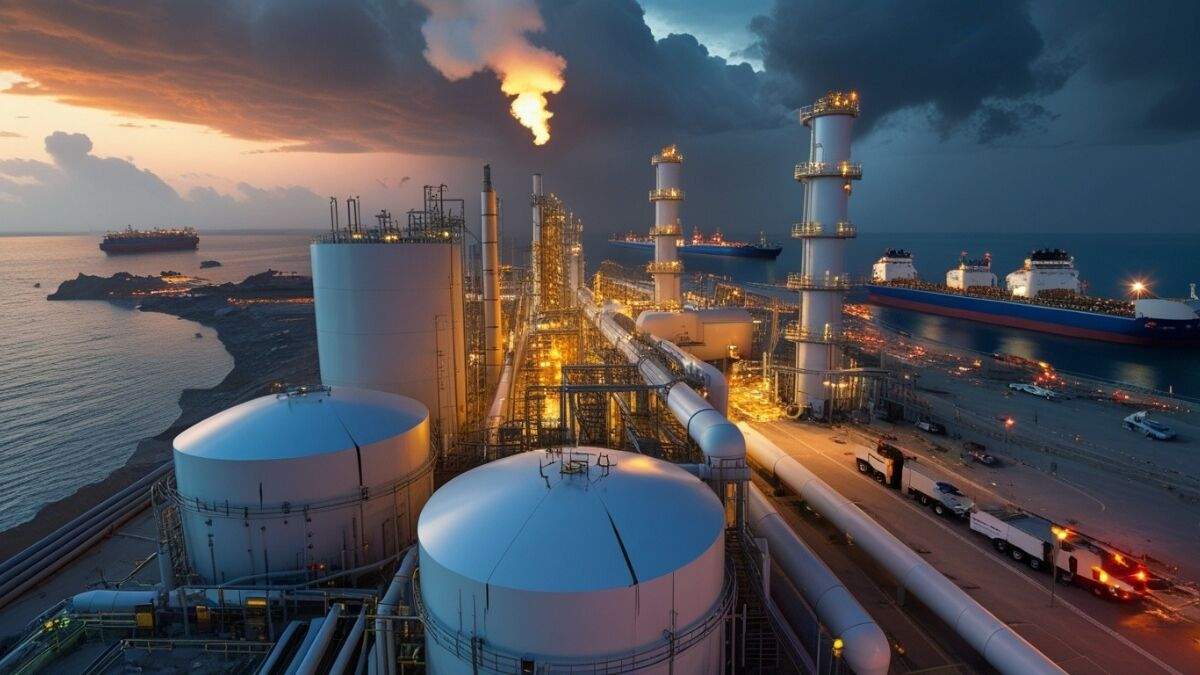
Iran first retaliated against the South Pars gas field attack by causing damage to the Ras Laffan facility, which is located on the other side of the same field and is the biggest LNG plant in the world. Global energy prices skyrocketed as a result of this Iranian onslaught, prompting Trump to declare that Israel would refrain from bombing the gas field any more. But there was a catch to Trump’s guarantee.
🔥 Energy War Shock Impact
- Trigger Event: Attack on South Pars gas field
- Iran Response: Strike on Ras Laffan LNG facility
- Global Impact: Energy prices surged worldwide
- Risk Level: Threat to Europe & Asia gas supply
- Strategic Importance: World’s largest gas reserve
F-35 Strike Claim and Expanding War Signals
Iran then claimed to have struck and destroyed a US F-35 plane, one of the most sophisticated stealth fighters in the world. And most recently, many were horrified to learn on Saturday that Iran was attacking Diego Garcia, a crucial US-UK military facility, from 4,000 kilometers away.
The consequences of the Iran campaign that Washington and Israel launched on February 28 have been becoming more apparent to Washington. The scope, impact, and economic consequences of Iran’s recent high-impact retaliation seem to have influenced President Donald Trump’s abrupt signal that Washington may “wind down” the war, from having its own vital assets like the F-35 reportedly damaged to having energy markets shaken in the name of bringing peace.
Trump Signals Possible De-escalation
On Friday, Trump said that he was thinking about “winding down” military operations against Iran and that the goals will soon be achieved. Regarding the “terror regime of Iran,” Trump recently said in a post on Truth Social, “We are coming very close to reaching our goals as we contemplate winding down our tremendous Military operations in the Middle East.”
His message was the clearest sign to far that he could be ready to put an end to the fighting that started on February 28. Iran launched counterattacks against Gulf energy centers, including Qatar’s Laffan LNG facility, which is located on the other end of the same gas field, hours after Israeli raids on Iran’s South Pars gas field on March 18 destroyed vital infrastructure.
⚠️ Military Escalation & Global Risk
- F-35 Incident: Claimed hit by Iranian defense
- US Reaction: Emergency landing confirmed
- New Threat: Missile attempt on Diego Garcia
- Range Expansion: 4000 km strike capability
- Global Concern: War spreading beyond Middle East
Strategic Gas Field Importance
Iran and Qatar share the world’s biggest gas reserve under the Gulf. On the Iranian side, it is known as South Pars; on the Qatari side, it is known as North Field or North Dome. Qatar utilizes the field to sell LNG to other countries, while Iran uses it to suit its local energy needs.
The LNG facility located in Ras Laffan Industrial City supplied almost one-fifth of the world’s supply prior to production.
Global Energy Crisis Trigger
Fears of a worldwide gas shortage increased after an Iranian missile breached defenses, inflicting “severe damage” and burns to the Ras Laffan complex. The strike turned a regional conflict into a worldwide economic risk by upsetting energy markets and directly endangering supply to Europe and Asia.
Shortly after the Ras Laffan strike caused energy prices to skyrocket, Trump said on Truth Social that Israel would stop attacking Iranian gas fields. He did, however, threaten to “massively blow up” the plant if Tehran continued to attack Qatar’s LNG infrastructure.
F-35 Controversy and Defense Capability
Iran claimed this week that it damaged a US F-35 stealth fighter during the drone and missile assault, forcing an emergency landing—possibly the first time the plane has been effectively targeted in battle.
Central Command said that one of the jets made an emergency landing and the pilot was in stable condition, however the US would not corroborate this. Even a little amount of damage to one of the United States’ most sophisticated planes sends a clear message: after weeks of attacks, Iran’s air defenses are still far from neutralized.
Diego Garcia Threat and Long-Range Capability
The Islamic Revolution Guards Corps (IRGC) of Iran claimed to have successfully struck a US Air Force F-35 stealth fighter plane in the airspace of central Iran. The IRGC’s air defense systems attacked the plane around 2:50 am local time, according to a statement published on its official news website on Thursday. “The fate of the fighter jet is uncertain and under investigation, and the chance of its crash is quite likely,” the statement said. Only one day has passed since the White House said in an X post that the F-35 is a symbol of “decisive American might.” Later, Iran also made public video that it said showed the IRGC Aerospace Force’s air defense targeting the F-35.
Iran sends a strong warning to Diego Garcia, a vital US outpost.
Unconfirmed sources on Saturday said Iran launched ballistic missiles at Diego Garcia, a crucial US-UK facility deep in the Indian Ocean, in a significant disclosure of Iranian defense capabilities.
Missile Reach and Global Warning
The message was clear even if the rockets missed: Iran may now strike distant Western military installations, not simply those in the Middle East.
Iran allegedly launched two intermediate-range ballistic missiles toward Diego Garcia, a joint US-UK military installation in the middle of the Indian Ocean, suggesting that its missiles are longer-range than previously believed.
Strait of Hormuz and Oil Supply Risk
If verified, this would be Iran’s first operational use of IRBMs and a major effort to harm US interests by targeting regions far outside the Middle East. According to the Wall Street Journal, which cited many US sources, neither of the missiles struck the installation, which is 4,000 kilometers from Iranian territory.
According to two of the persons WSJ quoted, one of the missiles failed in flight and the other was intercepted by an SM-3 interceptor launched from a US warship. One of the authorities said it was impossible to tell if an interception had occurred.
Regional Tensions and UAE Warning
Two locations that Britain is permitting the United States to use for “defensive” activities in Iran include Diego Garcia in the Chagos Islands. Fairfort is the other. Additionally, Iran has recently stepped up its effort in the Strait of Hormuz, interfering with commerce and attacking ships, obstructing a route that supplies around 20% of the world’s oil.
Further escalation became more difficult as a result of the subsequent rise in oil prices, which increased political pressure in Washington.We warn the United Arab Emirates that Iran’s formidable military forces will launch devastating attacks on Ras Al Khaimah in the UAE if any more aggression against the Iranian islands of Abu Musa and Greater Tunb in the Persian Gulf emanates from its territory.
Khatam Al-Anbiya, the military’s operational command, said in a statement that Tasnim news agency published on Saturday. Two disputed islands in the Gulf near the strategically significant Strait of Hormuz were the target of the threat.
Iran controls Abu Musa and the Greater Tunb islands, which the United Arab Emirates claims. These islands have long been a subject of contention between the two nations.The islands are situated in the Gulf close to the Strait of Hormuz’s entrance, which typically carries over 25% of the world’s oil.
Frequently Asked Questions
1) What caused the most recent escalation?
Following US-Israeli assaults on Iran on February 28, which included airstrikes on vital facilities including the South Pars gas facility and sparked fierce Iranian reaction, the situation escalated.
2) What makes the North Field/South Pars crucial?
The world’s biggest gas deposit, South Pars in Iran and North Field in Qatar, is essential to both Iran’s domestic energy supply and Qatar’s LNG exports, making it a vital global energy asset.
3) What made the Ras Laffan attack noteworthy?
A significant portion of the world’s gas supply was interrupted by Iran’s attack on Qatar’s Ras Laffan LNG project, which raised energy costs and turned a regional dispute into an international economic issue.
4) Did Iran really strike an F-35 aircraft?
Iran says it hit a US F-35, while the US has only acknowledged an emergency landing. If accurate, it indicates that Iran has sophisticated air defense capabilities against stealth aircraft.
5) What makes Diego Garcia important?
Diego Garcia is a strategic base. The conflict’s geographical scope has expanded outside the Middle East due to Iran’s claimed missile attempt, which demonstrates a wider attack range.
Conclusion
The escalation of the battle, which involves energy infrastructure, cutting-edge weaponry, and long-range attacks, seems to have put pressure on Donald Trump to de-escalate, underscoring the growing military and economic threats to the world.
Disclaimer: This article is for informational purposes only. Developments in geopolitical conflicts may change rapidly, and readers are advised to follow official sources for real-time updates.
