
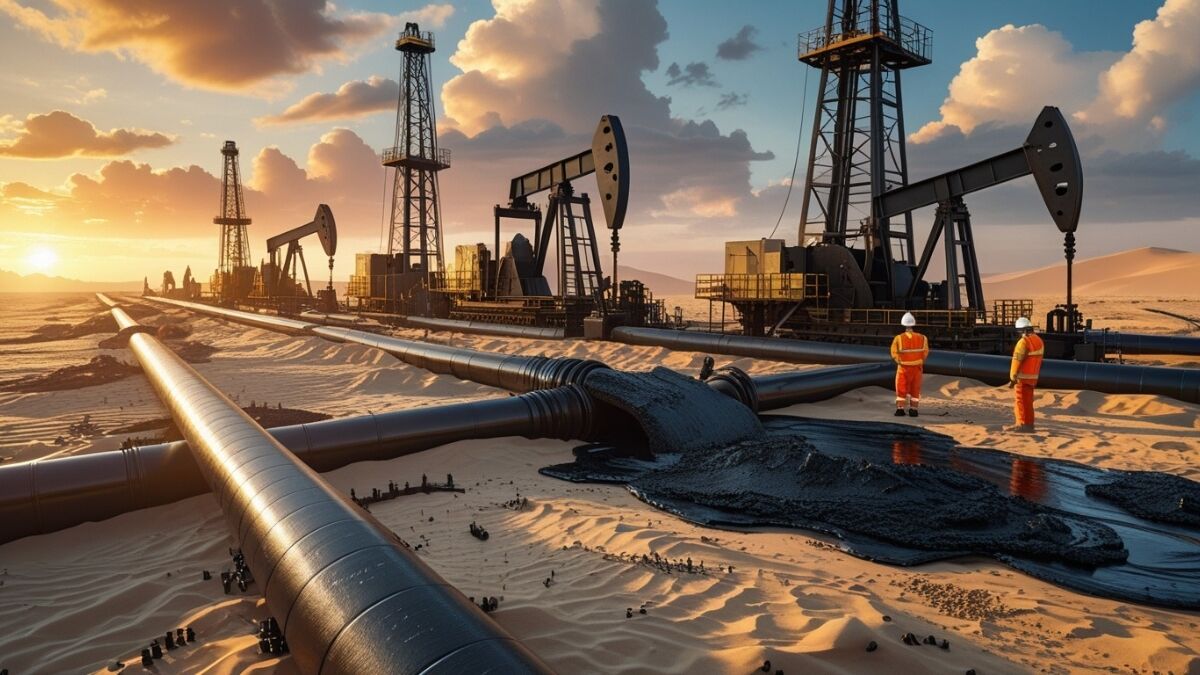
India is accelerating the expansion of its strategic petroleum reserves (SPRs) amid geopolitical tensions and energy supply disruptions, aiming to ensure long-term energy security.
India intends to expand its strategic petroleum reserves, which include a 2.5-million-ton reserve in Padur and a 4-million-ton facility in Chandikhol, in response to issues with energy supply.
India’s Strategic Petroleum Reserve Expansion
India’s long-delayed attempt to develop strategic petroleum reserves (SPRs) has gained importance due to the West Asia War and the disruptions to the energy supply.
According to persons with knowledge of the developments, Indian Strategic Petroleum Reserve Ltd. (ISPRL) plans to advance another project at Padur in Karnataka and issue a tender by the end of April for a 4-million-ton facility at Chandikhol in Odisha that was approved five years ago.
Project Costs and Developments
They stated that although the building cost of the Chandikhol project is estimated to be $1 billion, an additional $3 billion might be needed to fill the reserve.
Another development is that Megha Engineering and Infrastructures Ltd. (MEIL), based in Hyderabad, has received a work order to create a 2.5 million-ton crude reserve in Padur as India’s first strategic reserve using a public-private partnership (PPP) model.
Project Timelines and Phases
“A plan exists to increase the capacity of the strategic reserve. There have also been a few identified locations. The ongoing initiatives will advance more quickly. Chandikhol has completed the land allocation process. One of the two individuals mentioned above stated that the project’s RFP (request for proposals) will be released in a month. “The work order has been sent, and the necessary financial transactions have also been accomplished, so the construction of the Padur-II project will be completed swiftly.”
In September 2025, MEIL was victorious in the Padur Phase-II Crude Oil Underground Storage Cavern Project proposal. Dedicated single point mooring (SPM) and related onshore and offshore pipes are part of the project, which also involves the deployment and operation of 2.5 million-ton commercial-cum-strategic petroleum reserves.
Current Capacity and Government Plans
Until the time of publication, inquiries sent to MEIL, the Indian Strategic Petroleum Reserve, and the Ministry of Petroleum and Natural Gas remained unanswered.
India now has 5.3 million tons of strategic reserve capacity. On Monday, Prime Minister Narendra Modi told the Lok Sabha that India is developing an additional 6.5 million tons of oil reserves. In 2021, the Union cabinet approved the 6.5 million tonne capacity—2.5 million in Padur and 4 million in Chandikhol.
Industry Participation and Future Sites
Indian Oil Corp Ltd, Vitol, Bharat Petroleum Corp Ltd, Hindustan Petroleum Corp Ltd, HPCL-Mittal Energy Ltd, and Larsen & Toubro Ltd had expressed initial interest in developing the strategic crude deposit in Chandikhol, according to a September 2025 Mint story. In addition to these two sites, Mint previously reported that India intends to construct new SPRs at six places.
According to the second individual mentioned earlier, the Padur facility’s second phase is currently at the “engineering stage.” The individual stated that the project will include four storage facilities, each with a capacity of 625,000 tons.
Geopolitical Context and Risks
The ongoing US-Iran battle is causing delays to the country’s crude supplies, which is why there is a drive to accelerate the reservoir projects. Forty percent of India’s crude supplies are at risk because to the blockade of the Strait of Hormuz, which transports twenty percent of the world’s energy shipments.
According to the government, the nation’s oil reserves are enough, and more is pouring in from other sources. Price spikes, however, are concerning. About 90% of India’s oil needs are met by imports, and an increase of $1 per barrel of oil over the course of a year may result in an increase in the nation’s import bill of ₹16,000 crore.
Importance of Strategic Reserves
In addition to inflation and growth, this is probably going to have a number of macroeconomic effects on the external sector. Although strategic reserves are crucial for energy security, experts stated that India has to develop its reserves far more quickly.
“Strategic reserves are the requirement of the hour to assure energy security,” stated H.P.S. Ahuja, a former managing director and chief executive officer of the Indian Strategic Petroleum Reserves. The nation benefits from having both strategic and commercial reserves. He stated, “The PPP approach was developed to promote investments and fastrack the process,” implying that these are not quick fixes. “But it will take five to seven years to finish these initiatives.”
Kirit Parikh, a former energy member of the old Planning Commission of India, believes that these projects ought to have been expedited far sooner due to their lengthy gestation.
It goes without saying that strategic reserves are necessary in times of emergency, such as the ongoing conflict and its worldwide ramifications. According to Parikh, the capacities ought to have been expanded sooner. “Now that costs are high, the government should consider alternative quick fixes, like diversifying imports from additional nations. When the price of oil is low globally, strategic reserves should be considered.
Reserve Capacity Concerns
Approximately 3.37 million tonnes of the 5.33 million tonnes of strategic crude oil reserves at three locations in Andhra Pradesh and Karnataka are currently available and can serve as a buffer for short-term supply shocks, the government said Parliament on Monday. This is roughly 64% of the entire storage capacity.
In its report, which was turned in earlier this month, Parliament’s standing committee on petroleum and natural gas expressed worry about the insufficient funding for ISPRL’s operations and upkeep.
It saw a “sharp decrease” from the ₹220.04 crore budget estimate for ISPRL’s operations and maintenance expenditures to a revised estimate and actual spending of ₹100 crore each in FY25.
Frequently Asked Questions
1) Why is India currently increasing its crude reserves?
Strategic petroleum reserves are being developed more quickly as a result of growing geopolitical tensions and supply interruptions, particularly near the Strait of Hormuz.
2) The Chandikhol project: what is it?
In order to increase India’s emergency oil backup capability, a 4-million-ton crude oil storage facility in Odisha is proposed. Its construction will cost roughly $1 billion.
3) What makes the Padur Phase-II reserve unique?
The Padur project in Karnataka will be the first in India to use a public-private partnership model for the strategic expansion of petroleum storage.
4) What is India’s current reserve capacity?
In order to improve long-term energy security, India intends to add an additional 6.5 million tonnes to its present 5.3 million tonnes of strategic stocks.
5) Will these reserves address short-term supply problems?
No, these projects require five to seven years. Instead of depending on future reserves, short-term fixes include minimizing price shocks and diversifying oil imports.
Disclaimer: This article is for informational purposes only and does not constitute financial or investment advice.
