
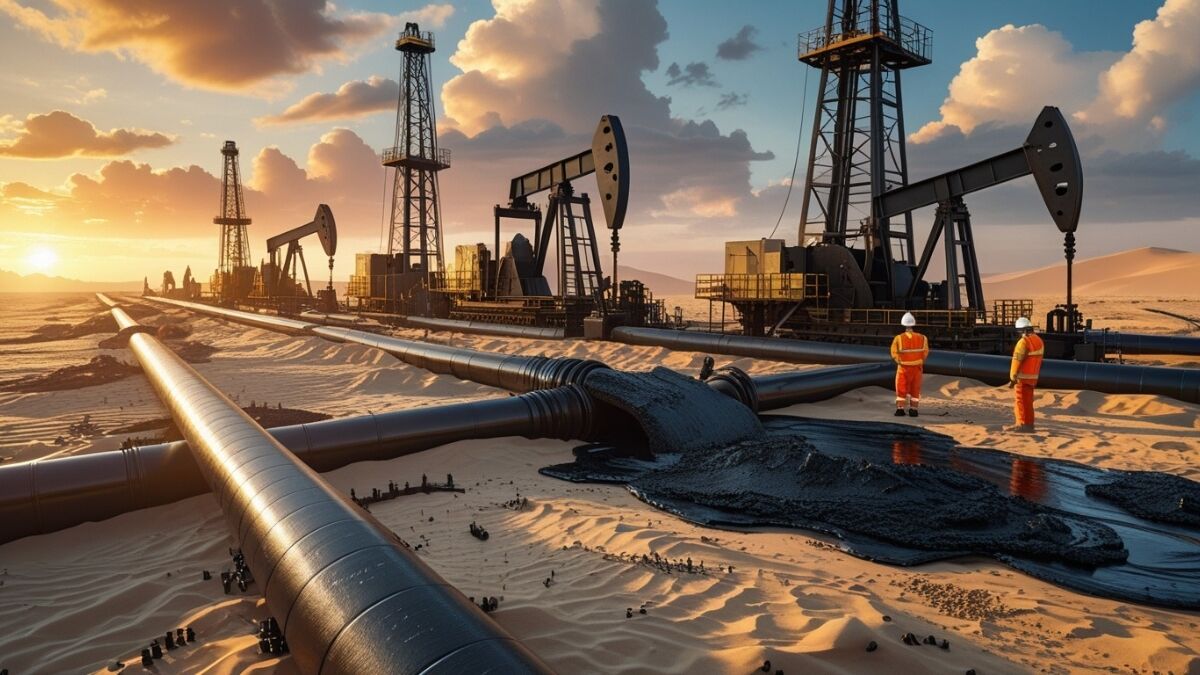
Oil prices surged sharply as geopolitical tensions in the Middle East escalated. Investors are closely watching supply disruptions, military developments, and global reactions that could impact energy markets worldwide.
Concerns that a protracted Middle East conflict could continue to disrupt supplies caused oil prices to rise 5% on Thursday, recovering from the losses of the previous session.
Oil Prices Surge Amid Middle East Conflict
At 10:57 am EDT (1457 GMT), Brent futures were up $5.26, or 5.2%, to $107.48 a barrel, near the session high of $107.84. After reaching a peak of $94.84, U.S. West Texas Intermediate oil futures increased by $3.53, or 4%, to $93.85 a barrel. On Wednesday, both benchmarks fell more than 2%.
Iran’s foreign minister stated on Wednesday that although Iran is considering a U.S. request to end the war, it has no plans to start negotiations to do so.
Political Tensions and Market Reaction
On Thursday, U.S. President Donald Trump cautioned Iran to “get serious” about a deal to put an end to nearly four weeks of conflict, one day after White House press secretary Karoline Leavitt warned that Tehran would face harsher consequences if it refused to acknowledge that it had been “defeated militarily.”
“There is just uncertainty and annoyance regarding the accuracy of reports originating from Iran and the United States. In an attempt to protect money, investors are once again switching to safer assets, according to Timothy Snyder, chief economist of Matador Economics.
⛽ Oil Market Highlights
- Brent Crude: $107.48 per barrel
- WTI Crude: $93.85 per barrel
- Price Jump: ~5% surge in a single session
- Main Cause: Supply disruption fears
- Investor Move: Shift toward safer assets
Military Escalation and Supply Risks
According to sources who spoke with Reuters, the Pentagon intends to send thousands of airborne troops to the Gulf in addition to the two Marine contingents already on their way, giving Trump greater choices for a ground assault. A Houthi leader told Reuters that the Iran-aligned Houthi movement in Yemen is prepared to attack the vital Red Sea waterway once more in support of Tehran. “Ongoing military escalation, including troop deployments and fresh strikes, alongside limited tanker movement under strict Iranian conditions, continues to strain global energy markets,” said MUFG analyst Soojin Kim.
According to three Israeli cabinet sources acquainted with the plan, the 15-point U.S. proposal, which was transmitted through Pakistan, would remove Iran’s highly enriched uranium stores, stop enrichment, limit its ballistic missile program, and reduce support for regional allies.
Global Supply Chain Disruptions
In what the International Energy Agency has described as the largest oil supply disruption ever, the battle has all but stopped exports through the Strait of Hormuz, which normally transports over a fifth of the world’s supply of LNG and crude oil.
Three Iraqi energy officials stated on Wednesday that the country’s oil production has decreased and that storage tanks have reached high and dangerous levels. According to data from the U.S. Energy Information Administration, Iraq was OPEC’s second-largest crude producer in 2025, after Saudi Arabia.
🌍 Global Supply Disruption Factors
- Strait of Hormuz: Major disruption to global oil flow
- Russia: Export capacity reduced by 40%
- Iraq: Production drop and storage pressure
- Shipping Risks: Tanker attacks and drone strikes
- Market Impact: Rising volatility and supply tightness
International Response
In an effort to protect Tokyo from a protracted battle, Japanese Prime Minister Sanae Takaichi requested IEA chairman Fatih Birol on Wednesday for another coordinated release of oil stockpiles.
According to Reuters calculations based on market data, at least 40% of Russia’s oil export capacity has been blocked as a result of Ukrainian drone assaults and the seizure of tankers, adding to supply concerns. According to two industry sources, Russia’s Kirishinefteorgsintez oil refinery, one of the biggest in the nation, stopped processing on Thursday after Ukrainian drone attacks resulted in fires in several areas of the facility.
Russia’s monopoly on oil pipelines According to the company’s CEO, Transneft would attempt to reroute oil exports from damaged Baltic Sea ports, according to an Interfax news agency report on Thursday. The Turkish transportation minister reported on Thursday that an explosion occurred close to Istanbul’s Bosphorus strait after a marine drone damaged a Turkish crude oil ship that was leaving Russia.
In the week ending March 20, U.S. crude stocks increased by 6.9 million barrels to 456.2 million barrels, the biggest level since June 2024 and well above analyst forecasts.
Frequently Asked Questions
1)What caused today’s dramatic increase in oil prices?
Fears of a protracted conflict, rising tensions in the Middle East, and supply interruptions, particularly near vital transit routes like the Strait of Hormuz, caused oil prices to rise by almost 5%.
What impact does the conflict in the Middle East have on the world’s oil supply?
Particularly in the Strait of Hormuz, which transports about one-fifth of the world’s oil and LNG supplies, the conflict restricts tanker movement and exports, endangering important shipping routes and production.
3) What part does Iran play in the present circumstances?
Uncertainty is growing as Iran considers a U.S. proposal but rejects talks while backing regional allies. Investor fears and volatility in oil prices are mostly caused by its position and military threats.
Are other nations causing supply disruptions?
Indeed, attacks have decreased Russia’s exports, Iraq’s storage is under pressure, and tanker events increase the risks, all of which tighten the world’s oil supply and increase market volatility in addition to Middle East tensions.
In what ways are governments reacting to the increase in oil prices?
While the United States explores military options, nations like Japan are looking for coordinated stockpile releases. In the face of growing geopolitical unpredictability and tensions, governments seek to maintain supply and stabilize markets.
Conclusion
Global reliance on secure energy pathways and the fragility of international oil markets have been highlighted by rising geopolitical tensions, broken supply lines, and uncertainty throughout major oil-producing countries.
Disclaimer: This content is for informational purposes only and does not constitute financial or investment advice.
