
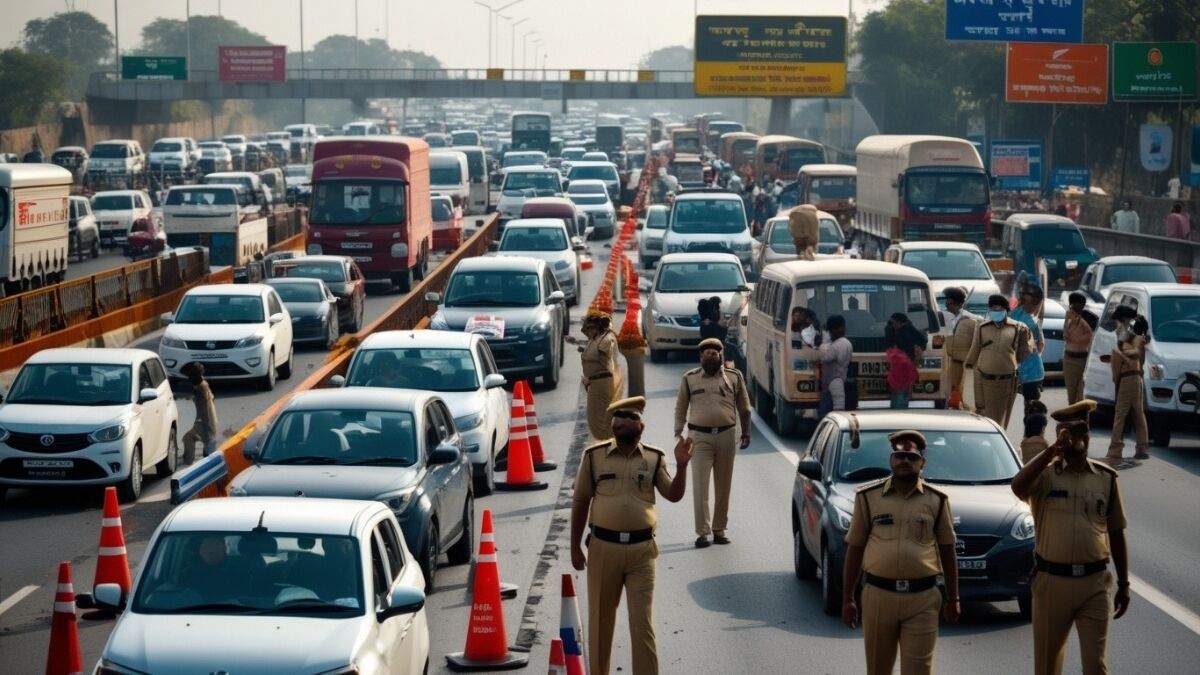
Ahead of the grand inauguration of Noida International Airport, authorities have issued a detailed traffic advisory to ensure smooth movement and safety during the high-profile visit.
Prior to Prime Minister Narendra Modi’s arrival for the Noida International Airport’s inauguration on March 28, the Gautam Buddh Nagar Traffic Police released a thorough advisory indicating that commercial trucks have been rerouted, parking areas have been properly segregated, and access points have been assigned.
Traffic Advisory Issued for Noida International Airport Inauguration
🚧 Traffic Guidelines
- Date: March 28
- Timing: 7 AM – 11 PM
- Focus: Smooth traffic flow
- Measures: Rerouting & parking zones
- Priority: Emergency services
- Advice: Avoid unnecessary travel
On Saturday, the advice will be in force from 7 a.m. to 11 p.m., with extra measures in place to guarantee the efficient operation of emergency services including fire departments and ambulances.
According to officials, cars traveling from Meerut and Ghaziabad will take the Eastern Peripheral Expressway, exit at Sirsa Toll, and travel through designated roundabouts before arriving at the location. For convenience, separate parking spaces have been designated, P-07 for Meerut and P-06 for Ghaziabad.
Parking and Route Plan for Different Cities
Cars coming from Mathura and Aligarh via the Yamuna Expressway will park in zones P-05, P-09, and P-11 after exiting at Jewar Cut and passing through the Sabauta Underpass and Kishorpur Gate.
Parking has been set up in zones P-13 and P-14 at Parohi Gate, where traffic from Hapur, Bulandshahr, and surrounding areas will be redirected via the Jewar–Khurja road.
Special Arrangements for VIPs and Media
🚗 Entry & Parking Plan
- VIP Parking: P-01, P-02, P-03
- Media Zone: P-08
- Officials: P-10
- Buses: P-15
- Public Entry: Kishorpur Gate
- Main Parking: P-07
Dignitaries will park in zones P-01, P-02, and P-03 and travel to the event via a designated Yamuna Expressway interchange. In the meanwhile, media representatives will park in zone P-08 and enter through Kishorpur Gate.
The location will be accessible through Kishorpur Gate for on-duty government employees, police officers, and administrative officials. Zone P-10 parking will be available. Official buses will also park in zone P-15 and pass through Dayanantpur.
Additional Traffic Diversions and Access Points
The majority of parking will be located at P-07, and commuters using the Noida–Greater Noida Expressway from Noida and Greater Noida will be redirected through service lanes and roundabouts before entering through a temporary gate close to the Ranehra Police Post.
While vehicles entering from Dankaur and surrounding areas would be directed along service roads and canal ways to the designated entrance points, vehicles arriving from Greater Noida West and surrounding areas will pass through Pari Chowk.
Guidelines for Local and Commercial Vehicles
The Kishorpur Gate will allow admission for two-wheelers and light motor vehicles, with parking available at P-04. Jewar town vehicles will also utilize the same gate and park in P-12.
While commercial trucks heading from Khurja to Jewar will be stopped in Khurja and redirected appropriately, those on the Jewar–Tappal route will be rerouted towards Tappal.
Official Schedule and Public Advisory
To ensure the high-profile event runs smoothly, officials asked commuters to stay on approved routes and refrain from making needless trips close to the venue.
In the meantime, PM Modi will first tour the terminal building at Noida International Airport in Jewar, Gautam Buddha Nagar, according to an official statement from the Prime Minister’s Office. According to ANI, he will address a public gathering and officially open Phase I of the airport at noon.
Important Aspects of Jewar’s Noida International Airport
One of the biggest greenfield airport projects in India is the Noida International Airport, whose Phase I was built under a Public-Private Partnership (PPP) model at an estimated cost of ₹11,200 crore.
It will be able to accommodate 12 million passengers annually (MPPA) at first, with the potential to grow to 70 MPPA in later stages. In addition to cutting-edge navigation technology like the Instrument Landing System (ILS) and contemporary airfield lighting to enable effective all-weather, 24-hour operations, the airport features a 3,900-meter runway that can accommodate wide-body aircraft.
Modern Infrastructure and Sustainability Features
It also features a strong cargo infrastructure, including a multi-modal cargo hub with an integrated cargo terminal and logistics zones. The cargo facility can handle more than 2.5 lakh metric tonnes per year, and it has the capacity to accommodate up to 18 lakh metric tonnes. There are also plans for a 40-acre Maintenance, Repair, and Overhaul (MRO) complex.
By implementing energy-efficient technologies and ecologically conscious practices, the airport, which is envisioned as a sustainable and future-ready project, seeks to function as a net-zero emissions facility. Its architecture blends traditional ghats and havelis with contemporary infrastructure, reflecting Indian history.
Disclaimer: This content is for informational purposes only. Traffic plans and arrangements may change based on real-time conditions and administrative decisions.
