
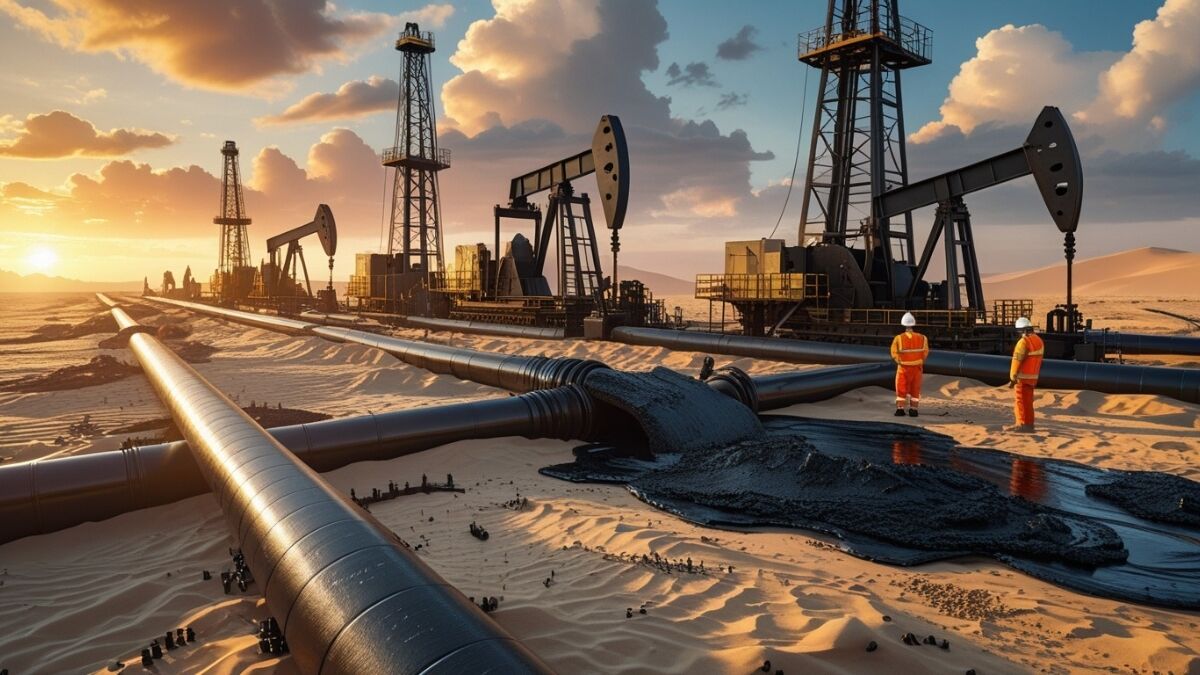
India and Brazil are strengthening energy ties as both nations explore strategic cooperation in crude oil supply and refining capabilities to enhance energy security and economic growth.
Kenneth felix Haczynski da Nóbrega, Brazil’s ambassador to India, claims that in return for more crude oil, India’s refining capabilities may assist address Brazil’s serious vulnerability.
India-Brazil Energy Partnership Gains Momentum
In an interview, Brazilian ambassador to India Kenneth Felix Haczynski da Nóbrega stated that Brazil, the largest oil producer in South America, can assist India in meeting its need for crude oil and, consequently, import more diesel from New Delhi, the fourth-largest refiner in the world.
He also discussed a potential partnership between Brazilian and Indian oil refining firms to establish a refinery in Brazil that imports petroleum products, particularly diesel.
🤝 India–Brazil Energy Opportunity
- Brazil Role: Major crude oil supplier
- India Role: Global refining powerhouse
- Key Trade: Crude oil ↔ Diesel exchange
- Goal: Strengthen energy security
- Future Plan: Joint refinery projects in Brazil
Strategic Shift Amid Global Energy Crisis
His comments coincide with New Delhi’s efforts to diversify its energy sources and obtain equity oil and gas from Brazil, the seventh-largest producer and exporter of crude in the world, amid the US-Israel-Iran conflict that has forced energy-importing countries like India to bolster supply.
In January of this year, India’s state-owned Bharat Petroleum Corp. Ltd. (BPCL) renewed a 2025 contract with Petrobras to purchase 12 million barrels of crude in 2026–2027.
Brazil’s Refining Vulnerability and India’s Advantage
According to Nóbrega, Brazil has one “vulnerability” despite being mostly self-sufficient in the production of crude oil. “One weakness is that we are self-sufficient in crude oil production, but we are not self-sufficient in refined oil,” he stated, pointing out that the majority of the nation’s freight transportation by road and rail depends on diesel.
He stated, “India may also establish refineries in Brazil because you are one of the major countries in terms of oil refining,” pointing out that refined oils, including diesel, are among India’s top exports to the biggest nation in South America.
⚙️ Refining Strength vs Demand Gap
- Brazil Issue: Lack of refining capacity
- India Strength: 258 million tons refining capacity
- Dependency: Brazil relies on diesel imports
- Solution: Indian refinery investment
- Impact: Balanced energy ecosystem
Expanding Refining Capacity and Global Role
With its 258 million tons of annual refining capacity, India has assisted nations like Mongolia and Nigeria in building refineries. Reliance Industries Ltd., which owns and runs the largest integrated refining facility in the world in Jamnagar, Gujarat, recently announced that it would partner with America First, a US company, to build a refinery in the US.
“Brazilian crude is heavy and sour, and Indian refineries have sufficient expertise to process it,” Nóbrega said, adding that ongoing geopolitical tensions will only strengthen India-Brazil relations as countries look for dependable, trustworthy partners. They are also less expensive than other varieties because of the nature of this crude. Therefore, India would benefit from importing more Brazilian crude. Second, since we already export a lot of petroleum products, Brazil would also be a good market for diesel made in India, according to Gaurav Moda, partner and leader of the energy sector at EY-Parthenon India.
Future Collaboration in Exploration and Investment
He noted that Indian refiners are in a good position to build refineries in the nation in South America.
He stated that the exploration of deepwater and offshore blocks is another important area in which Brazil and India can collaborate. Brazil possesses a number of these blocks, whereas India wants to expand the production of hydrocarbons from deepwater and offshore blocks, but its exploration and production sector lacks the necessary skills.
Trade Growth and Bilateral Investments
The Ministry of External Affairs reports that bilateral trade between Brazil and India reached $15.21 billion in 2025. In 2024, India exported over $800 million worth of refined petroleum products to Brazil and purchased $1.94 billion worth of crude oil, according to UN Comtrade data.
In Brazil’s exploration and production sector, New Delhi is also participating. Together, Bharat PetroResources Ltd. and ONGC Videsh Ltd., the overseas division of the state-owned Oil and Natural Gas Corp. Ltd. (ONGC), have spent over $3.5 billion in offshore oil assets.
Strengthening Ties Beyond Energy
The two nations signed many memorandums of understanding (MoUs) to improve collaboration in vital minerals, pharmaceutical regulation, micro, small, and medium businesses (MSMEs), and postal services during Brazilian President Luiz Inácio Lula da Silva’s visit to India in February 2026.
Prior to that, Mint revealed on January 27 that the Adani Group, founded by Gautam Adani, had partnered with Embraer S.A., a Brazilian aircraft maker, to build a small-jet production facility in India.
According to Nóbrega, bilateral commerce has benefited from foreign direct investment (FDI) flows from India to Brazil. “And it is anticipated to have an impact on trade in a more sustainable manner because, for instance, when Indian automakers increase their investments in Brazil, that increases the export, the flow of auto parts from India to Brazil in the same way that as Embraer localizes, their production here will also have an increased export of aerospace parts,” he stated.
Frequently Asked Questions
1) Why are Brazil and India working together on energy projects?
Brazil wants refined fuels, while India needs steady supplies of crude. Their complementing skills build a win-win alliance that boosts economic relations, resilience in the face of international geopolitical unpredictability, and energy security.
2) What is the primary suggested trade arrangement?
India will supply refined goods like diesel, and Brazil would export crude oil to India. For balanced energy cooperation, this exchange makes use of Brazil’s production power and India’s capacity for refining.
3) What are the advantages of Brazilian crude for India?
Brazilian crude is appropriate for Indian refineries built for heavy, sour oil and is comparatively less expensive. In the event of worldwide interruptions, this helps India diversify its imports, cut expenses, and guarantee a steady supply.
4 What are the advantages of Indian refining for Brazil?
Brazil is dependent on diesel imports because it lacks adequate refining capacity. Collaborating with India guarantees a consistent flow of refined fuels and could facilitate the growth of indigenous refining facilities.
5) What are the prospects for future cooperation?
Both nations can work together on deepwater drilling, offshore exploration, and the construction of refineries in Brazil. Long-term strategic energy cooperation can be strengthened through investments, knowledge sharing, and joint ventures.
Conclusion
The energy connection between Brazil and India demonstrates strategic complementarity, improving supply security, increasing commerce, and facilitating long-term cooperation in exploration and refining, all of which benefit both economies in the face of changing global energy concerns.
Disclaimer: This content is for informational purposes only and reflects current developments in global energy cooperation, which may evolve over time.
