
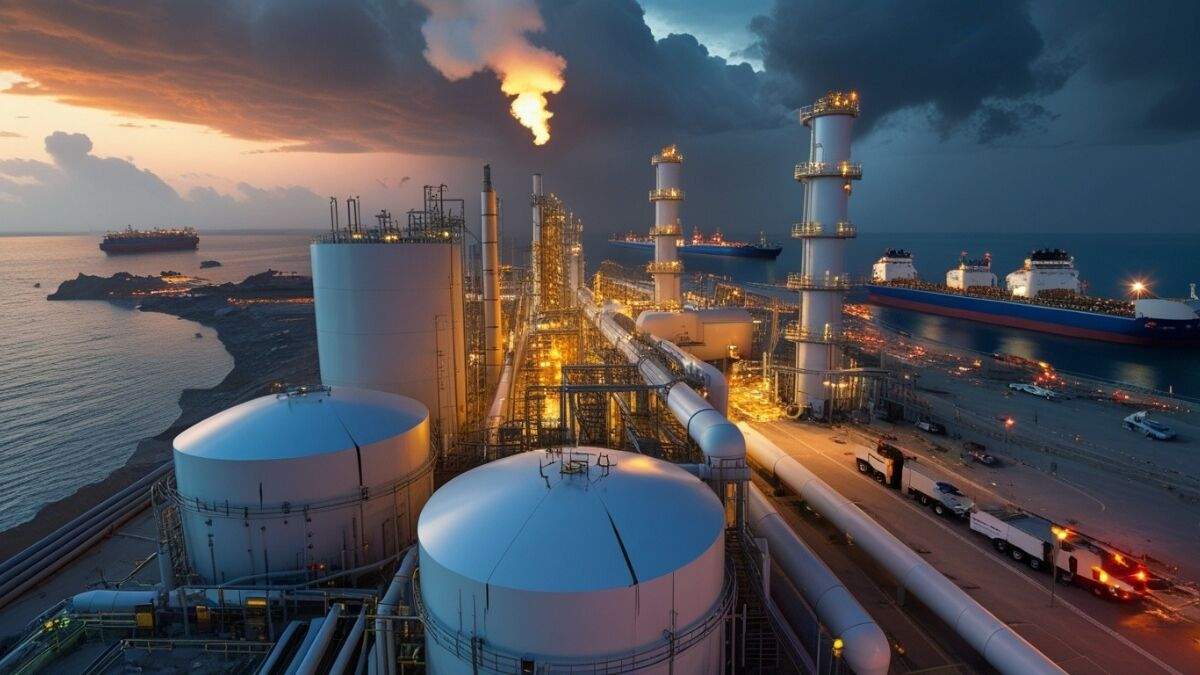
Amid rising tensions in West Asia, India’s energy supply chain continues to remain stable as key LPG shipments safely cross one of the world’s most critical maritime routes, the Strait of Hormuz.
Amidst tensions in West Asia, the Indian ship MT Jag Vasant, carrying over 47,000 metric tonnes of liquefied petroleum gas (LPG), reached a port in Vadinar, Gujarat, on Saturday after passing through the war-torn Strait of Hormuz.
Indian LPG Shipment Safely Reaches Gujarat
Two more merchant ships carrying petroleum goods for India crossed the Strait of Hormuz earlier, according to sources who spoke to ANI. Indian Navy warships were ready to assist them. More ships are anticipated to arrive soon, they said.
The Vadinar Terminal of DPA Kandla in Jamnagar, Gujarat, received a shipment of 47,000 metric tons of LPG on Saturday, according to the report. According to ANI, the ship, MT Jag Vasant, will use a Ship-to-Ship (STS) procedure to move its cargo to another ship at anchoring.
🛢️ LPG Shipment Details
- Ship: MT Jag Vasant
- Cargo: 47,000 MT LPG
- Destination: Vadinar, Gujarat
- Operation: Ship-to-Ship transfer
- Route: Via Strait of Hormuz
Naval Support and Maritime Security
Sources told ANI that Indian Navy warships were ready to support the trade ships.
On March 24, ANI reported that the LPG tankers Jag Vasant and Pine Gas had sailed from the Persian Gulf in close proximity to one another. According to reports, they were carrying about a day’s worth of cooking gas for the nation.
Strategic Importance of Shipments
The two tankers, which were carrying over 92,000 tons of LPG, had passed through Hormuz and were anticipated to arrive at ports in India between March 26 and 28, according to the Ministry of Ports, Shipping, and Waterways.
According to ship-tracking data on the MarineTraffic platform, the Jag Vasant carrying LPG from Kuwait passed through the strait after the Pine Gas, which had loaded in UAE waters, according to Reuters.
Strait of Hormuz and Global Tensions
Iran allows five nations to cross the Strait of Hormuz. Despite Tehran’s ongoing military actions in the Gulf, Iranian Foreign Minister Abbas Araghchi reiterated on Thursday that the Strait of Hormuz is still only accessible to a few nations.
Tensions over one of the most important energy channels in the world have significantly increased, as seen by the fact that India, China, Russia, Iraq, and Pakistan have been allowed passage while others face restrictions. “We allowed friendly countries like China, Russia, India, Iraq, and Pakistan to cross the Strait of Hormuz,” Araghchi stated.
⚠️ Strait of Hormuz Situation
- Region: West Asia
- Concern: Geopolitical tensions
- Impact: Global energy routes
- Countries Allowed: India, China, Russia, Iraq, Pakistan
- Risk: Maritime security challenges
India’s Safety and Monitoring Measures
“In the Gulf region, there has been no information in the last 24 hours regarding any incident involving Indian-flagged ships or Indian seafarers,” said Rajesh Kumar Sinha, Special Secretary in the Ministry of Ports, Shipping, and Waterways, during a joint interministerial briefing. He added that authorities are keeping a close eye on the situation and maintaining coordination with various stakeholders. “Everyone is secure,” Sinha declared. “In the Persian Gulf, there are 20 ships traveling under the Indian flag, with roughly 540 Indians onboard, and they are also safe,” he stated, adding that Indian ships operating there are equally safe. Sinha went on to say that the Directorate General of Shipping has been actively addressing questions and issues via its contact center.
“The DG Shipping communication center, which is open around-the-clock, received 98 calls and 335 emails in the last 24 hours, all of which were answered,” he stated. In the past, MT Shivalik and MT Nanda Devi had made it safely to the Indian coast while transporting roughly 92,712 tonnes of LPG.
Previous Successful Shipments
On March 16, the LPG carrier Shivalik arrived in Mundra, Gujarat; the next day, another LPG tanker, Nanda Devi, arrived in Kandla port, Gujarat. On March 13, two LPG carriers set out on their voyage, and early on March 14, they crossed the Strait of Hormuz.
On March 18, the Indian-flagged oil tanker Jag Laadki arrived in Mundra carrying 80,886 tons of crude oil from the United Arab Emirates. Jag Prakash, another tanker transporting gasoline from Oman to Africa, has already passed the strait without incident and is currently en route to Tanzania.
Frequently Asked Questions
1) What is the Strait of Hormuz and why is it important?
The Strait of Hormuz is a critical global oil transit route through which a significant portion of the world’s oil and LPG shipments pass, making it essential for energy security.
2) Is India’s LPG supply safe amid West Asia tensions?
Yes, Indian officials have confirmed that shipments and seafarers are safe, and cargo is being closely monitored with naval support if needed.
3) What is Ship-to-Ship (STS) transfer?
STS is a process where cargo is transferred from one ship to another while anchored, often used for efficiency in logistics.
4) Are Indian ships facing any threats in the region?
As per official reports, there have been no recent incidents involving Indian ships or crew in the Gulf region.
5) How many Indian seafarers are currently in the Gulf?
Approximately 540 Indian seafarers are onboard 20 Indian-flagged ships operating in the Persian Gulf, all reported safe.
🚢 Key Oil Tanker Movements
- Jag Vasant: 47,000 MT LPG
- Jag & Pine Gas: 92,000+ MT LPG combined
- Shivalik & Nanda Devi: Earlier successful arrivals
- Jag Laadki: 80,886 MT crude oil
- Jag Prakash: Fuel transport to Tanzania
Disclaimer: This article is for informational purposes only and is based on reported updates. It does not represent any official policy or prediction.
