
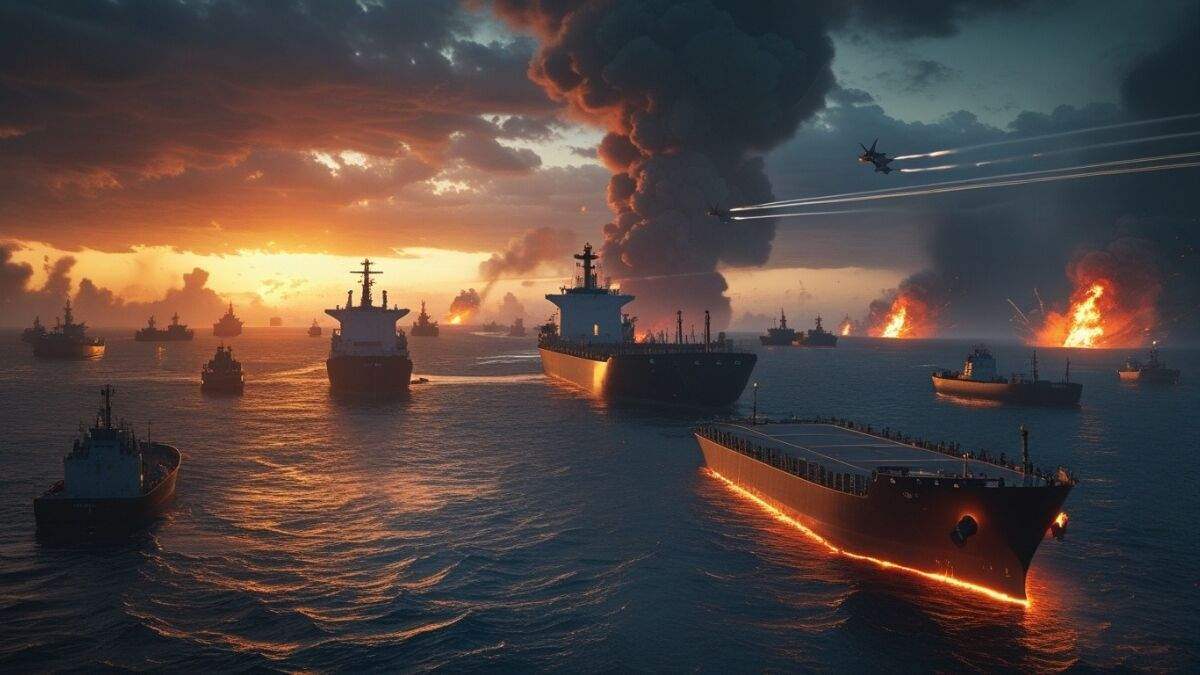
A deepening geopolitical crisis in the Gulf is sending shockwaves across global markets, with rising oil prices threatening economic stability, inflation control, and everyday affordability worldwide.
Gulf to Globe: Experts warn of a global growth shock as Hormuz blockade pushes oil above $114.Economists warn that the world will experience months of higher prices, slower growth, and declining purchasing power when oil prices surpass $114 and the Strait of Hormuz closes.
Oil Shock and Global Economic Impact
In the midst of the US-Israeli conflict with Iran, traffic in the Strait of Hormuz drastically decreases as a ship stays anchored. Washington, DC — Following President Donald Trump’s Tuesday ultimatum for Iran to reopen the Strait of Hormuz or face assaults on its electrical infrastructure, oil prices have surged, with US crude hitting $114 per barrel.
⛽ Global Oil Price Surge
- US Crude: $114 per barrel
- Brent Crude: $110.91 per barrel
- Trigger: Strait of Hormuz blockade
- Impact: Rising inflation globally
- Concern: Slower GDP growth
- Risk: Long-term economic instability
Brent crude increased 1.72% to $110.91 on Sunday, while US crude increased 2.35% to $114.16 a barrel. Trump said that Iran would be “living in Hell” if the Strait remained blocked in a graphic social media post.
Along with threatening strikes on the nation’s bridges and power plants, he later posted, “Tuesday, 8:00 P.M. Eastern Time!” without providing any other information. The prolonged conflict in Iran could impede global economic growth, the International Monetary Fund (IMF) said last week.
Rising Costs for Everyday Life
To put it simply, the Washington-based organization claims that ordinary people in many nations would have to pay more for fuel, heating, and food if the battle continues to interrupt supply of oil, natural gas, and fertilizer from the Gulf region. These effects might persist for years.
The war, which started on February 28, 2026, with US and Israeli assaults against Iran, is already in its fifth week. The IMF’s statement serves as a warning of the wider costs of the conflict.
Food Security and Agricultural Risks
The UN Food and Agriculture Organization’s (FAO) chief economist, Maximo Torero, cautions that the decline in tanker traffic over the Strait of Hormuz is causing one of the worst shocks to global commodities flows in recent memory.
Torero highlights the dangers that rising fertilizer and energy prices pose to agricultural productivity and food security. “One of the worst shocks to global commodity flows in recent years is being caused by the continued interruption to the Strait of Hormuz trade corridor, with substantial consequences for food security, agricultural production, and world markets.”
🌾 Food & Inflation Crisis
- Fertilizer Trade: 1/3 passes through Hormuz
- Impact: Higher farming costs
- Result: Expensive food globally
- Risk: Lower agricultural output
- Concern: Food security crisis
- Effect: Supply chain disruption
A substantial portion of natural gas and around one-fifth of the world’s oil flow through the Strait of Hormuz. Approximately one-third of the global seaborne commerce in fertilizers, which farmers employ to cultivate crops, passes through the region.
Tankers and cargo ships find it difficult to transport cargo securely when hostilities obstruct these routes. Higher pricing and shortages result from this. Due to the interconnectedness of the world economy, even nations that are remote from the war experience its effects.
Inflation and Consumer Impact
Increased fertilizer costs make food production more costly for farmers, which ultimately raises the price of bread, rice, vegetables, and other commodities in stores. Moody’s Analytics head economist Mark Zandi cautions about the direct impact on regular people.
The spike in oil prices, which has already reduced the price of a gallon of gas, poses a threat to consumers. Inflation will swiftly pick up speed, reducing consumers’ purchasing power and having an impact on GDP, jobs, and consumer expenditure.
Global Financial Pressure
Higher oil prices are “another negative supply shock, boosting inflation and reducing growth, putting the Fed in a no-win situation,” according to Zandi. In anticipation of potential steep increases in heating costs for the upcoming winter, governments throughout Europe are now thinking about providing additional subsidies or welfare assistance to families that find it difficult to make ends meet.
In simple terms, the IMF described the issue as follows: “A brief conflict might send oil and gas prices rising before markets adjust, but a long one might keep energy expensive and burden nations that rely on imports.” Or, with persistent uncertainty and geopolitical danger, the world might settle somewhere in the middle—tensions persist, energy remains expensive, and inflation is difficult to control.
Long-Term Economic Outlook
“Much relies on how long the conflict lasts, how far it expands, and how much damage it inflicts on infrastructure and supply lines,” the statement continued. Long-term increases in oil prices have historically been associated with greater inflation and slower GDP.
In the near term, some nations that produce and export gas and oil, like the United States, might profit from higher energy costs since they make more money from the sale of such commodities.
Even in these locations, regular families will still have to pay extra at the gas station, which could lower living standards. The effects are more severe for many other countries, particularly those that import the majority of their energy. In order to pay for increased fuel and transportation expenses, businesses might need to increase their own rates.
This could result in more widespread inflation, which would compel central banks to think about hiking interest rates, making borrowing more costly for all. According to the IMF assessment, there may not be enough space to help suffering people and businesses, which might worsen and prolong the economic damage.
If the Middle East crisis continues to restrict the flow of oil, gas, and fertilizer out of the Gulf, “all roads lead to higher prices and slower growth worldwide,” the IMF said.
Frequently Asked Questions
1) Why do oil prices increase worldwide when the Strait of Hormuz closes?
Due to the fact that about one-fifth of the world’s oil flows through it, disruptions lower supply and result in instantaneous price increases across the globe.
2) What impact does increased oil have on daily life?
Growing fuel prices drive up production and transportation costs, making necessities like food, energy, and travel more costly for households around the world.
3) How does the International Monetary Fund function in this situation?
It evaluates global risks and cautions that protracted disruptions can burden economies, particularly those that import energy, and limit growth and inflation.
4) Why are fertilizer prices affected as well?
The Gulf region is a major exporter of fertilizer. Disruptions increase the cost of farming, which lowers yields and drives up food prices in global markets.
5) Who gains from the high cost of oil?
Higher energy costs nevertheless lower consumer purchasing power and local economic stability, even though oil-exporting countries and businesses may benefit in the near run.
Conclusion
Global interconnectedness is shown by the Hormuz crisis, when conflict interrupts food and energy networks, causing inflation and reducing growth, leaving governments, corporations, and people dealing with protracted uncertainty and economic strain on a global scale.
Disclaimer: This content is for informational purposes only and reflects ongoing global developments. Economic conditions may change rapidly based on geopolitical events.
