
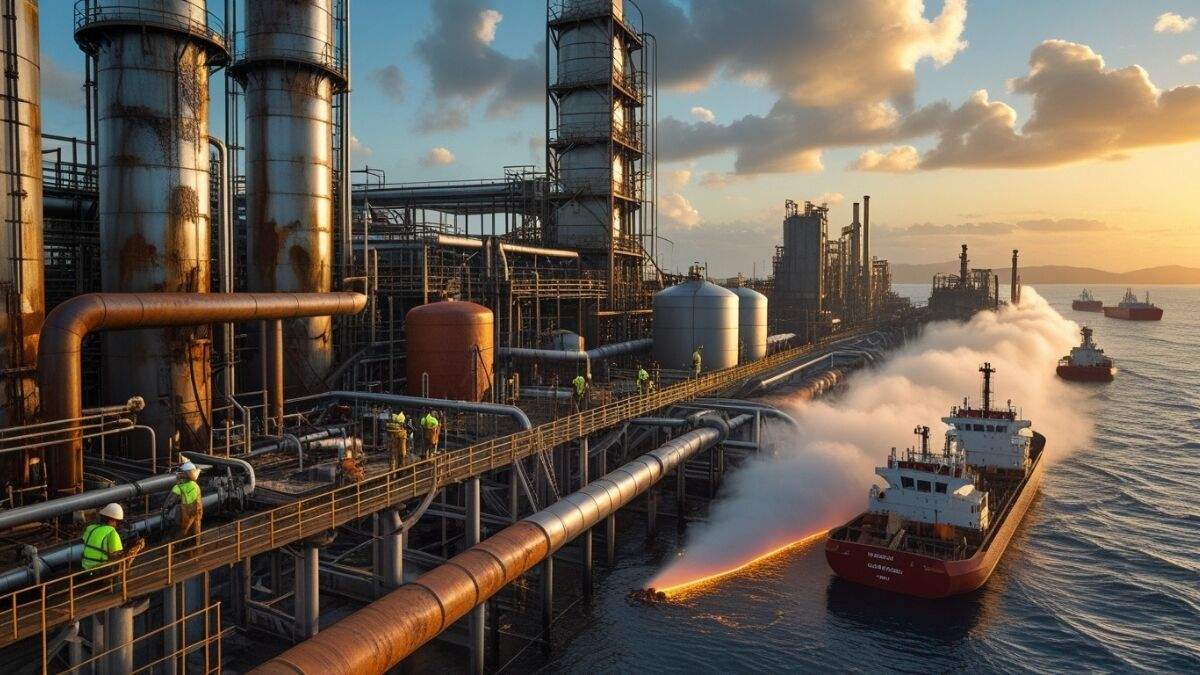
Venezuela’s oil sector, once a global powerhouse, is now struggling due to years of underinvestment. Reviving its crude upgrading infrastructure could unlock significant value and reshape global oil flows.
There is a lot of work to be done to revitalize Venezuela’s crude oil sector, which was negatively impacted by years of inadequate investment and poor management.
Reviving Venezuela’s Crude Oil Sector
Repairing and restarting the industry’s crude upgraders, which transform Venezuela’s extra-heavy oil into a lighter synthetic crude that can be piped, exported, and refined, is one rehabilitation project that might offer a lot of value for the money. We will talk about how upgrading the upgraders could have a significant impact on U.S. Gulf Coast refiners in today’s RBN blog.
🛢️ Crude Upgraders Key Role
- Function: Convert heavy crude to lighter oil
- Benefit: Easier transport and refining
- Impact: Boost export capacity
- Challenge: Most facilities are inactive
- Need: Investment and repairs
- Opportunity: High return potential
In the wake of President Nicolás Maduro’s overthrow by the United States, we have written extensively about Venezuela’s oil industry this year. In Take Me Money and Run Venezuela, we summarized how the nation went from supplying Gulf Coast refiners with more than 1 MMb/d of heavy sour crude in the late 1990s and early 2000s to currently producing less than 1 MMb/d, or about 25% of its previous output.
We then examined the distinctive features of Venezuela’s crude slate in Orinoco Flow, pointing out that the majority of reserves are located in the 21,000-square-mile Orinoco Belt and are extra-heavy (API as low as 8–14 degrees), making the oil challenging and expensive to transport and refine. We contrasted Canadian and Venezuelan heavy crudes in When Love Comes to Town.
Decline in Production and Challenges

Lastly, we outlined the doable actions Venezuela would need to take to increase oil production in Round and Round (which previewed our first Drill Down Report of 2026, which is accessible here).
In our new series on Venezuela, this is the second. The refining industry was the subject of the first article, and with the increasing oversupply of refined goods from the Gulf Coast, we see little interest from Western businesses in making the significant expenditures required to revive it. (For a more thorough discussion of this, see our biannual Future of Fuels study.)
Upgraders vs Refiners: A Different Scenario
However, compared to the country’s refiners (black pentagons in Figure 1 below), the situation with Venezuela’s crude upgraders is very different. The nation’s four upgraders (white pentagons along the coast) are essential to boosting production from the Orinoco Belt (blue-shaded area), but they are also in poor condition due to years of underinvestment and hardly functional, if at all.
⚠️ Production Constraints
- Main Issue: Lack of functional upgraders
- Dependency: Imported diluents
- Cost: High blending expenses
- Impact: Limited exports
- Risk: Supply instability
- Solution: Infrastructure revival
Before being exported, the extra-heavy crude produced there must either be converted into synthetic crude oil (SCO) or combined with a diluent like condensate or natural gasoline. The absence of functional upgrading capacity is a significant barrier to oil production because the great bulk of the diluent used in Venezuela must be imported.
Frequently Asked Questions
1. What are the real functions of crude upgraders?
By breaking down big hydrocarbon molecules, they improve flow, transport efficiency, and refinery compatibility without requiring substantial blending, turning extra-heavy crude into lighter synthetic oil.
2. What makes upgraders essential for Venezuela?
The majority of Venezuelan oil is too thick to transport or sell. By removing this obstacle, upgrades enable production from the Orinoco Belt to more consistently reach export markets.
3. Without increasing capacity, what restricts production?
Without upgraders, Venezuela’s ability to produce and export more oil is directly limited since it must dilute crude with imported light hydrocarbons, which are expensive and frequently scarce.
4. What caused Venezuela’s upgrading system to deteriorate?
A large portion of the upgraded infrastructure became partially or completely unusable due to equipment failures, inefficiencies, and shutdowns brought on by persistent underinvestment, technical neglect, and operational mismanagement.
5. How might repairs help the world’s oil markets?
Enhanced upgrading capability would help refineries, particularly those along the U.S. Gulf Coast, optimize operations and stabilize feedstock availability by increasing the supply of medium and heavy crude replacements.
Conclusion
Rehabilitating Venezuela’s upgraders provides a workable way to increase exports, reduce dilution costs, and revive output while providing refiners with appropriate crude, resulting in operational and economic benefits across markets.
Disclaimer: This content is for informational purposes only and reflects industry analysis. Market conditions and geopolitical factors may change rapidly.
