
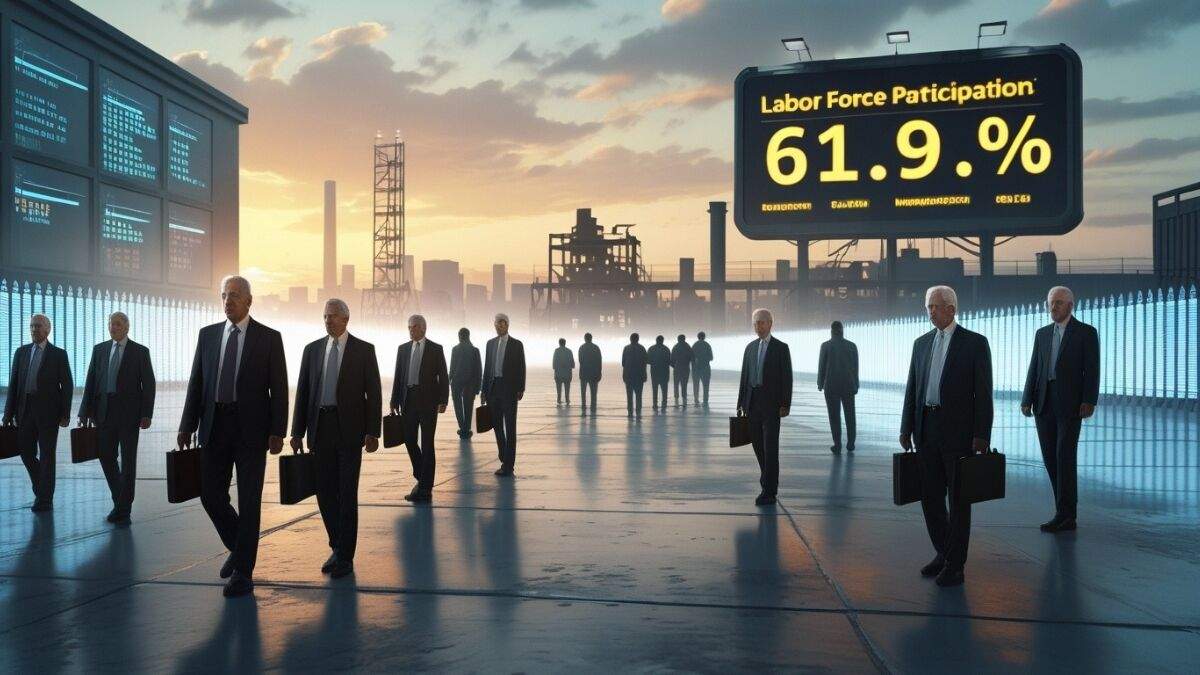
This report highlights concerns around declining labor force participation in the U.S., driven by demographic shifts and policy changes, and its long-term impact on economic growth.
With the exception of the epidemic, an important labor measure has fallen to a half-century low due to an aging population and Trump’s immigration crackdown. Some economists are uneasy about that.
Labor Force Participation Hits Multi-Decade Low
Last month, the U.S. labor market recovered with robust job growth and a drop in unemployment. However, the ongoing decline in labor force participation also became apparent.
Outside of the pandemic, the labor-force participation rate—the percentage of the working-age population that is either employed or seeking employment—edged down to 61.9% in March, its lowest level since 1977.
Long-Term Decline and Key Drivers
Due in significant part to the aging population, the rate has been steadily declining since the early 2000s. In the early months of the epidemic, it plummeted, then recovered and expanded for a while until starting to decline again in 2024.
The Trump administration’s immigration crackdown and the population’s ongoing aging have contributed to the decline in recent months, according to economists. The rate is important because it influences how quickly the economy grows. Either more workers join the economy, or each worker produces more, and the economy expands.
📊 Labor Force Key Insights
- Participation Rate: 61.9% (Lowest since 1977)
- Main Causes: Aging population & lower immigration
- Impact: Slower long-term economic growth
- Trend: Declining since early 2000s
- Risk: Future labor shortages
Economic Growth Concerns
According to Gus Faucher, chief economist at PNC Financial Services Group, “a lower labor force participation rate predicts poorer long-run economic development.”
Fortunately, over the past few years, U.S. productivity growth has above historical averages, according to Greg Daco, chief economist at EY-Parthenon. He stated, “That has essentially largely compensated the decrease in the growth of the labor force.” “But how much more productivity increase we will receive in the next years is an open question,” he continued.
Aging Population and Early Retirement Trends
Since the massive postwar generation known as baby boomers began retiring in the early 2000s, the participation rate has been under pressure. This trend has persisted in recent months as younger boomers approach retirement age.
Another cause has been the early retirement of workers aged 55 and above. Many in this group left the workforce before turning 65 as a result of the epidemic, and this trend has persisted as some choose to avoid the chaos of artificial intelligence. Americans 55 and older now have the lowest labor force participation rate in almost 20 years, at 37.2% last month, down from 40.2% in January 2020.
⚠️ Economic Risks Ahead
- Labor Shortage: Fewer workers entering workforce
- Immigration Drop: Reduced young labor supply
- Retirement Surge: More workers exiting early
- Growth Impact: Slower GDP expansion
- Dependency Risk: Higher pressure on active workers
Role of Immigration and Workforce Dynamics
According to Daco, some members of this group may have been motivated to retire early because they had accumulated significant equity in their homes and 401(k)s. According to him, some may have struggled to find employment after losing one and ultimately quit.
The immigration policies of the Trump administration have also had a negative impact on the participation rate. Reduced immigration and deportations have cut off a flow of people, many of whom are young, who enter the nation with the express purpose of finding employment.
Future Workforce Challenges
According to Laura Ullrich, an economist at the job-search website Indeed, “we have aged our workforce in a more fast fashion with immigration dropping and fewer individuals entering.”
Because “we are also at some point going to be witnessing losses in population,” a reduced participation rate might eventually generate additional problems for the American economy, according to Ullrich. According to her, there may be a labor shortage in some places due to a smaller pool of possible workers and reduced participation rates within that pool.
Frequently Asked Questions
1) What is the rate of labor force participation?
The percentage of working-age individuals who are either employed or actively looking for work is known as the labor-force participation rate. This indicator of workforce involvement aids economists in determining the strength of the economy, the availability of labor, and prospective long-term growth tendencies.
2) What is causing the participation rate to drop?
The primary causes of the reduction include an aging population, a rise in retirements, and a decrease in immigration, all of which reduce the workforce and the percentage of persons who are actively looking for work.
3) What impact does aging have on the job market?
The labor supply decreases when more older people retire, which slows economic growth and puts more pressure on younger workers to maintain levels of economic output and productivity.
4) How does immigration affect the availability of labor?
Reduced immigration restricts this influx, speeds up workforce aging, and contributes to decreased participation rates and possible labor shortages across industries. Immigration boosts growth by bringing younger workers into the labor force.
5) Can productivity make up for lower rates of participation?
By raising production per worker, higher productivity can partially offset fewer workers, but depending only on productivity is risky and could not be sufficient to make up for long-term drops in labor force participation.
Conclusion
Long-term growth is at risk due to declining participation, which is a reflection of aging and less immigration. Productivity is helpful, but maintaining economic growth will require immigration, worker engagement, and demographic shift adaption measures.
Disclaimer: This content is for informational purposes only and should not be considered economic or financial advice. Readers should verify facts from official sources.
