
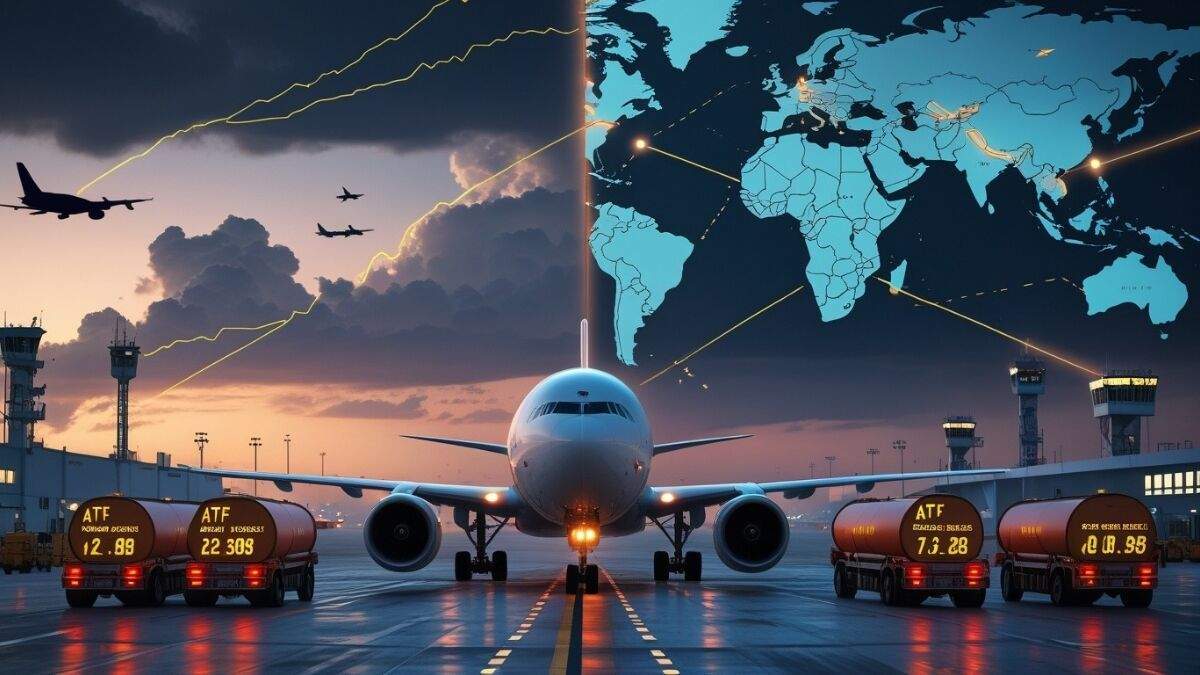
Rising fuel costs and geopolitical disruptions are putting severe pressure on airline finances, prompting government intervention and operational adjustments across the aviation sector.
Fuel price increases and delays to airspace have put a burden on airline finances. As airlines increase surcharges, tax cuts and restricted price increases provide no respite. As airline finances are strained by a spike in worldwide costs and interruptions in West Asia, the Center is looking for state-level jet fuel tax reduction.
Airline Industry Faces Cost Pressure Amid Fuel Surge
According to a senior ministry official, the ministry of civil aviation is in talks with state governments to lower the tax on aviation turbine fuel (ATF), which is now between 1% and 29%. “We are requesting that states reduce their jet fuel taxes. Given the recent increase in fuel prices, it would provide some respite, the official stated.
Fuel accounts for 35–40% of operating expenditures, making it the biggest expense for airlines. Due to the turmoil in West Asia, prices have increased dramatically in recent weeks, increasing carrier expenses.
⛽ Airline Fuel Cost Crisis
- Main Issue: Rising jet fuel prices
- Cost Share: 35–40% of expenses
- Reason: West Asia conflict
- Impact: Higher airline operating cost
- Government Step: Tax reduction request
- Relief Goal: Lower financial burden
Sharp Rise in Fuel Prices
According to figures from the International Air Transport Association (IATA), jet fuel prices increased 117.8% from $95.95 per barrel in late February to $209 per barrel for the week ending April 3. As the war between the US, Israel, and Iran intensified, crude oil prices likewise skyrocketed, going from $67.02 per barrel at the end of February to $115.85 per barrel on April 7.
Taxes increase the burden. Depending on where airlines refuel, there are pricing differences due to state-level taxes and an 11% excise fee imposed by the federal government on ATF. Currently, 31 jurisdictions maintain a value-added tax (VAT) of 1% to 5% on jet fuel, while five governments impose a VAT of 18% or more. High state taxes, according to airlines, influence operating economics.
Government Measures and Tax Challenges
Jet fuel taxes vary by state and have historically been a problem for airlines. In the past, the Center brought it up with state governments, and some of them did considerably lower charges. According to G.S. Bawa, secretary general of the Air Travelers Association, “it does help airlines control a portion of their fuel costs and cut down expenses in the current situation.”
Still, there might not be much respite. Within hours, state-owned Indian Oil Corp. reversed a more than 100% increase in jet fuel costs for domestic airlines earlier this month, bringing the increase down to roughly 8.5% in New Delhi. The partial rise, according to the ministry of petroleum and natural gas, was intended to protect carriers from a shock to gasoline prices in the face of disruptions in the world’s energy markets.
🏛️ Government Relief Measures
- ATF Tax Cut: Requested from states
- Price Cap: 25% increase limit
- Fuel Price Control: Partial rollback
- Goal: Protect airlines
- Focus: Cost stabilization
- Support: Policy coordination
Airlines Passing Costs to Passengers
The action is a component of a larger cost-cutting initiative. Additionally, starting in April, the Center has set a 25% restriction on domestic jet fuel price increases by oil marketing firms. Financial burden has resulted from the approximately twofold increase in international route prices, which are still market-linked.
Meanwhile, airlines have started to pass on increased expenses. Fuel surcharges have been amended by IndiGo and Air India. Starting in April, a distance-based structure will replace the flat price that was implemented in mid-March.
Industry Demands for Additional Support
Additionally, carriers are looking for more assistance. In previous talks with the ministry, airlines asked for more stability in fuel prices, a reduction in route navigation fees, and a waiver of parking fees at airports managed by the Airports Authority of India.
“We are developing important initiatives to assist the aviation sector. Asangba Chuba Ao, Joint Secretary of the government of Civil Aviation, stated at a press conference on Tuesday that “the government is collaborating with other stakeholders.”
Operational Challenges and Flight Disruptions
According to Bawa, airlines’ demands to rationalize expenses like parking and airport fees are opportunistic. “These costs account for no more than 4-5% of their expenses.” However, they are advocating for flexibility on them as well under the current situation, he added.
Additionally, operational pressures are increasing. Nearly 50% of Indian carriers’ capacity on overseas routes is impacted by airspace limitations imposed by many West Asian nations. “There is of course pressure on airlines,” Ao stated. Cancellations have “impacted their (airlines) earnings,” he continued.
Scale of Disruptions
Since February 28, there have been almost 10,000 canceled flights to West Asia, according to Ao. The average number of daily flights (both ways) has drastically decreased from 300–350 to 80–90, highlighting the extent of the disruption.
Frequently Asked Questions
1) What is causing the current strain on airline finances?
In addition to airspace delays that result in cancellations, reduced capacity, and lower revenues, which have a substantial influence on overall financial stability, airlines must contend with rising fuel costs brought on by spikes in global oil prices and the conflict in West Asia.
2) What impact does the tax on aviation turbine fuel (ATF) have on airlines?
State-by-state variations in ATF taxes lead to uneven increases in operating expenses. Despite government efforts to lessen financial hardship, high VAT rates and excise taxes drive up the cost of fuel, distorting airline economics and limiting profitability.
3) How is the government assisting airlines?
In an effort to stabilize airline expenses in the face of unstable global conditions, the Center is pushing states to lower ATF taxes, limiting increases in domestic fuel prices, and thinking about relief measures like lower airport fees.
4) How are airlines reacting to growing expenses?
In order to handle decreased international capacity and continuous interruptions, airlines are raising fuel surcharges, switching to distance-based pricing, and looking for ways to cut airport and navigation fees.
5) What effects have airspace limitations had on airline operations?
Over 10,000 flights have been canceled as a result of West Asia airspace closures, drastically lowering daily flights and impacting over half of international capacity. This has resulted in significant revenue losses and operational difficulties for airlines.
Conclusion
Fuel price spikes and disruptions put a great deal of financial burden on airlines. Even though tax cuts and caps provide some respite, long-term sector stability and profitability are nevertheless under pressure from persistent volatility and operational difficulties.
Disclaimer: This article is for informational purposes only and reflects current developments in the aviation sector.
