
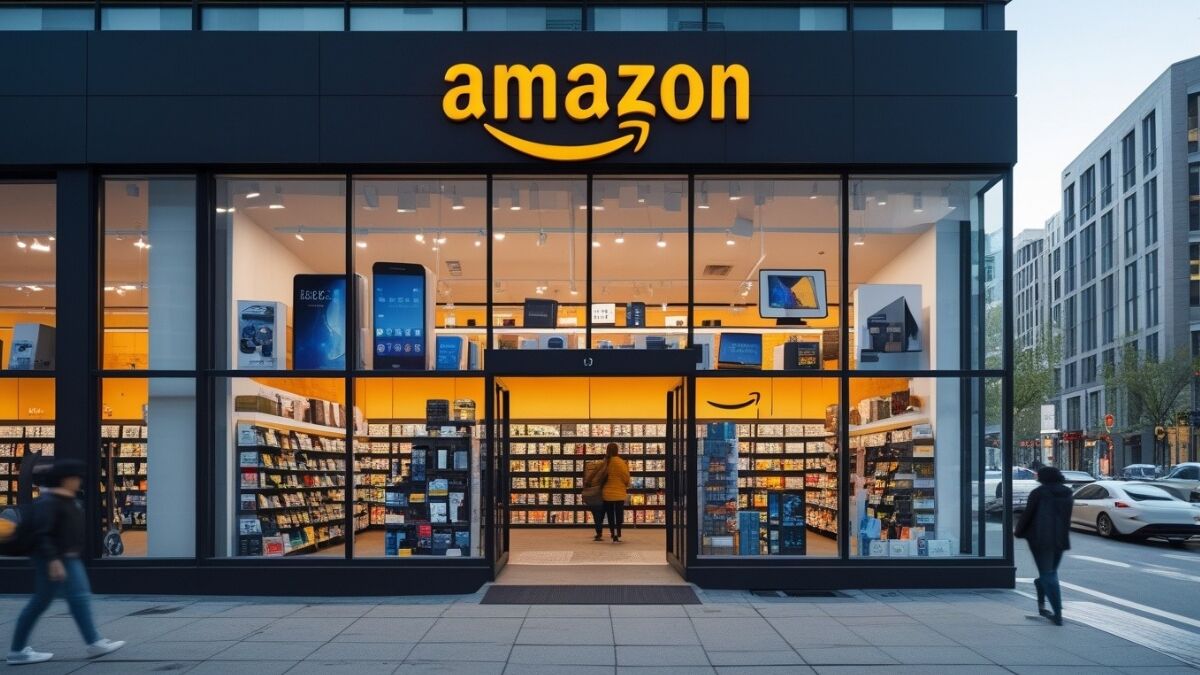
In order to concentrate on growing its same-day food delivery service and expanding its Whole Foods Market operations, Amazon.com is closing dozens of physical Amazon Fresh stores and automated Amazon Go outlets.
Amazon Shifts Strategy Away From Physical Grocery Stores
In a blog post on Tuesday, the online retailer acknowledged that while it has observed “encouraging signals” in its physical grocery stores under the Amazon brand and “gathered valuable insights” about consumer preferences, “we have not yet created a truly distinctive customer experience with the right economic model needed for large-scale expansion.”
As part of its intentions to construct at least 100 Whole Foods Market sites in the coming years, Amazon will transform some of the locations into Whole Foods stores.
🛒 Amazon Grocery Strategy Shift
- Store Closures: Amazon Fresh & Amazon Go outlets
- Core Focus: Same-day online grocery delivery
- Expansion Plan: 100+ new Whole Foods Market stores
- Customer Insight: Physical model lacked scalable economics
- Delivery Growth: 40x rise in perishable same-day orders
Market Reaction and Stock Performance
In early afternoon trade, the S&P 500 was up 0.5%, but Amazon’s stock was up 2% to about $243. The stock has increased by 2.2% in the last 12 months and by roughly 5.5% this year. In afternoon trading, Instacart’s stock was down about 6%, while Walmart’s was down 0.5%.
Walmart, which has 4,000 locations, and Amazon have fought for market share in grocery sales. With over $150 billion in total sales and over 150 million consumers who shop for food annually, Amazon claims to be among the top three grocery retailers in the United States.
Competitive Landscape in the Grocery Sector
According to David Bellinger and other Mizuho analysts, expanding the fulfillment network could help Amazon increase its market share from an estimated 3% in the category to the mid-single digit range over the next two to three years. However, the researchers also point out that Publix had a 4.1% market share of food expenditure, Costco had an 8.4% market share, and retail rival Kroger had an 8.5% market share for the 12 months ending in June 2025.
Amazon’s move on Costco, which serves a different type of customer who makes large purchases, has no effect on Mizuho. According to the researchers, Costco’s warehouse structure is less reliant on online grocery transactions.
⚠️ Amazon vs Walmart Grocery Battle
- Amazon Share: ~3% currently
- Walmart Share: ~20% grocery dominance
- Challenge: 4,000+ Walmart store network
- Amazon Edge: Speed, logistics & same-day delivery
- Analyst View: Bigger disruption needed to close gap
Amazon’s Evolving Retail Model
In a research note, the analysts stated that “we see something greater and more disruptive as essential” for Amazon to actually challenge Walmart’s 20% market share.
Its strategy has already begun to change in several ways. A supercenter concept in suburban Chicago that will sell groceries, household goods, and general merchandise is one of the new retail formats that Amazon is testing. Mizuho stated that Walmart was heavily focused on this notion.
Same-Day Delivery and Technology Expansion
According to Mizuho, Amazon ran roughly 15 Amazon Go sites and 60 Amazon Fresh outlets. According to Mizuho, the increasing emphasis on online-driven delivery “is a big lift and massive structural limitation vs. the 4,000+ Walmart store locations.”
Produce, dairy, meat, baked goods, frozen meals, millions of common household items, electronics, and other Amazon.com products will still be available for purchase, according to Amazon, “all delivered within hours.”
Fresh goods now comprise nine of the top ten most ordered items in regions where perishables are offered for same-day delivery, according to the company, which also said that sales of perishable groceries through its same-day delivery service had increased forty times since January 2025.
Whole Foods and Just Walk Out Technology
Five of the new Whole Foods stores will be smaller-format Whole Foods Market Daily Shops, offering everyday goods, coffee, and cooked meals. After purchasing Whole Foods in 2017, Amazon has grown it to over 550 stores.
Amazon said that the “Just Walk Out” technology it created at its Amazon Go locations—which enables them to focus on an automated grab-and-go format—has been “transformative.” It runs the system in 360 third-party sites, such as sports arenas and hospitals.
In order to “assist employees maximize break time,” it is extending that technology internally to breakrooms at over 40 Amazon fulfillment locations in North America, with more planned for this year.
Frequently asked questions
1. What is the reason behind the closure of Amazon Fresh and Amazon Go stores?
Despite gaining important consumer data, Amazon claims it has not yet discovered a scalable, economical model for its physical grocery stores under the Amazon brand.
2. What does Amazon prioritize above actual grocery stores?
Amazon is increasing its Whole Foods Market footprint in new places and concentrating on same-day online grocery delivery.
3. Will Amazon entirely cease selling groceries in physical stores?
No, certain Amazon Fresh locations will become Whole Foods stores, and in the upcoming years, Amazon intends to open over 100 new Whole Foods locations.
4. What effect does this have on the competitiveness between Costco and Walmart?
Amazon continues to lag behind Walmart’s 20% market share in groceries. According to analysts, Costco’s bulk-buying strategy keeps it mostly untouched, but Amazon’s delivery-first strategy confronts difficulties in comparison to Walmart’s extensive physical retail network.
5. How does Amazon’s plan incorporate same-day delivery?
A key component of Amazon’s strategy is same-day grocery delivery. Since January 2025, same-day delivery sales of perishable products have grown forty times, with fresh goods accounting for the majority of top orders.
Conclusion
Rather than retreating from grocery, Amazon’s move to reduce the number of Amazon Fresh and Amazon Go outlets is a strategic shift. Amazon is placing a wager that convenience, speed, and logistics will dominate food buying in the future by increasing same-day delivery and growing Whole Foods.
Amazon’s strong rise in online grocery delivery indicates that it is carving out a separate path—one that favors digital power over physical expansion—even though it is still difficult to compete head-to-head with Walmart’s enormous store presence.
Disclaimer: This article is for informational purposes only and does not constitute financial, investment, or business advice. Market data and company plans are subject to change.
