
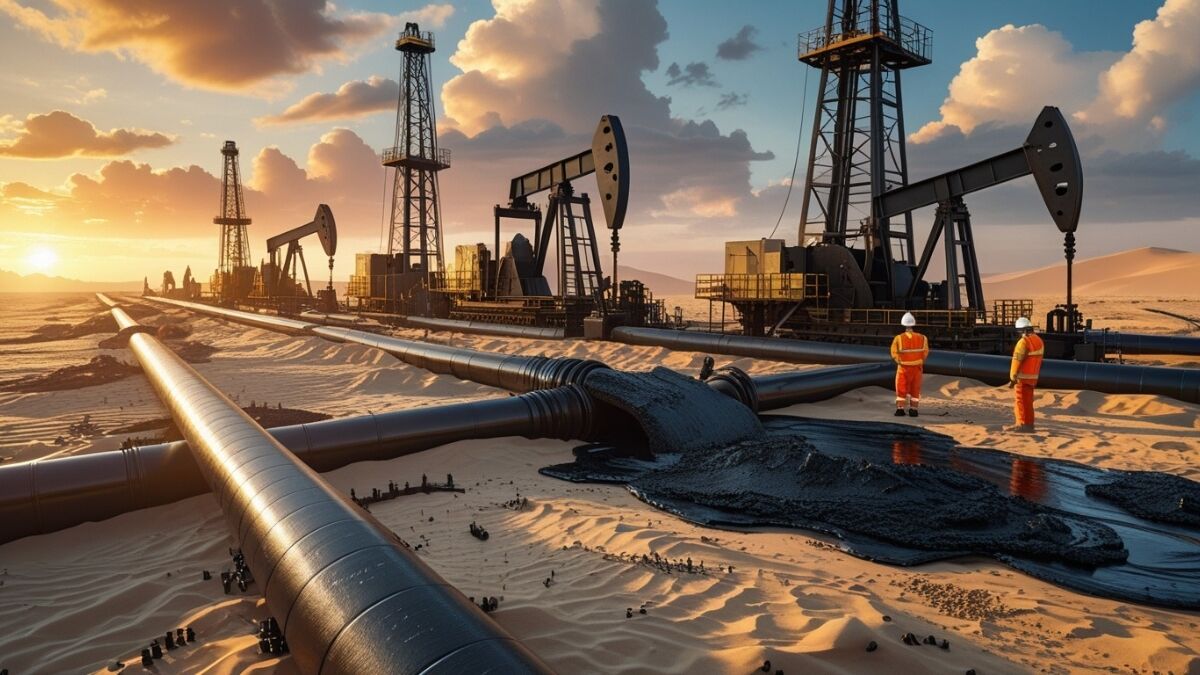
Global crude oil prices have surged sharply, crossing $110 per barrel due to geopolitical tensions. For an import-dependent economy like India, this creates widespread effects across the energy sector, government finances, and consumers.
For the first time in almost three years, Brent crude surged above $110 per barrel on March 9. A chokepoint that transports about one-fifth of the world’s seaborne oil was shut off due to the Iranian dispute. Such a price increase is inconvenient for the majority of large oil-consuming economies.
India’s Oil Dependency and Economic Impact
It is a direct cost impact for India, which imports more than 88% of its petroleum and produces relatively little at home. The trade gap rises by about $243 million annually for every dollar more per barrel. A natural hedge does not exist.
The impact on India’s oil industry is not uniform. It has varying effects on the government budget, midstream pipelines, downstream refiners, and upstream producers.
India’s Domestic Oil Production Reality
India barely produces 28.6 million metric tons of crude domestically annually, which is less than 12% of its total consumption. The import bill increases nearly entirely when prices rise. Some businesses benefit. Most people lose. Refiners suffer greatly from the arithmetic.
The currency exacerbates the situation. On March 8, 2026, the rupee was around Rs 92 to the US dollar, up from Rs 83 in April 2024. Dollars leave India due to high oil prices, while safe-haven flows draw them back.
Rupee Depreciation and Import Costs
Although the Reserve Bank of India interfered in forward and spot markets, the course of events was predetermined. The import bill deteriorates in both currencies when the dollar and crude both move against India at the same time.
A 5% rupee decline affects Indian Oil Corporation Limited’s (IOCL) standalone profit before taxes by Rs 5,725 crore. To manage the upstream windfall, the government has a mechanism. The Special Additional Excise Duty (SAED), a windfall tax on domestic crude production that was first implemented in 2022, is imposed when prices rise.
Windfall Tax and Government Revenue Mechanism
As prices increased, Oil India’s SAED increased from $2.59 per barrel in Q1 FY 2023–2024 to $10.27 per barrel in Q1 FY 2024–2025. Following the repeal of SAED in December 2024, Oil and Natural Gas Corporation (ONGC) claimed a reduction of Rs 1,350 crore in statutory levies in Q2 FY 2025-26. The system introduces earnings volatility for upstream companies while smoothing government income.
The situation is more complicated when it comes to subsidies. Liquefied petroleum gas (LPG), which is mostly used for cooking in India, has regulated rates. IOCL, Bharat Petroleum Corporation Limited (BPCL), and Hindustan Petroleum Corporation Limited (HPCL) sell LPG below cost when crude prices rise and wait for the government to make up the difference.
📊 India Oil Price Impact Snapshot
- Brent Crude: Crossed $110 per barrel
- India Import Dependency: 88% of crude oil
- Trade Deficit Impact: $243 million increase per $1 crude rise
- Rupee Level: Around Rs 92 per US dollar
- Domestic Production: Only 28.6 million metric tons annually
- Main Impact: Higher inflation, subsidy pressure, fiscal stress
LPG Subsidy Pressure on Oil Marketing Companies
After a previous Rs 22,000 crore subsidy against a Rs 28,000 crore negative buffer, the Union Cabinet allocated Rs 30,000 crore in August 2025 to compensate LPG losses. The management of IOCL has seen that the market capitalization of all three OMCs has decreased due to the delayed reimbursement.
better prices directly result in better profits for oil producers, but not all of the benefits reach the bottom line because the government takes a larger cut as prices climb.
ONGC Revenue Sensitivity to Crude Prices
On a stand-alone basis, ONGC’s revenue net of levies is moved by approximately Rs 6,180 crore annually for every $1 change in crude. This is calculated by multiplying approximately 20 million tonnes of standalone crude production (147 million barrels) by the rupee-dollar rate of approximately Rs 92, which covers royalty, cess, oil-linked condensate, and natural liquid gas (NGL) streams that all reprice with crude.
The caveats are real: if SAED is revived, more of the upside is recouped; royalty and cess both climb with crude, so the government’s cut grows at the same time; and the Rs 92 assumption matters—change the exchange rate and the sensitivity number goes with it.
Overseas Investments and Currency Translation Effects
ONGC Videsh contributes a total of Rs 107 crore. The gain is mostly due to a translation effect: when the rupee depreciates, OVL’s $4–5 billion dollar-denominated debt increases significantly.
Price levels have less of an impact on midstream businesses than the behavioral reactions they elicit. Refineries and heavy industries move to less expensive liquid substitutes as gas costs rise in tandem with oil prices, which lowers transmission volumes.
Gas Market Pricing Lag and Transmission Decline
Despite keeping FY26 projection at 134 to 135 MMSCMD, state-owned GAIL, the top natural gas company in India, reported a decrease of 5 MMSCMD in Q4 FY25 transmission volumes as IOCL and BPCL shifted to liquid fuels.
This is made worse by a structural pricing lag: GAIL sources about 10 to 11 MMSCMD of gas on a nine-month average crude-linked basis, but sells it at a three-month average price. This mismatch damages during sharp price swings in either way.
⚠️ Refinery Margin Pressure
- Singapore Complex GRM Peak: $35 per barrel in July 2022
- BPCL Average GRM: Fell from $14.14 to $6.82
- IOCL GRM: $2.95 per barrel in Q3 FY25
- Profit Pressure: Rising crude but slower retail fuel price adjustments
- Major Risk: Inventory volatility and shrinking margins
- Outcome: Refiners face the highest financial pressure
Refining Margins and Crack Spread Dynamics
Downstream businesses are in the most uncomfortable situation. When crude prices increase more quickly than product prices, inventory fluctuates and arrives without request, and marketing margins deteriorate when retail prices fail to keep up with input costs, the gross refining margin contracts.
The regional benchmark, the Singapore Complex GRM, peaked in July 2022 at about $35 per barrel before drastically falling as product cracks returned to normal.
Product Cracks and Supply Disruptions
Crude pricing and refinery margins have a nonlinear relationship. Reliance Industries said that in Q3 FY26, despite a 15% year-over-year decline in Brent to $63.70 per barrel at the time, gasoline cracks increased 106% year-over-year and gasoil cracks increased 62% year-over-year as supply interruptions caused severe regional shortages.
The price difference between a refined product and the crude used to manufacture it is known as the crack spread.
Retail Price Ceiling and Political Economy
There is a cleaner ceiling for marketing margins. According to BPCL management, the region of $65 to $70 a barrel is where margins are still strong, with pressure increasing over $70 to $75.
For gasoline and diesel, a net retention margin of Rs 2.50 to Rs 3.00 per litre is deemed acceptable—but only if retail prices can keep up with input costs, which political economy seldom permits during an inflationary period.
Partial insulation is provided by the hedging programs maintained by IOCL, BPCL, and GAIL through swaps, options, and OTC derivatives. However, hedging lessens variation rather than direction. The hedge protects you when crude moves $40 per barrel against you. It does not undo the effect.
Fiscal Deficit Risk Rising
Financial institutions had previously predicted that the fiscal deficit would decrease from 4.8% of GDP in FY 2024–2025 to 4.4% in FY 2025–2026, while real GDP growth would remain at 6.5% in both years. These estimates used the assumption that oil would be within a reasonable range.
A sustained move of $35 above the $75 threshold at $110 per barrel tests all three figures at once: the GDP growth due to the consumption squeeze that follows retail price pass-through, the fiscal deficit due to accelerating subsidy obligations, and the trade deficit due to import costs, which run at about $243 million per additional dollar per barrel.
Every barrel gains a currency multiplier from the rupee at over Rs 92. India has previously visited this location in 2008, 2012, and 2022. Each time, it was able to do so by combining fiscal account consolidation, increasing subsidies, and keeping retail prices low once oil declined.
Three characteristics of March 2026 were not present simultaneously in previous episodes: the rupee enters this cycle at a structurally weaker level than in previous ones; the price shock is coming from a military conflict with no apparent timeline for resolution; and the LPG subsidy buffer has just been refilled, meaning the government is already spending on that line before prices have been fully absorbed.
Whether India can withstand a $110 oil scenario over time is not the question. It has previously done so. This time, the question is who in the oil chain bears the absorption costs and how much they are.
Frequently Asked Questions
1. Why is the price of crude oil so important to India?
Since India imports more than 88% of its crude oil, rising global prices have a direct impact on the nation’s import bill, trade imbalance, and inflation.
2. Which businesses profit from rising oil prices?
Although taxes limit their benefits, upstream firms like Oil and Natural Gas Corporation and Oil India Limited profit from rising crude sales prices.
3. Why do refiners suffer the most?
Because they frequently can not boost fuel prices right away, refiners like Indian Oil Corporation Limited, Bharat Petroleum Corporation Limited, and Hindustan Petroleum Corporation Limited must purchase pricey crude, which puts pressure on their profit margins.
4. How does the rupee affect the price of oil?
A lower rupee increases the cost of imports because oil is priced in dollars, which amplifies the effect of rising crude prices.
5. How does the government control the high cost of oil?
The government employs a number of instruments, such as:
Fuel subsidies
Producers’ windfall taxes
Modifying excise taxes
permitting or postponing increases in fuel prices.
Conclusion
An increase in the price of crude oil has a cascading effect on India’s energy sector. Currency pressure, refiner profit compression, and increased government subsidy responsibilities follow an increase in the import bill.
In the end, businesses, government funds, and consumers all bear some of the expense. India has already handled similar oil shocks, but the economic balancing act becomes much more challenging when high crude prices coexist with a weak rupee and geopolitical unpredictability.
Disclaimer: This article is for informational and educational purposes only. Economic data and market interpretations may change as new developments emerge.
