
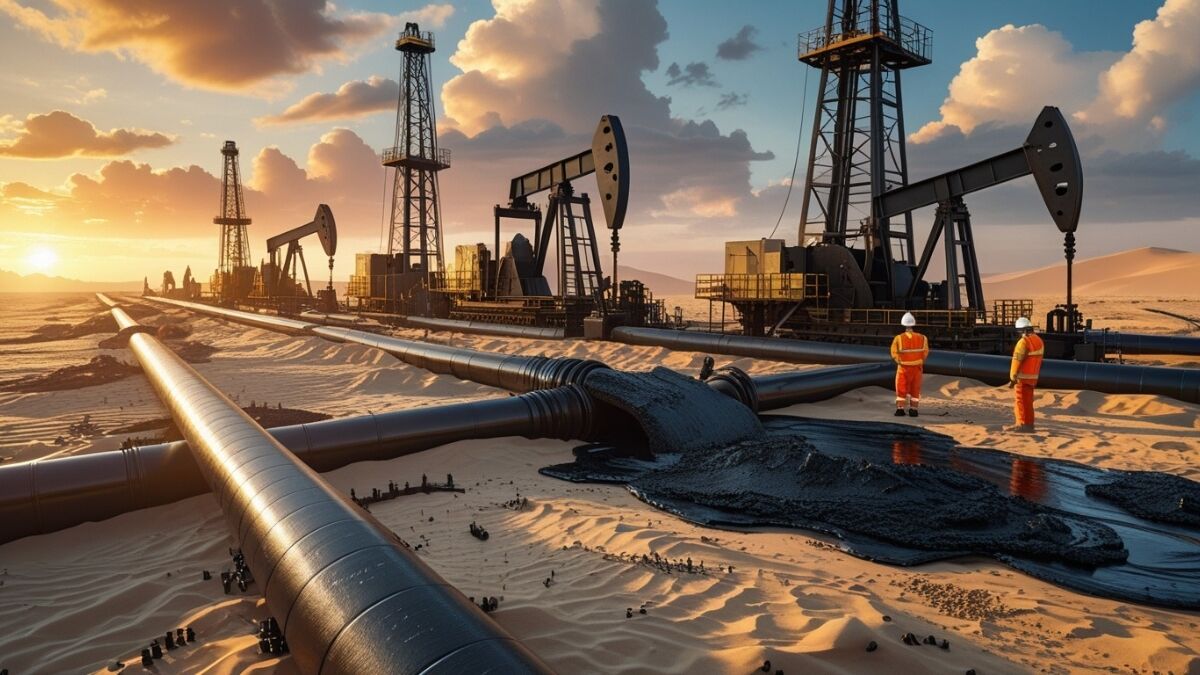
This article explains how Canada is leveraging the global energy crisis to expand its market share, strengthen exports, and attract international investment.
Canada is seizing an unanticipated chance to increase its market share in international energy markets brought about by the conflict in Iran.
Canada Sees Opportunity in Global Energy Crisis
Tim Hodgson, the Canadian Minister of Energy and Natural Resources, stated on Monday that “it has never been clearer that our friends need oil and gas from trustworthy suppliers like Canada with Iran blocking the Strait of Hormuz.”
Canadian government representatives and business leaders surrounded Hodgson as he spoke at S&P Global’s annual oil conference in Houston. The United States receives the great majority of Canada’s energy exports. However, Canada has also started shipping oil and liquefied natural gas to China and other Asian nations in recent years.
🌍 Canada’s Energy Opportunity
- Trigger: Middle East supply disruption
- Advantage: Reliable energy supplier
- Key Markets: Asia & China
- Exports: Oil & LNG growing rapidly
- Focus: Long-term global contracts
Rising Demand from Asian Markets
At the energy conference, Jackie Forrest, executive director of Arc Energy Institute, told Barron’s that there is a “good probability” that Canadian LNG businesses will secure long-term contracts with new clients this year. Regarding the contracts, she stated, “I think they are possible and that gets done, especially in view of the lack of LNG.”
Due to the damage to vital LNG facilities in the Middle East and the effective closure of the Strait of Hormuz, Asian nations that previously relied on the Middle East for the majority of their energy may suddenly be prime customers.
Geographical Advantage and Export Strategy
Canada has a geographical edge when it comes to selling to Asia. American ships are required to navigate the Panama Canals. Without any obstacles, ships leaving Canada’s west coast can go faster to Asia’s east coast.
As part of a nationwide LNG strategy to expand the nation’s export capabilities, Canada began transporting LNG to Asia last summer. It is anticipated that the Canadian industry would be able to export 6.1 billion cubic feet of LNG per day by 2030. By 2040, Canadian Prime Minister Mark Carney wants to double that.
📈 Export Growth Targets
- LNG Target 2030: 6.1 billion cubic feet/day
- Vision 2040: Double capacity
- Pipeline Plan: 1 million barrels/day
- Oil Production 2030: 6–6.1 million barrels/day
- Oil Production 2035: 8 million barrels/day
Pipeline Expansion and Production Growth
Over the past year, Canada has also been attempting to increase its oil exports. However, it will take years to establish the infrastructure required to do that at scale.
The Carney government and Alberta are presently figuring out the specifics needed to start the application process for a pipeline that would transport at least one million barrels of crude per day from Alberta’s oil sands to the west coast for export. We anticipate submitting the application in the summer.
Oil Sands Profitability and Market Performance
At the conference, Brian Jean, the minister of energy and mining for Alberta, stated that Canada is having “excellent negotiations with Asia and different jurisdictions” over financing the pipelines. Canadian oil production and exports will rise if and when they come to pass.
Jean stated, “We are probably going to be around 6 or 6.1 million barrels” in daily oil production by 2030. By 2035, he predicted, production might reach 8 million barrels per day.
The oil sands, an unusual but enormous energy source, provide the majority of Canada’s crude oil. The industry uses steam in an underground process to remove bitumen, or heavy oil, from the sands in order to generate oil.
Businesses that produce from oil sands stand to gain more than their competitors in the current high oil price scenario. According to Michael Berger, senior energy analyst at Enverus, this is due to the comparatively cheap break-even production cost of oil from the sands, which is between $30 and $40 per barrel.
Investor Interest and Global Partnerships
Since the beginning of the conflict, the stocks of Canadian oil sands firms, such as Imperial Oil, Canadian Natural Resources, Cenovus, and Suncor, have increased by more than 12%. Prior to the Iran war, they were already outperforming the S&P Energy Sector, a popular U.S. energy stock index. The Canadian sands businesses have all increased by at least 45%, while the State Street Energy Select SPDR ETF, which is based on that index, has increased by 36% so far this year.
International energy firms expect to gain from early investments in the Canadian energy sector. ConocoPhillips has a significant stake in the oil sands of Canada. Shell is probably going to invest in the next phase of the LNG project, having already invested in Phase I.
Shell CEO Wael Sawan stated during the conference, “It was a long, long-running investment thing that started over a decade ago.” “But, regrettably, the premise of it played to what is currently happening, which is that you need diversity of supply.”
Frequently Asked Questions
1. Why does the crisis benefit Canada?
Canada gains from the increasing need for stable and dependable energy exporters brought about by problems in the Middle East’s oil supply, which presents Canada as a safe option for nations experiencing shortages.
2. What makes Asian nations significant in this context?
In order to guarantee energy security and long-term stability, Asian nations that rely significantly on Middle Eastern energy imports are aggressively looking for new suppliers, such as Canada, due to supply disruptions.
3. What geographic advantage does Canada have?
Canada’s west coast makes it possible to ship directly to Asia without going via clogged canals, which cuts down on travel time and expenses and increases the efficiency and competitiveness of its energy exports internationally.
4. How does Canada want to boost exports?
To move more oil and gas for foreign markets, particularly Asia, Canada is building pipelines from Alberta to the west coast, increasing export capacity, and investing in LNG facilities.
5. Why are oil sands currently profitable?
Oil sands production has relatively low break-even costs, so when global oil prices rise due to supply shortages, Canadian producers generate higher profits compared to many other energy sources.
Conclusion
In order to establish itself as a reliable provider and profit economically from growing demand and changing international energy markets, Canada is taking advantage of global energy disruptions to increase exports, draw investment, and fortify infrastructure.
Disclaimer: This content is for informational purposes only and does not constitute financial or investment advice.
