
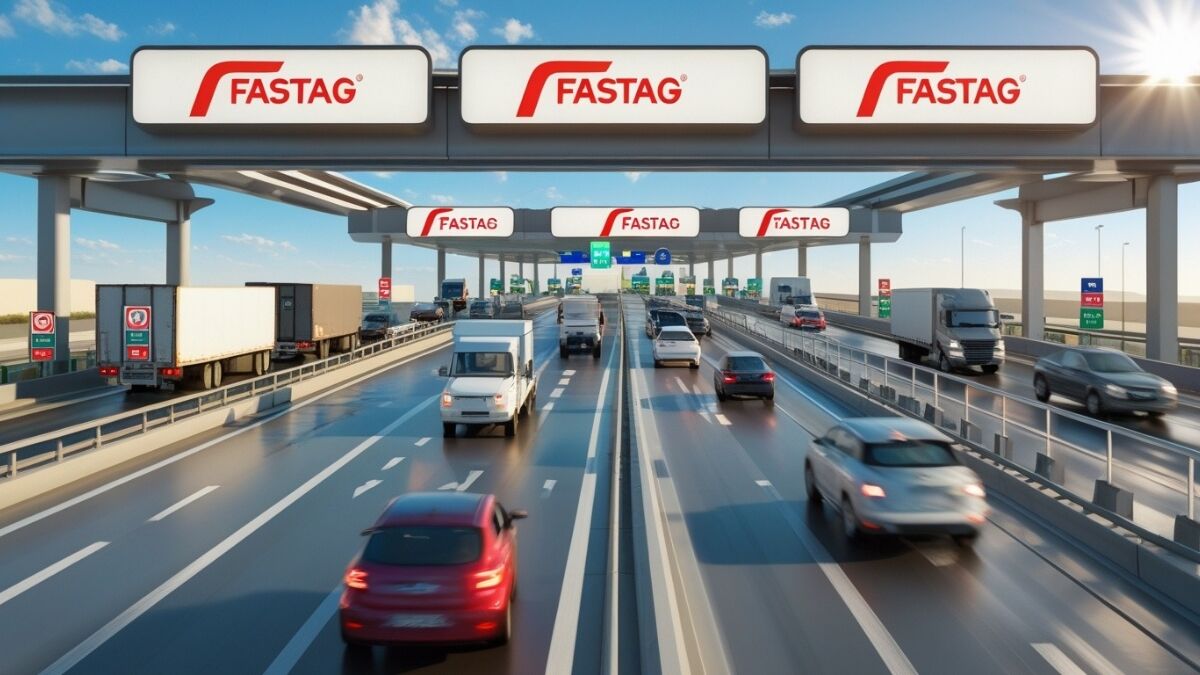
In a landmark move, the National Highways Authority of India (NHAI) called off Know Your Vehicle (KYV) mandatory requirements needed for activation after procurement of FASTag pass. For all FASTag issuance from 1 February 2026, motorists will no longer face ‘inconvenience and delays’ that come with KYV.
NHAI Ends KYV Requirement for FASTag
Previously, banks had to conduct KVY verification for all vehicles that were issued FASTags. The move to overhaul the KYV system involving 40 banks that issue FASTags for cars is a significant step forward “to enhance public convenience and eliminate post-activation harassment faced by highway users,” Ministry of Road Transport and Highways in its 1 January press release said.
🛣️ NHAI Ends KYV for FASTag
- Effective Date: From 1 February 2026
- Old Requirement: Banks had to conduct KYV verification for all FASTag vehicles
- Purpose of KYV: Prevent misuse & revenue leakage at toll plazas
- Existing Vehicles: Class 4 vehicles no longer need mandatory KYV; verification triggered only in case of complaints or mismatches
🔒 NHAI Pre-Activation Safeguards
- VAHAN Validation: Mandatory validation of vehicle details from VAHAN database
- No Post-Activation Checks: Eliminates repeated follow-ups after activation
- RC-Based Validation: Required only if vehicle details unavailable on VAHAN
- Online FASTags: Activated only after full bank validation
Purpose of KYV System
To ensure that FASTags are correctly mapped to vehicle registration numbers, the KYV system was introduced to prevent misuse and revenue leakage at toll plazas. Customers were required to furnish the following details to complete KYV for FASTag activation:
- Registration Certificate (RC) front image.
- Registration Certificate back image.
- Vehicle image from the front, ensuring that windshield and vehicle number is clearly visible
- Vehicle image from any one side, ensuring that the entire vehicle is clearly visible
- FASTag pasted on the windshield and a picture snapped from inside the vehicle.
Changes for Existing Vehicles
Under the revamped system, existing Class 4 vehicles (including car, jeep and van) with FASTags will no longer require mandatory KYV. In case of complaint, loose or duplicate tags, or mismatches between the vehicle number and the FASTag, the KYV verification will be triggered.
NHAI Introduces Pre-Activation Validation Norms
Instead of KVY, NHAI introduced pre-activation validation norms for issuer banks by implementing a VAHAN-based validation of FASTag activation, which is mandatory. This eliminates the need for repeated follow-ups with customers after FASTag activation.
“To ensure accuracy, compliance, and system integrity while simplifying the process for users, NHAI has simultaneously strengthened pre-activation validation norms for Issuer Banks,” the ministry said. The Ministry introduced 4 “Strong Pre-Activation Safeguards” which are listed as follows:
Key Pre-Activation Safeguards
- Mandatory VAHAN-based validation: FASTag will be activated once vehicle details are validated from the VAHAN database.
- No post-activation validation
- RC-based validation only in exceptional cases: Issuer Banks will have to validate details using the Registration Certificate (RC) before FASTag activation if vehicle details are not available on VAHAN database.
- Online FASTags covered: Only after complete validation by banks, FASTags sold through online channels will also be activated.
