
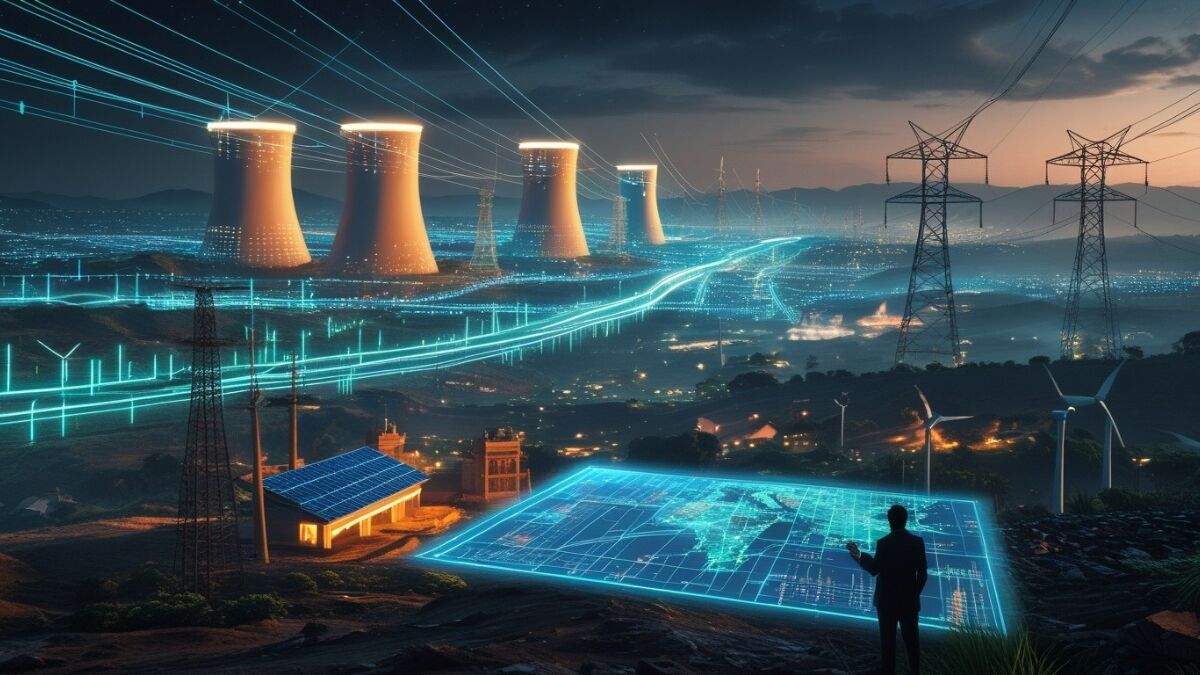
India’s rapid growth in data centers and AI infrastructure is prompting authorities to rethink electricity demand planning to ensure grid stability and uninterrupted power supply.
Concerned that the expansion of concentrated data centers in some areas could distort usage and affect the country’s power supply, the Central Electricity Authority is remapping electricity demand.
India Reassesses Power Demand Amid Data Center Boom
NEW DELHI: Fearing that a concentration of data centers in a few states could distort usage and negatively impact the stability of the country’s grid, India’s top power sector planning authority has gone back to the drawing board to chart electricity demand.
According to two people with knowledge of the developments, the Central Electricity Authority (CEA) will also request that states and power distribution corporations include data center power consumption predictions in their resource adequacy plans. The demand for power is predicted to soar as a result of the data center hubs, drastically altering the host states’ demand profiles and potentially affecting grid stability.
⚡ Data Center Power Impact
- Main Concern: Grid stability
- Cause: Concentrated data centers
- Effect: Rising electricity demand
- Risk: Demand distortion
- Action: Demand remapping
- Goal: Reliable power supply
Planning for Future Electricity Needs
The goal of including data centers’ anticipated electricity consumption in state resource adequacy plans is to guarantee that there is enough capacity for power generation, storage, and transmission to satisfy consumer demand.
By 2030, the government anticipates investing $200 billion in data centers and artificial intelligence infrastructure. Their capacity is expected to increase from roughly 1.2GW in 2025 to 10GW, and their electricity consumption is expected to increase from 10-15 TWh in 2024 to 40-45 TWh by the end of the decade.
Understanding Power Consumption Growth
One trillion watts of power used continuously for an hour is equal to one terawatt hour. A typical LED lightbulb consumes roughly 10 watts.
It is anticipated that Andhra Pradesh, Uttar Pradesh, Maharashtra, Telangana, Karnataka, and Tamil Nadu will develop large data centers. Microsoft, Amazon, Alphabet, the Adani Group, Reliance Industries, the AM Group, Larsen, and Toubro are among the companies that have pledged to invest in India’s AI market. “The CEA is working on demand projections for data centers and will add the requirement for estimation of data center demand in resource adequacy plans,” one of the two individuals stated.
📊 Growth & Investment Outlook
- Investment: $200 Billion by 2030
- Capacity Growth: 1.2GW → 10GW
- Power Demand: 10-15 TWh → 40-45 TWh
- Key States: AP, UP, MH, TS, KA, TN
- Drivers: AI & Data Centers
- Impact: Infrastructure upgrade need
Long-Term Planning and Forecasting
A resource adequacy plan calculates the quantity and kind of energy resources needed to supply power at the lowest feasible cost. The strategy evaluates storage capabilities, reserve margins, costs, and annual power generation capacity from both conventional and renewable sources. The resource adequacy planning guidelines require the exercise to have a rolling horizon of ten years.
Mint sent emails to representatives of the CEA and the power ministry, but they did not reply until the time of publication. India’s current data center load of roughly 1.2GW is expected to rise to 13.6GW by 2032 and 16.4GW by 2040, according to the parliamentary standing committee on energy, which presented its report to the Lok Sabha last month.
Government and Expert Insights
The parliamentary panel was informed by the power ministry that the 21st Electric Power Survey Exercise is being used to determine a rise in electricity demand due to the rapid growth of artificial intelligence (AI), other large-scale data centers, and other developing loads. The National Electricity Plan for the years FY28 to FY37, which is anticipated to be released by March 2027, would take the rise in demand into account, according to the ministry.
Debasish Mishra, chief growth officer at Deloitte South Asia, estimates that data centers or clusters will add to the base load by consuming roughly 2GW of power each day. According to Mishra, they could alter the state’s and the region’s demand profile, which could have an effect on the national grid.
Risks to Grid Stability
Planning is necessary since 2-3GW will have a significant impact on Maharashtra, Andhra Pradesh, and Karnataka. According to him, instances of grid instability brought on by abrupt spikes in demand could result in a grid collapse.
Data center hubs might not significantly affect the nation’s peak demand load, according to Alok Kumar, the former electricity secretary and current director general of the All India Discoms Association.
Balanced Outlook on Growth
According to Kumar, “data center plans and estimates have been highly ambitious across the globe.” Even in large economies, they have not materialized as anticipated. By 2030, a total of 5 to 8 GW of data center capacity might be deployed.
According to Kumar, there might be further reasons to be concerned in developing fields like home space cooling.
Frequently Asked Questions
1. What is the Central Electricity Authority doing?
In order to ensure grid stability and sufficient production, storage, and transmission capacity across states over the next ten years, it is updating power demand predictions to account for increasing data center loads.
2. Why is power planning concerned with data centers?
They use a lot of electricity continuously (baseload), which could distort demand in some regions, put strain on infrastructure, and raise the possibility of localized shortages or grid instability if improperly planned.
3. Which states might be most affected?
Large clusters may be present in states like Andhra Pradesh, Uttar Pradesh, Maharashtra, Telangana, Karnataka, and Tamil Nadu, which would greatly raise their demand for electricity and necessitate massive improvements to their power infrastructure.
4. What is the potential electricity consumption of data centers?
According to estimates, national capacity might reach 10GW or more, and demand could increase from 10–15 TWh in 2024 to 40–45 TWh by 2030.
5. What is a plan for resource adequacy?
It is a long-term planning framework that guarantees an adequate and economical supply of energy, taking into account the generating mix, reserves, storage, and future demand growth, including new industries like AI-driven data centers.
Conclusion
In order to protect grid stability, guarantee dependable supply, and facilitate the quick expansion of digital and AI infrastructure across the country, India’s power planners are recalibrating techniques to manage data center-driven demand growth.
Disclaimer: This article is for informational purposes only and reflects ongoing developments in India’s power and infrastructure sector.
