
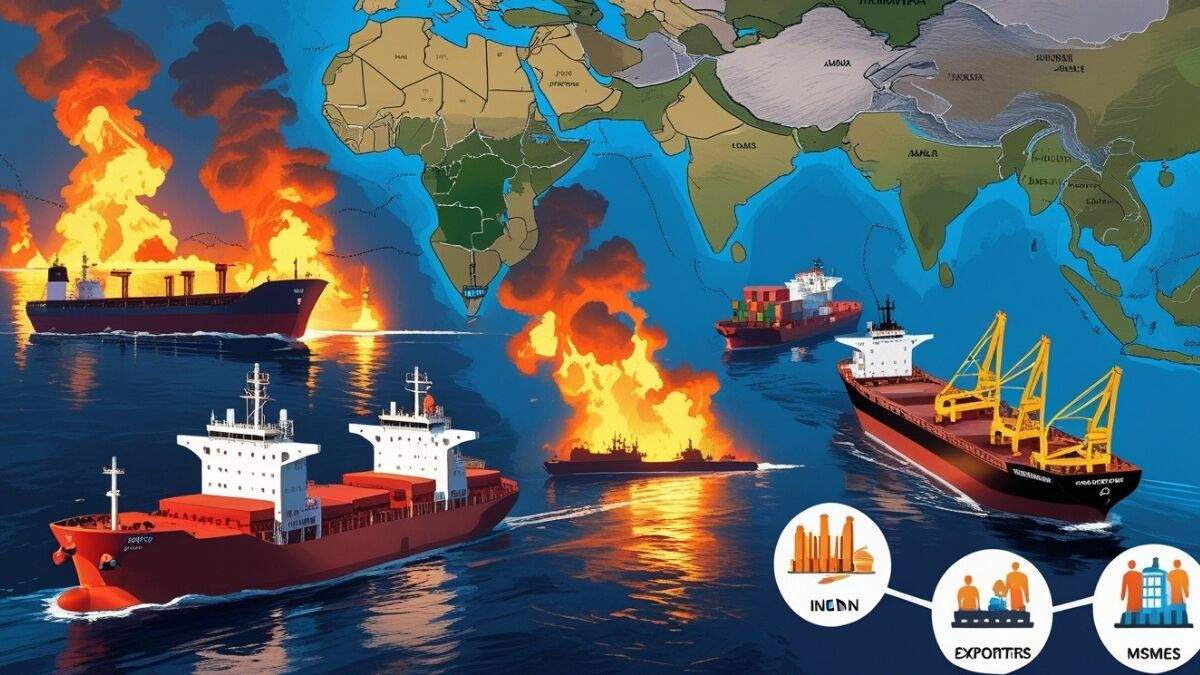
India offered a significant rescue package on Thursday under its Export Promotion Mission, called rescue (resilience & logistics intervention for export facilitation), amid the rising conflict between the United States and Iran and its expanding effects on marine logistics around the Gulf.
India Launches RELIEF Package for Exporters
According to the government, the package would be implemented under the mission with a ₹497 crore cash investment. To facilitate real-time tracking of claims and fund use, the Export Credit Guarantee Corporation of India (ECGC) would continue to operate a dashboard-based monitoring system.
Objective of RELIEF Initiative
The goal of the intervention is to assist Indian exporters who are impacted by the unusual increase in freight, increased insurance costs, and export hazards associated with the US-Israel conflict with Iran over the larger maritime corridor of West Asia. Due to supply chain disruptions brought on by the violence in West Asia, the cost of essential industrial inputs has increased.
The most recent intensification of assaults in the area caused a spike in energy prices on international markets, with benchmarks rising more than 5% on Thursday and the Indian crude basket reaching all-time highs. In order to facilitate careful monitoring and response during this energy crisis, India has also required oil and gas companies to provide ball-by-ball operating parameters.
🇮🇳 RELIEF Package Highlights
- Package Size: ₹497 crore
- Purpose: Support exporters
- Coverage: Up to 100% risk protection
- Future Cover: 95% risk coverage
- MSME Support: 50% cost reimbursement
- Monitoring: ECGC dashboard system
In response to the closing of the vital Strait of Hormuz, which is traversed by around 20% of the world’s energy-laden ships, the government had already implemented a coordinated customs and logistics operation to assist exporters in handling stranded or returning goods.
The official statement states that the three complementary components of the RELIEF intervention cover shipments intended for delivery or transshipment to nations in the region, including the United Arab Emirates (UAE), Saudi Arabia, Kuwait, Israel, Qatar, Oman, Bahrain, Iraq, Iran, and Yemen.
Risk Coverage and Financial Protection
“First, during the eligible period (14 February 2026 to 15 March 2026), exporters who have already obtained ECGC credit insurance cover for eligible consignments will benefit from up to 100% risk coverage, over and above the existing ECGC cover, thereby ensuring enhanced protection without additional financial burden,” the government statement stated.
Additionally, it stated that in order to maintain exporter confidence and enable continuous shipment flows despite logistical uncertainties, exporters planning upcoming consignments during the next three months—16 March to 15 June—will be encouraged to obtain ECGC cover with government support for up to 95% risk coverage over and above the current ECGC cover.
MSME Support and Reimbursement
The RELIEF program offers prompt assistance to exporters who are having difficulties as a result of increased geopolitical concerns in West Asia. Trade flows will continue as long as the government responds to disturbances near the Strait of Hormuz that raise freight prices and insurance rates.
According to Rajeev Juneja, president of the PHD Chamber of Commerce and Industry, “the inclusion of both past and projected exports combined with concentrated assistance for MSMEs indicates a much needed nuanced and balanced governmental response.”
RELIEF includes a partial reimbursement mechanism of up to 50% for eligible non-ECGC-insured MSME exporters, acknowledging that some MSME exporters may not have obtained credit insurance during the 14 February–15 March period but are facing extraordinary freight and insurance surcharge burdens.
The government said, “This assistance is meant to give prompt relief against conflict-related logistics cost escalation and would be granted subject to defined requirements, documentation verification, and announced limits (up to ₹50 lakh per exporter).”
Maritime and Energy Challenges
The government hopes to minimize order cancellations, preserve jobs in export-related industries, maintain exporter trust, and lessen the immediate effects of logistical difficulties via RELIEF. It said that the action strengthens India’s resolve to be resilient and competitive in international commerce amid difficult times.
22 Indian-flagged ships are still stuck on the western side of the Strait of Hormuz, and the nation is under strain due to an energy shortfall.
Shipping and Port Operations
Speaking to the media about the events in West Asia, Rajesh Kumar Sinha, special secretary of the Union Ministry of Ports, Shipping, and Waterways, stated that 22 Indian-flagged ships carrying 611 Indian sailors are stranded in the western Persian Gulf region and that several high-level organizations are working together to keep a close eye on the situation.
“Ports are closely monitoring vessel movements and cargo operations and have created additional storage capacity, including measures at Jawaharlal Nehru Port Authority (JNPA), V.O. Chidambaranar Port (VOCPA), Visakhapatnam Port, and Mundra,” he continued, citing State Maritime Boards in Gujarat, Maharashtra, Goa, Keralam, Andhra Pradesh, and Puducherry as confirmation that India’s maritime industry is still running smoothly.
In addition to exemptions on fees and operational assistance measures, Deendayal Port Authority has increased storage capacity by allocating around 54 acres of land. It has also given port customers a 50% reduction on harbor mobile crane rates, according to Sinha.
Oil Supply and Price Pressure
According to him, the crude oil ship Jag Laadki landed at Mundra Port at 6 a.m. on March 18 and is now unloading cargo, which should be finished on March 19. Meanwhile, another ship carrying Russian crude that was reserved by Mangalore Refinery and Petrochemicals Ltd. is scheduled to arrive in India on March 21.
After new attacks on vital energy infrastructure in West Asia increased concerns of a wider supply shock, crude prices spiked over 6% on Thursday, with Brent reaching a high of $118 per barrel.
Fears of a protracted supply shock have increased as a result of the conflict’s turn toward attacking energy infrastructure, driving up oil prices and putting import-dependent nations like India at danger.
⚠️ India Energy & Trade Impact
- Ships Stuck: 22 vessels
- Sailors: 611 onboard
- Oil Price: Brent near $118
- Risk: Supply disruption
- Ports: Operating with extra capacity
- Inflation: Rising energy costs
“We continue to remain in touch with all concerned countries to ensure that energy security needs are met and our energy supplies have an unimpeded transit,” said Randhir Jaiswal, the ministry of external affairs spokesperson, in response to a question about how the escalation has affected India’s efforts to secure safe passage for Indian-flagged vessels.
The benchmark Brent oil contract for April on the Intercontinental Exchange was trading at $113.03 a barrel at the time of writing, up 5.3% from its previous finish. Since the start of the conflict on February 28, the price of crude oil has fluctuated around the world.
For the first time in four years, prices surpassed $100 a barrel on March 9, peaking at over $119 before declining to about $100. Fresh strikes on Iran’s South Pars gas field and retaliatory attacks on energy assets in Saudi Arabia, Kuwait, and Qatar have recently occurred in the area.
Additionally, the price of the Indian crude basket has reached an all-time high of $146.39 per barrel. The basket contains sweet grade (Brent Dated) and sour grade (Oman & Dubai average) crude oil processed at Indian refineries in a ratio of 78.71:21.29.
Government Monitoring and Market Measures
Sujata Sharma, joint secretary, marketing and oil refinery at the ministry of petroleum and natural gas, stated that the basket’s calculations were “a complex formula” and that “there is pressure (on prices) is there, definitely, but till now, there is no price increase (for petrol and diesel).”
However, earlier this month, oil marketing companies (OMCs) raised the cost of commercial LPG by around ₹115 per cylinder and home LPG by ₹50 per cylinder.
According to a research released on Thursday by Kotak Institutional Equities, OMCs would have to pay more for petroleum, freight, and insurance if they are not allowed to set their own prices. Large price increases for gasoline and diesel are very challenging due to the unfavorable public mood during LPG shortages.
In recent years, OMCs have profited from higher marketing margins. But now, poor profits will undermine the cushion. New capital expenditures for LPG storage are probably in store after the crisis, it said.
The Center has ordered all oil and gas enterprises to provide comprehensive operational data, including information on production, imports, exports, stock levels, and consumption, due to the volatility of the world markets.
According to a notification from the ministry, refiners, LNG importers, pipeline operators, city gas distributors, and petrochemical companies in the public and private sectors must routinely—daily, weekly, or monthly—report granular data to the ministry’s Petroleum Planning and Analysis Cell (PPAC) under the Petroleum and Natural Gas (Furnishing of Information) Order, 2026.
Speaking to the media, Sharma said that the action is intended to provide PPAC with a legal enforcement mechanism for gathering such data, giving it “legal muscle.” As a result, everyone must now provide the information. Even today, PPAC is understanding. However, it will be easier to execute now that it has legal force,” Sharma said.
Frequently Asked Questions
1. What is India’s RELIEF package?
India launched the ₹497 crore RELIEF (Resilience & logistical Intervention for Export Facilitation) package to assist exporters who are experiencing interruptions as a result of logistical problems brought on by conflict, increased freight prices, and insurance concerns in West Asia.
2. Who will gain from this plan?
Risk coverage, reimbursement, and financial protection would be advantageous for Indian exporters, particularly MSMEs, transporting products to nations like Iran, Saudi Arabia, Qatar, and the United Arab Emirates.
3. In what ways does the ECGC assist exporters under RELIEF?
The Export Credit Guarantee Corporation of India helps exporters deal with uncertainty without incurring extra costs by offering up to 100% risk coverage for previous shipments and up to 95% for future consignments.
4. What prompted the introduction of this package?
Disruptions in trade routes such as the Strait of Hormuz led to the introduction of the package, which had a significant influence on Indian export operations and global supply chains by raising insurance premiums, delaying shipments, and increasing freight costs.
5. How can MSME exporters get extra assistance?
In order to alleviate the financial strain brought on by the continuing geopolitical situation, MSME exporters without ECGC insurance are eligible for up to 50% reimbursement for higher freight and insurance expenses, up to a maximum of ₹50 lakh per exporter.
Conclusion
In the face of supply interruptions and geopolitical uncertainties, India’s RELIEF plan offers exporters vital financial protection. The program guarantees trade continuity, boosts resilience, and protects economic stability in the face of persistent global uncertainty by mitigating risks, cutting expenses, and assisting MSMEs.
Disclaimer: This content is for informational purposes only and should not be considered financial or policy advice.
