
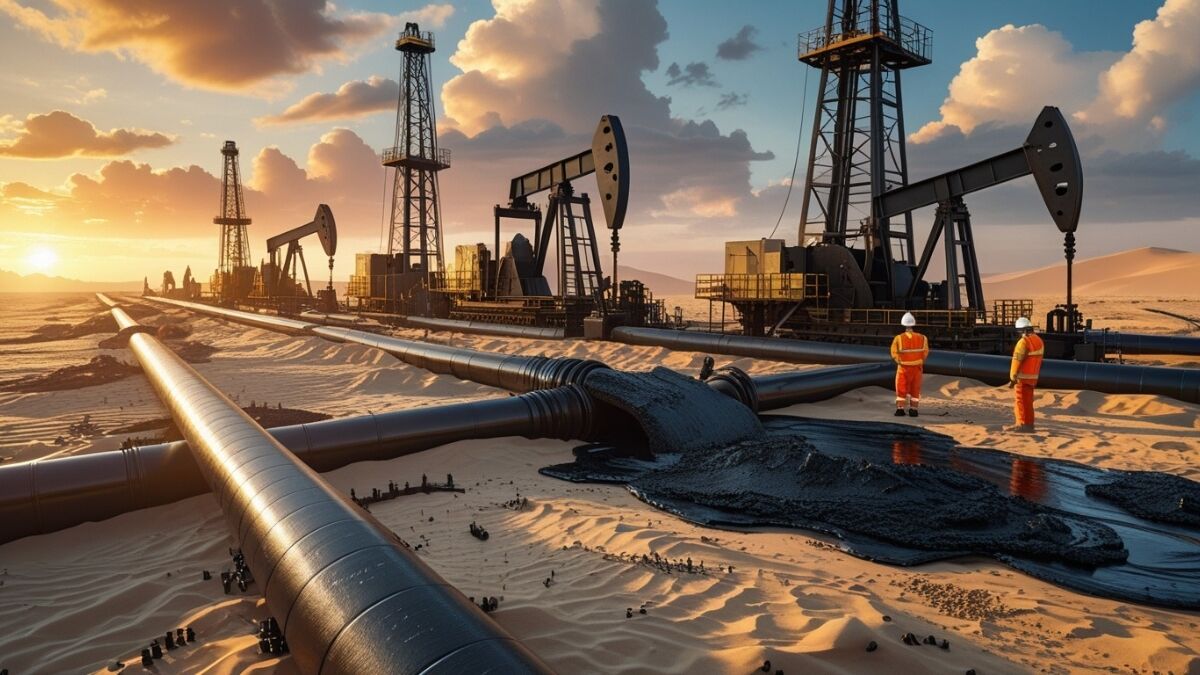
The ongoing Middle East conflict has sent oil prices soaring, shaking global stock markets and raising fears of stagflation. Here’s a detailed look at the market impact, oil supply risks, and expert insights.
Concerns about whether the world economy can sustain rising oil prices, which momentarily reached around $120 per barrel, their highest level since four summers ago, caused stock markets to tremble globally on Monday.
Global Stock Markets React to Rising Oil Prices
Following its lowest week since October, the S&P 500 dropped 1.3%. As of 9:35 am Eastern time, the Nasdaq composite was down 1.2% and the Dow Jones Industrial Average was down 721 points, or 1.5%. That came after stock market losses in Europe and Asia were far more severe.
Since the United States and Israel launched attacks to start the war with Iran, the main concern for financial markets has been how high oil prices will rise and how long they will remain there.
Brent Crude Hits Multi-Year High
The international standard, Brent crude, briefly reached $119.50 per barrel early on Monday. It has not been so costly since the summer following Russia’s invasion of Ukraine in 2022, another armed conflict that also increased the possibility of oil supply obstructions.
Household budgets already strained by rising inflation may collapse if oil costs remain extremely high for an extended period of time. In the meantime, businesses would face an increase in their own fuel and inventory costs for their data warehouses and shop shelves. All of this increases the likelihood of stagflation, the worst-case scenario for the world economy, in which inflation stays high and GDP stagnates.
Oil Prices Correct After Speculation of Global Coordination
Yes, after speculation that some of the biggest economies in the world would coordinate a response to the rising price of oil, oil prices reversed their enormous gains on Monday. The price of a barrel of Brent crude decreased to $101.76, but it is still up 9.8% from Friday.
In contrast, a barrel of benchmark US crude temporarily surged as high as $119.48 before rising 9.6% to $99.59.
US Stock Market Outlook
As long as oil prices do not remain excessively high for an extended period of time, the US stock market has a history of recovering rather rapidly from previous armed engagements, such as Russia’s invasion of Ukraine in 2022. The S&P 500 index, which is the foundation of many 401(k) funds, is still within 5% of its record set in January despite all of the recent market fluctuations.
This has led some expert investors to speculate that stock price declines may eventually present chances to purchase stocks at lower prices before they rise once more.
According to Sameer Samana, head of global equities and real assets at Wells Fargo Investment Institute, “we continue to expect that the current acute scarcity of oil will be reversed in the next months as additional supply comes online and oil should drop dramatically.”
Dependence on the Strait of Hormuz
But all of that depends on the oil flow being back to normal. It is far from that right now. A fifth of the world’s oil passes through the Strait of Hormuz, a small waterway off the coast of Iran, on a daily basis. Tanker trade has now almost ceased due to concerns about a potential Iranian assault.
Macquarie Research’s oil and gas experts predict that if the strait stays closed for just a few weeks, the price of oil might rise to $150 per barrel or more.
In a report, the strategists under the direction of Vikas Dwivedi stated, “We are increasingly confident that without an agreement and a prompt suspension of all kinetic action, We are not trying to forecast how long Hormuz transit would be significantly or totally restricted, but the crude market will start to crack in days rather than weeks or months.”
Industries Facing Immediate Impact
Companies who already have high fuel expenditures are the ones experiencing the most immediate impact on Wall Street. Due to the need to load large cruise ships with fuel, Carnival suffered a 7.3% loss. Old Dominion Freight dropped 3.8%, while United Airlines plummeted 6.9%.
Retailers who needed their clients to have enough money left over after gasoline to spend and who had to ship in goods from a distance also faced difficulties. Williams-Sonoma declined 4% and Best Buy fell 4.4%.
🛢️ Global Oil Price Surge Alert
- Peak Brent Price: $119.50 per barrel
- Key Risk: Strait of Hormuz closure
- Impact: Wall Street losses, higher inflation
- Countries Affected: US, Europe, Asia
- Industries: Airlines, cruise lines, retailers
- Expert Insight: Recovery possible if oil supply normalizes
Stocks declined even further in foreign stock markets, where economies are more reliant on the import of natural gas and oil. The French CAC 40 down 1.7%, Japan’s Nikkei 225 fell 5.2%, and South Korea’s Kospi fell 6%.
Zhai Jun, a Chinese special envoy to the Middle East, called for an end to the attacks and stated that attacks on people and non-military targets should be denounced. Lee Jae Myung, the president of South Korea, issued a warning against hoarding, panic buying, and refiners and gas outlets working together.
Over the weekend, both sides of the conflict attacked fresh targets, including civilians. Bahrain accused Iran of attacking a desalination plant that is essential to the Gulf’s drinking water supply. Following an attack on the nation’s only oil refinery, its national oil company declared a state of force majeure. Israel attacked Tehran’s oil storage, prompting environmental alerts and dense smoke.
⚠️ Global Stock Market & Inflation Warning
- Stock Losses: S&P 500, Nasdaq, Dow, Nikkei, Kospi
- Economic Risk: Stagflation concerns
- Fuel Costs: Increased operational expenses for companies
- Investor Advice: Opportunities may arise for long-term investments
- Policy Watch: Governments monitoring Gulf conflict closely
Late on Sunday, President Donald Trump declared that the current high price of oil is worth the expense. In a message on his social media network, he stated that short-term oil costs, which will quickly decline after the Iran nuclear danger is eliminated, are a very modest price to pay for the United States, the world, safety, and peace.
As of late Friday, the yield on the 10-year Treasury stayed at 4.15 percent in the bond market. Treasury yields are rising due to concerns about high inflation and oil prices. However, concerns over a possible slowdown in the economy are also declining.
Following an unexpectedly poor report on the US labor market that revealed companies eliminated more positions than they created last month, concerns about potential stagflation grew on Friday.
Frequently Asked Questions
1. Why did the world’s stock markets decline?
Due to concerns that rising energy costs could impede the global economy, stock markets fell as oil prices spiked as a result of the war between Iran, Israel, and the United States.
2. How much did the price of oil increase?
For a brief period, the price of Brent Crude Oil hit its highest point since 2022 at almost $119.50 per barrel.
3. What role does the Strait of Hormuz play in this crisis?
About 20% of the world’s oil supply passes through the Strait of Hormuz, and tanker traffic has halted as a result of attacks, endangering the world’s energy supplies.
4. Which stock markets were most impacted?
Asian markets like the Nikkei 225 and Kospi saw even more severe declines than major indices like the S&P 500, Dow Jones Industrial Average, and Nasdaq Composite.
5. Which economic risk worries experts?
Stagflation, a scenario in which economic growth slows but inflation stays high, is something that economists are afraid of.
Conclusion
Growing tensions in the Middle East have caused oil prices to rise, which has caused global markets to decline. Energy prices may increase further if supply interruptions persist, particularly in the Strait of Hormuz, raising the possibility of inflation and weaker global economic growth.
Disclaimer: This article is for informational purposes only and does not constitute financial advice. Market conditions can change rapidly.
