
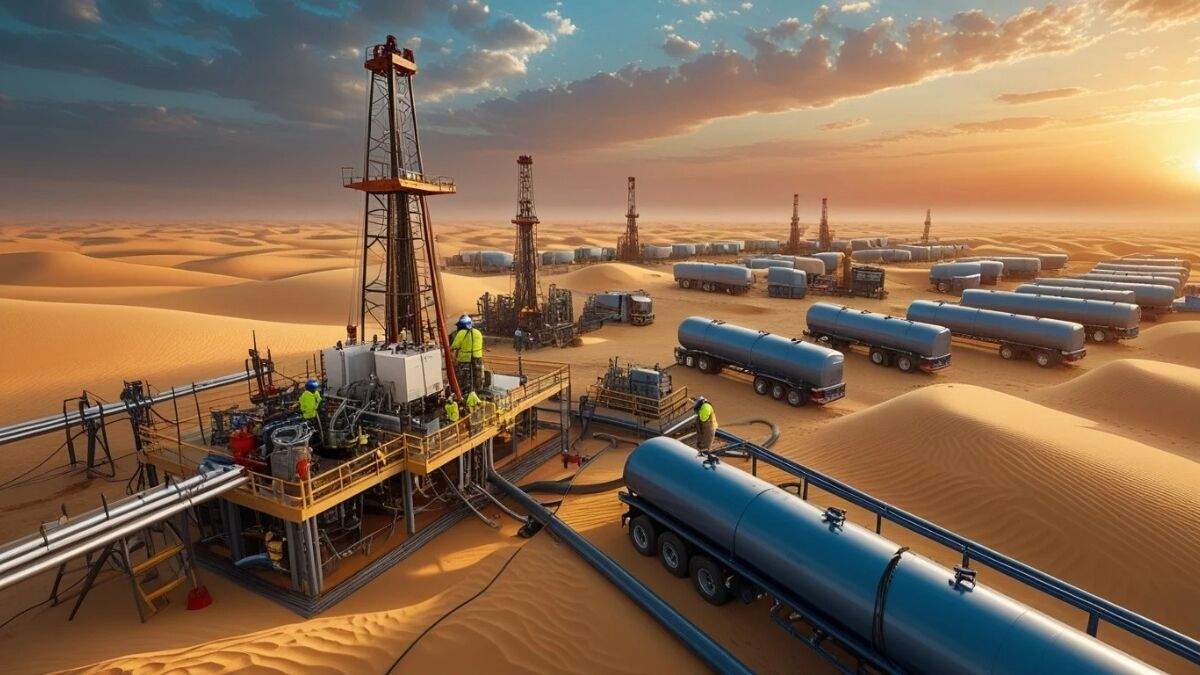
Oil India Ltd.’s breakthrough in Rajasthan highlights India’s push for energy security through advanced extraction technologies and increased domestic production.
Oil India Ltd. has dramatically increased crude production from Rajasthan’s Thar desert amid increased geopolitical tensions and uncertainties in the world’s oil markets, reaching a record output of 1,202 barrels per day from the Jodhpur sandstone formation, according to officials.
Record Crude Production in Rajasthan
Compared to last year’s 705 barrels per day, the state-run enterprise has raised production by around 70%, which is a significant milestone in efforts to ensure energy security and increase domestic output.
According to officials, tankers carry crude oil from the Baghewala field in Jaisalmer to the Oil and Natural Gas Corporation (ONGC) facilities in Mehsana, Gujarat. From there, it is piped to Indian Oil Corporation Ltd.’s (IOCL) Koyali refinery.
Logistics and Supply Chain Management
⛽ Rajasthan Oil Production Surge
- Daily Output: 1,202 barrels/day
- Growth: ~70% YoY increase
- Location: Thar Desert, Rajasthan
- Field: Baghewala oil field
- Transport: Tankers + pipelines
- Goal: Boost energy security
Oil India’s Rajasthan field produced 43,773 metric tonnes of crude oil annually in the fiscal year 2025–2026, up from 32,787 metric tonnes the year before. This significant growth was fueled by advances in technology and effective operations.
According to company representatives, the adoption of cutting-edge recovery methods, such as Cyclic Steam Stimulation (CSS), a thermal enhanced oil recovery process used to extract high-viscosity crude, is largely responsible for the success.
Advanced Extraction Technologies Driving Growth
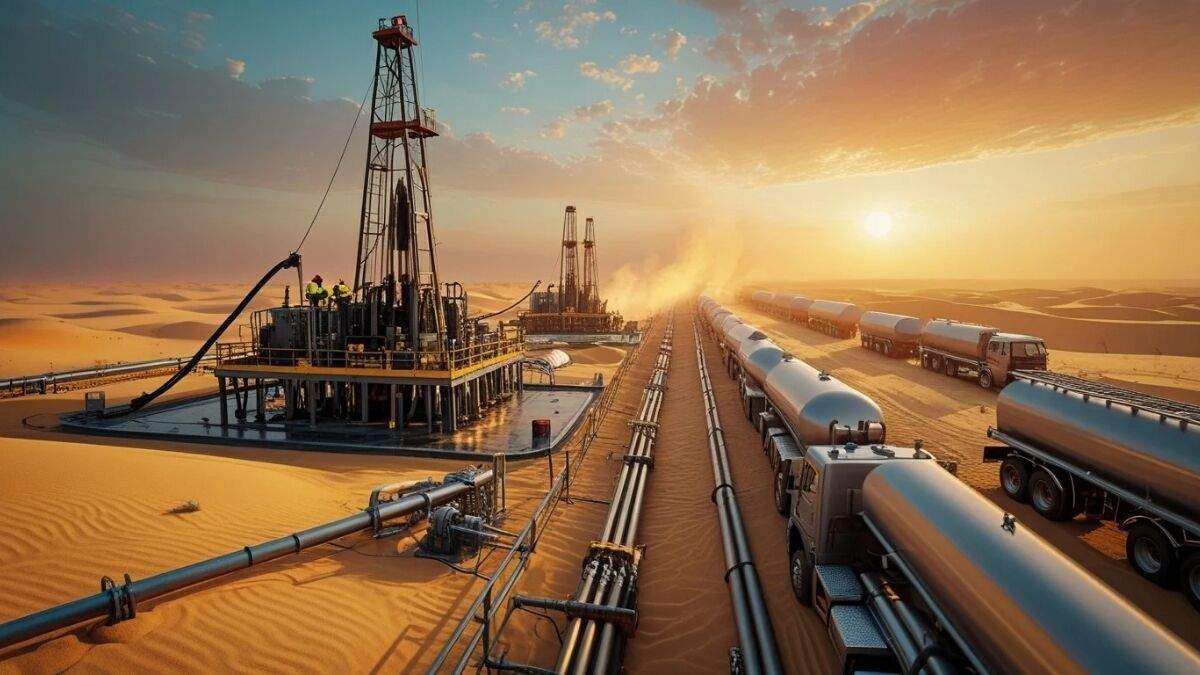
Considering the difficult geological conditions of the Thar region, this is a noteworthy accomplishment. It highlights how unconventional resources might help meet India’s energy needs,” an official stated.
One of India’s few onshore heavy oil fields is the Baghewala oil field, which is situated in the Bikaner-Nagaur sub-basin of the Rajasthan basin. Oil India dug 13 new wells this year, up from nine previously, and completed CSS operations in 19 wells, a 72% increase over the previous year.
Innovations in Heavy Oil Recovery
⚙️ Oil Extraction Innovations
- Key Tech: Cyclic Steam Stimulation (CSS)
- New Wells: 13 drilled this year
- CSS Ops: 19 wells completed
- Tools: Electric heaters & rod pumps
- Techniques: Fishbone drilling, barefoot completion
- Benefit: Efficient heavy oil extraction
In order to increase production efficiency, the company has also implemented cutting-edge drilling and production technologies like electric downhole heaters, hydraulic sucker rod pumps, high-temperature thermal wellheads, and fishbone drilling and barefoot completion, which are being used for the first time in India’s heavy oil reserves.
According to officials, the region’s high crude viscosity made traditional extraction techniques impractical, which led to the use of cutting-edge strategies including diluent injection and artificial lift systems.
Overcoming Geological Challenges
Since 2017, Oil India has started using the Baghewala field to produce heavy crude. The field was found in 1991 and has since grown to 200.52 wells, 33 of which are operating, cover an area of 26 square kilometers.
Large-scale extraction and new standards for thermal enhanced oil recovery in India have been made possible by the effective deployment of CSS technology, which was first tested in 2018.
Boost to India’s Energy Security
According to officials, the accomplishment will significantly lessen India’s reliance on imported crude and improve the country’s long-term energy resiliency.
Frequently Asked Questions
1) What significant accomplishment did Oil India Ltd. make in Rajasthan?
In the Thar desert of Rajasthan, Oil India Ltd. produced a record 1,202 barrels of crude oil per day, a 70% increase above output levels from the previous year.
2. What is the location of the Baghewala oil field?
One of India’s rare onshore heavy oil reserves with difficult extraction circumstances is the Baghewala oil field, which is located in Jaisalmer inside the Bikaner-Nagaur basin of Rajasthan.
3. After extraction, how is the crude oil transported?
Tankers carry extracted crude to Oil and Natural Gas Corporation facilities in Mehsana. From there, it travels by pipeline to the refinery of Indian Oil Corporation Ltd. in Koyali for processing.
4. What technology greatly increased output?
With the help of advances like fishbone drilling, artificial lift systems, and electric downhole heaters, Cyclic Steam Stimulation, a thermal enhanced oil recovery technique, greatly increased the extraction of high-viscosity crude.
5. What makes this accomplishment significant for India?
By lowering reliance on imported crude oil, this output boost enhances India’s energy security and demonstrates the potential of unconventional resources and cutting-edge technologies to fulfill rising local energy demands.
Conclusion
In the face of unstable global oil markets, Oil India’s Rajasthan success demonstrates how creativity and cutting-edge recovery techniques can unlock challenging reserves, increase local output, and improve India’s long-term energy security.
Disclaimer: This content is for informational purposes only and does not constitute financial, industrial, or investment advice.
