
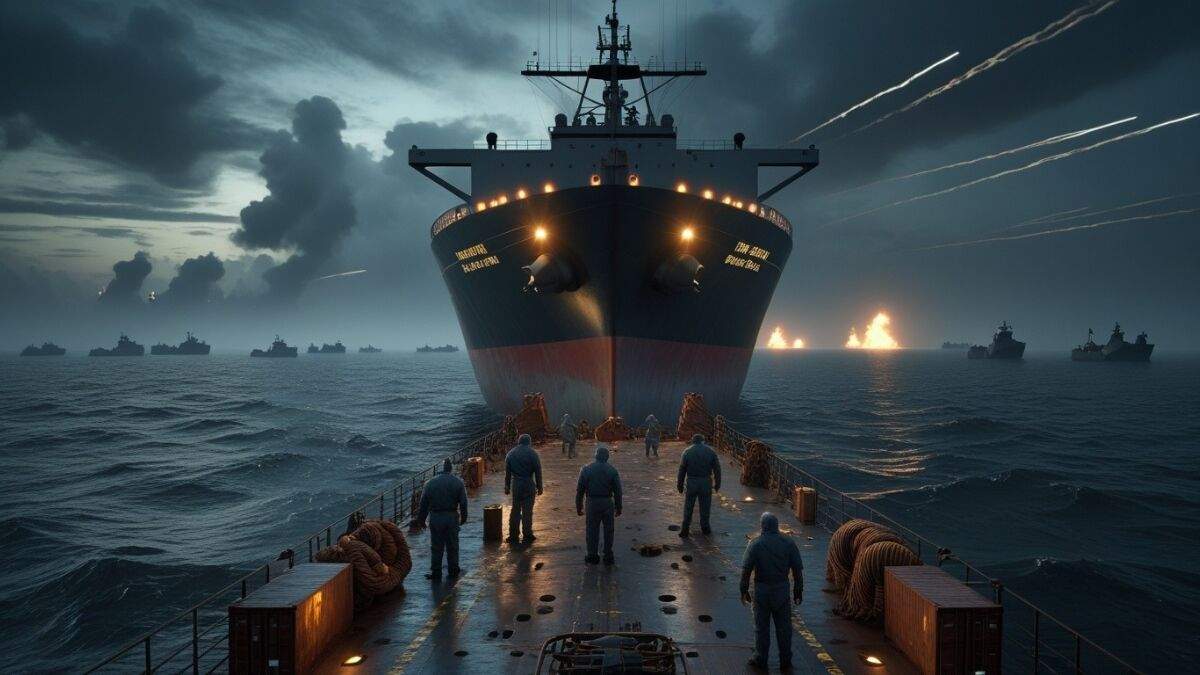
The ongoing conflict in the Persian Gulf has not only disrupted global oil supply but also exposed the harsh realities faced by seafarers stranded at sea. This report highlights the human cost behind the crisis.
Rakesh Ranjan Singh, the 47-year-old captain of the oil tanker ASP Avana, passed away on the 19th day that it was stranded in the Persian Gulf.
Tragic Death Highlights Human Cost of Oil Crisis
Singh had sailed to the Persian Gulf to fill crude after boarding the ship in early February. However, when Israeli and American forces attacked Iran on February 28, his trip back to Asia came to an abrupt end. His ship was stranded off the coast of Dubai because no ships were permitted to traverse the Strait of Hormuz due to the possibility of an assault.
On March 18, Elegant Marine Services, the tanker’s operating firm, informed Singh’s family that the skipper had experienced a medical emergency. According to Alok Singh, the late captain’s brother-in-law, crew members attempted to administer first aid to him but were unsuccessful. The skipper was transported to the Rashid Hospital in Dubai by speed boat when air ambulances were not permitted to fly in to assist. It was too late by then.
Medical Emergency and Delayed Rescue
⚠️ Crisis at Sea Snapshot
- Ships Stranded: 2,000+
- Seafarers Affected: 20,000+
- Main Blockage: Strait of Hormuz
- Duration: Over 1 month
- Key Issue: Security threats
- Impact: Supply chain disruption
They informed the brother-in-law that cardiac arrest was the cause of death. When asked for comments, Elegant Marine Services did not reply. The International Maritime Organization reports that there are about 2,000 ships with over 20,000 seamen stranded in the Persian Gulf. Because fewer than 200 ships have been able to pass through the Strait of Hormuz, the majority have been stranded on board for more than a month.
During normal times, vital supplies of natural gas, fertilizer, and other cargo shipments, as well as 20% of the world’s oil, travel through the narrow river to reach international markets. When the crucial shipping waterway will return to normal is unknown.
Survival Struggles of Stranded Crew
Many ships are running low on freshwater and fresh veggies, so sailors are sharing survival strategies and advice via social media and extremely high-frequency marine radios. A few Chinese crew workers have recorded themselves gathering condensate from air conditioners in order to take showers and do laundry. Some have started fishing over the side of their tankers, catching largehead hairtail, squid, and tuna to cook.
Supply replenishment has grown challenging and costly. Attacks have frequently occurred near the United Arab Emirates’ Port of Fujairah, where ships typically seek refuge. Businesses that provide ships with fresh food are raising their prices. According to screenshots of supply price lists seen by The Wall Street Journal, the market rate for mangos is currently $31 per kilogram, or approximately 2.2 pounds, while oranges are $15 per kilogram, or nearly three enormous pieces of fruit.
Rising Costs and Crew Hardships
🚢 Seafarers Crisis Impact
- Food Prices: Mango $31/kg, Orange $15/kg
- Main Issue: Supply shortages
- Work Duration: Up to 10 months at sea
- Salary Boost: Double pay offers
- Captain Pay: Up to $26,000/month
- Risk Level: Wartime hazard
Due to the continued scarcity and high cost of flights to key crew-change sites, such as Dubai, it is still difficult to fly in crews and switch them out.
Since the beginning of the crisis, crew along the strait have contacted the London-based International Transport Workers’ Federation, a labor union that represents a million seafarers, with approximately 1,000 requests for assistance. 200 seamen requested assistance leaving a ship to return home, and an increasing number of reports state that ships are running out of food. Pay and other contractual rights while in the conflict zone have been the subject of more than half of the calls.
Safety Risks and Rescue Challenges
We find it incomprehensible that certain shipowners continue to expose seamen by bringing their vessels there. Mohamed Arrachedi, who manages requests for the federation from mariners in Iran and the Arab countries, said, “It is completely inappropriate.” “When they request it, seafarers should be able to return home. They have no desire to be heroes.
While most commercial sailors spend six months at sea annually, certain Chinese and Southeast Asian seafarers may spend up to ten months at sea without a respite. Cargo prices have increased due to the war, and shipowners are eager to give seamen who are willing to travel to the Gulf significant rises.
War Risks and Rising Incentives
According to employment ads, crew staffing agencies in China sometimes offer double salary. A voyage across the Strait of Hormuz can currently earn a captain almost $26,000 per month. Depending on the ship management business and the seniority level of the crew member, pay varies significantly.
On a commerce ship, a boatswain can make up to $5,200 per month managing equipment such as cables and ropes and supervising the seamen on deck. According to a number of sailors, wartime hazard pay is necessary since the risks are genuine.
Attacks and Maritime Incidents
On March 2, crew members on ships anchored close to the Marshall Islands-flagged oil tanker MKD Vyom overheard the commander of the tanker and an Omani navy ship having a heated argument over the marine VHF radio. In a recording provided to the Journal, the skipper stated, “Missile attack. Starboard side.” “There was an explosion in the engine room.”
A junior seafarer was killed when the ship, which was headed for a port in Saudi Arabia, was hit by a remote-controlled boat approximately 50 miles off the coast of Muscat, Oman, according to the recording. The ship was carrying 59,463 metric tons of fuel.
A another ship saved the crew members who had deserted the ship. The captain stated on the tape that there were no additional firefighter uniforms, thus the deceased crew member’s body was left in the engine room. The operator of the ship was unavailable for comment. Two more commercial ships were struck that same day. Lloyd’s List Intelligence data indicates that at least ten were hit that week.
Fear and Uncertainty at Sea
A 30-year-old Chinese sailor on a ship awaiting entry into the Persian Gulf recounts witnessing drones and missiles flying overhead both during the day and at night. According to many sailors and Navtex communications viewed by the Journal, Navtex messages—a type of automated, short-range maritime-safety text broadcasts sent directly to ships—communicate which vessels have been attacked or sunk.
One 32-year-old Chinese seafarer claims that Iran’s Islamic Revolutionary Guard Corps often uses marine VHF to warn ships not to enter the strait. The ship is carrying liquefied natural gas and has been stalled 25 nautical miles northwest of Dubai for weeks.
He claimed that a few days ago, at around 5:40 a.m., he was startled awake by a tremendous blast and that thick smoke was rising from a neighboring ship. Naturally, I am afraid, but I am afraid to tell my family. I simply let them know everything is fine,” he remarked.
Escape Attempts and Risky Journeys
The seafarer claimed that despite the LNG shipowner’s repeated requests for the crew to cross the strait, the captain and other crew members had all refused. He stated that the crew will only move forward if they receive two distinct signals: the Iranian navy must clearly declare over VHF radio that regular trade in the strait has resumed, and the United States must seize control of two crucial islands close to Iran.
After being stranded for three weeks, a 48-year-old Chinese laborer on a ship transporting Iranian commodities to China reported sneaking across the strait in late March. To obtain a safety code, the ship had to get in touch with Iranian agents, cruise to a predetermined spot close to Iran’s Larak Island, and present the code to the Revolutionary Guard, who would then permit the ship to pass. It is currently en route to China.
He said, “The shipowner also gave us a war zone allowance, and we only started loading after the entire crew voted in favor of it.”
Frequently Asked Questions
1. Rakesh Ranjan Singh was who?
47-year-old tanker skipper Rakesh Ranjan Singh passed away following a medical emergency while stuck in the Persian Gulf amid a worsening regional war.
2. What caused the ships to become stuck in the area?
Military tensions prevented ships from passing safely through the Strait of Hormuz, a vital international oil transit route that is under risk of attack.
3. What difficulties do stranded seafarers encounter?
Seafarers must use survival techniques including fishing and rationing aboard resources due to food and freshwater limitations, high supply prices, safety hazards, and few evacuation choices.
4. What impact has the crisis had on international shipping?
The disruption affected the distribution of oil, gas, and key commodities, decreased vessel movement, and raised freight prices, all of which had an influence on global trade markets.
5. What is the function of the International Transport Workers’ Federation?
In addition to responding to distress calls, the International Transport Workers’ Federation promotes safety, equitable compensation, and crew changes during emergencies.
Conclusion
The problem draws attention to the human and financial costs of war, highlighting the vulnerability of seafarers, the disruption of trade, and the pressing need for stronger international cooperation and tighter marine regulations to safeguard international shipping lanes.
Disclaimer: This content is for informational purposes only and does not constitute professional advice.
