
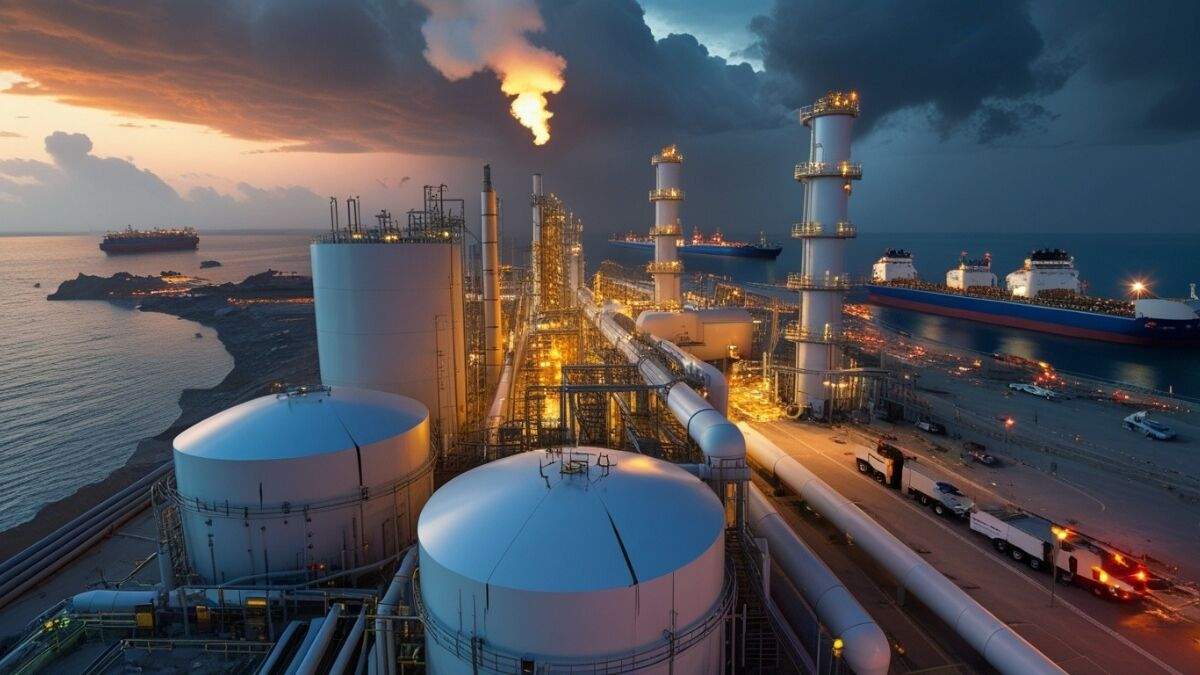
This article highlights the massive impact of recent attacks on Qatar’s LNG infrastructure, affecting global energy supply, major economies, and long-term LNG market stability.
The CEO of QatarEnergy and the state minister for energy affairs told Reuters on Thursday that Iranian strikes had destroyed 17% of Qatar’s LNG export capacity, resulting in an estimated $20 billion in lost yearly income and endangering supply to Europe and Asia.
Qatar LNG Infrastructure Hit by Major Attacks
According to Saad al-Kaabi, the unprecedented attacks caused damage to one of Qatar’s two gas-to-liquids (GTL) facilities and two of its fourteen LNG trains. In an interview, he said that the repairs would prevent the production of 12.8 million tons of LNG annually for three to five years.
🔥 Qatar LNG Damage Overview
- Capacity Loss: 17% LNG export capacity
- Annual Impact: $20 billion loss
- Damaged Units: 2 LNG trains + 1 GTL plant
- Production Loss: 12.8 million tons/year
- Repair Time: 3–5 years
- Global Impact: Europe & Asia supply risk
“I never would have imagined that Qatar and the region would be under such an onslaught, particularly from a brotherly Muslim nation in the month of Ramadan, hitting us in this fashion,” Kaabi said.
Escalating Regional Conflict
After Israeli assaults on its own gas infrastructure, Iran launched a series of attacks against Gulf oil and gas installations hours earlier.
Due to the two damaged trains, state-owned QatarEnergy will have to declare force majeure on long-term contracts for up to five years for LNG supplies headed for China, South Korea, Italy, and Belgium, according to Kaabi.
Force Majeure and Supply Disruptions
We must declare force majeure since these are long-term commitments. Although it was a shorter time, we had already made a declaration. He said, “Now it is whatever the era is.”
Following previous assaults on its Ras Laffan production facility, which came under fire once again on Wednesday, QatarEnergy announced force majeure on all of its LNG output.
🌍 Global LNG Supply Impact
- Affected Countries: China, South Korea, Italy, Belgium
- Contract Impact: Long-term LNG supply disruption
- Major Companies: Shell & ExxonMobil involved
- Other Products Hit: LPG, helium, condensate
- Industrial Impact: Chipmakers & energy sectors affected
- Market Effect: Rising global energy prices
Shell is a partner in the damaged GTL complex, which might take up to a year to repair, while US oil giant ExxonMobil is a partner in the damaged LNG facilities. According to Kaabi, ExxonMobil, a Texas-based company, owns 34% of LNG train S4 and 30% of train S6.
Train S6 affects South Korea’s KOGAS, EDFT, and Shell in China, while Train S4 affects supply to Italy’s Edison and EDFT in Belgium. According to him, the area has regressed 10 to 20 years due to the extent of the assaults’ destruction. Naturally, many individuals use this as a safe haven to have a secure location to stay, among other things. And I believe that perception has changed.
Industrial and Corporate Impact
The consequences go well beyond LNG. Condensate and liquefied petroleum gas (LPG) shipments from Qatar would decline by around 24% and 13%, respectively. Naphtha and sulfur production will both decrease by 6%, while helium output will decrease by 14%.
These losses affect everything from the usage of LPG in Indian eateries to the use of helium by South Korean chipmakers. According to Kaabi, the construction of the damaged units cost around $26 billion. According to him, there is now no work being done on Qatar’s enormous North Field extension project, which might be delayed for over a year.
Wider Economic Consequences
“It is between Iran and Israel if Israel attacks Iran. He said, “It has nothing to do with us or the area.” “And now, in addition to that, I am suggesting that everyone in the globe should avoid oil and gas facilities, whether they are in the US, Israel, or any other nation.”
At 295 square kilometers, the Ras Laffan Industrial City is almost one-third the size of New York City. It also has various gas-related facilities, such as an oil refinery, condensate splitting units, LNG storage facilities, and a gas-to-liquids facility, in addition to LNG processing.
Global LNG Supply Significance
According to ship-tracking data gathered by Bloomberg, the Ras Laffan LNG project contributed almost 19% of the world’s LNG shipments in 2025.
Additionally, according to statistics from the Energy Institute, its exports accounted for more than a quarter of all gas consumption in Taiwan, Pakistan, and India.
Frequently Asked Questions
1. Which Ras Laffan Industrial City facilities sustained damage?
Production capacity was drastically reduced when two LNG trains and one gas-to-liquids plant were damaged. Since these facilities are essential for the processing and export of liquefied natural gas, their destruction would seriously disrupt long-term supply agreements and the world’s energy markets.
2. To what extent has Qatar lost LNG capacity?
Approximately 12.8 million tons per year, or 17% of the entire LNG export capacity, has been eliminated. Energy-importing countries in Europe and Asia may experience a protracted supply shortage if repairs take three to five years.
3. Which nations are most impacted by interruptions in supply?
There are shortages in major importers including China, South Korea, Belgium, and Italy. These countries are largely dependent on long-term LNG contracts, which are now under force majeure, which might result in increases in energy prices and unpredictability in supply.
4. Which businesses are working on the affected projects?
Partners in the impacted facilities include multinational energy companies like Shell and ExxonMobil. Their activities and investments in Qatar’s LNG infrastructure will result in operational interruptions and financial losses that go beyond the area.
5. How may this affect the economy more broadly?
In addition to LNG, decreased production of condensate, helium, and LPG has an impact on global industry. Fuel prices may rise in nations like India, and Asian manufacturing sectors may experience shortages of vital industrial gases and petrochemical feedstocks.
Conclusion
The assaults on Qatar’s energy infrastructure underscore supply chains’ geopolitical dangers and cause a significant disruption to the world’s LNG markets. Long-term effects on global producers and consumers will result from prolonged outages that will strain economies, increase energy costs, and change global energy dependence.
Disclaimer: This content is for informational purposes only and reflects reported developments in global energy markets.