
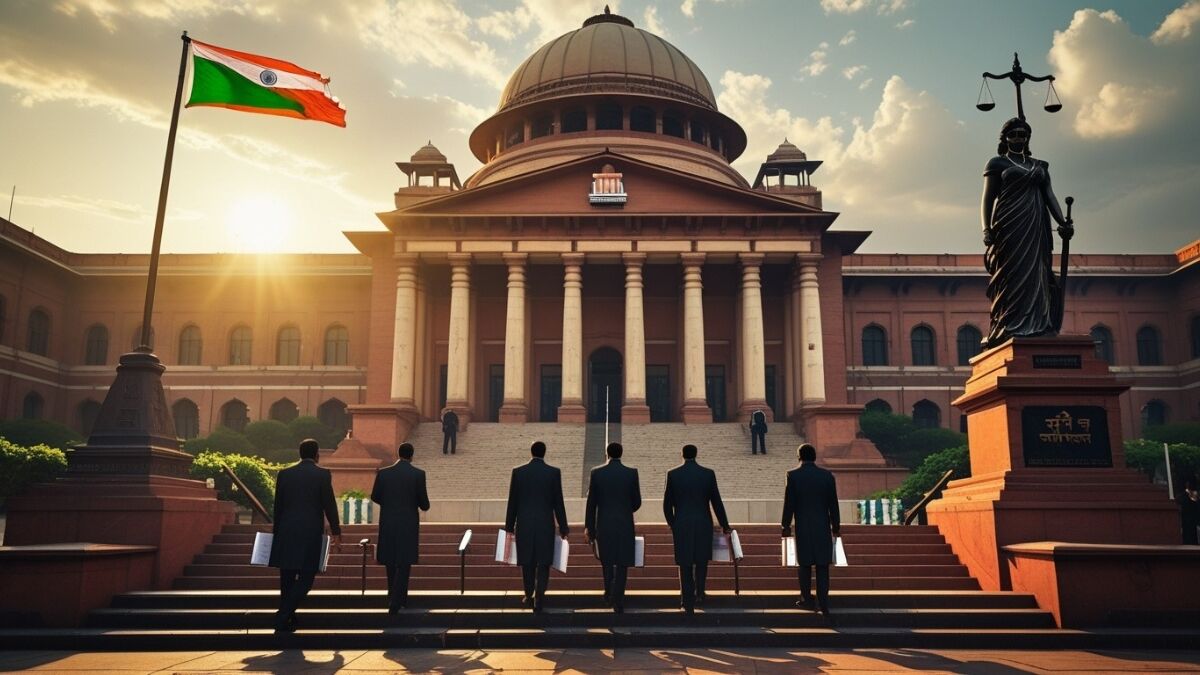
To guarantee the application of the Solid Waste Management Rules, the Court ordered the appointment of senior Union and State authorities as party respondents.
The Supreme Court has voiced concerns with the Solid Waste Management Rules’ implementation, pointing out that no expected outcomes are being seen at the local level despite multiple legal revisions.
The Bhopal Municipal Corporation appealed the National Green Tribunal’s decision to award environmental compensation of Rs. 1.80 crores and Rs. 121 crores, respectively, for alleged violations of waste management regulations. The bench, which also included Justices Pankaj Mithal and SVN Bhatti, was considering the case.
The Court noted the changing regulatory framework governing municipal garbage while evaluating the appeals. The Solid Waste Management Rules, 2016 took the place of the previous Municipal Solid Waste (Management and Handling) Rules, 2000. The Bench noted that the Solid Waste Management Rules, 2026, which are scheduled to take effect on April 1, 2026, have now surpassed even these.
The Court did clarify, nevertheless, that recurrent regulatory changes by themselves will not fix fundamental flaws.
The Court expressed worry that implementation issues, not a lack of regulations, are the root cause of India’s waste management crisis when it noted that the “statutory process is not generating desired result because of many reasons at the field level.”
The Court warned that the new regime might not succeed in improving the “ground reality” unless preliminary groundwork is finished before the rules go into effect, although characterizing the implementation of the 2026 Rules as a “welcoming step.”
“Therefore, in the facts and circumstances of the case, it would be necessary to ensure that infrastructure for the waste management is provided in accordance with the 2026 Rules.” The court added, stressing the significance of establishing waste management infrastructure in accordance with the 2026 Rules prior to their effective date, which is April 1, 2026.
“The introduction of new rules, though a welcome step, is expected to be completed by the authorities before the effective date sets in, otherwise Rules, 2026 will not be improving the ground reality.”
The Court stated that collaboration between several governmental levels would be necessary to ensure implementation. Therefore, it suggested that prominent Union and State officials be named as party respondents in both appeals. These officials would include:
(i) Secretary, Indian Ministry of Forests, Environment, and Climate Change;
(ii) Secretary, Housing and Urban Affairs Ministry;
(iii) Secretary, Panchayati Raj Ministry;
(iv) Madhya Pradesh’s chief secretary;
(v) Additional Chief Secretary, Madhya Pradesh’s Department of Housing and Urban Development; and
(iv) Principal Secretary, Madhya Pradesh’s Department of Housing and Environment
As a result, the Appellant-Corporation was instructed to implement the adjustment and provide the updated cause title by the next scheduled hearing date of February 19, 2026, at the latest.
