
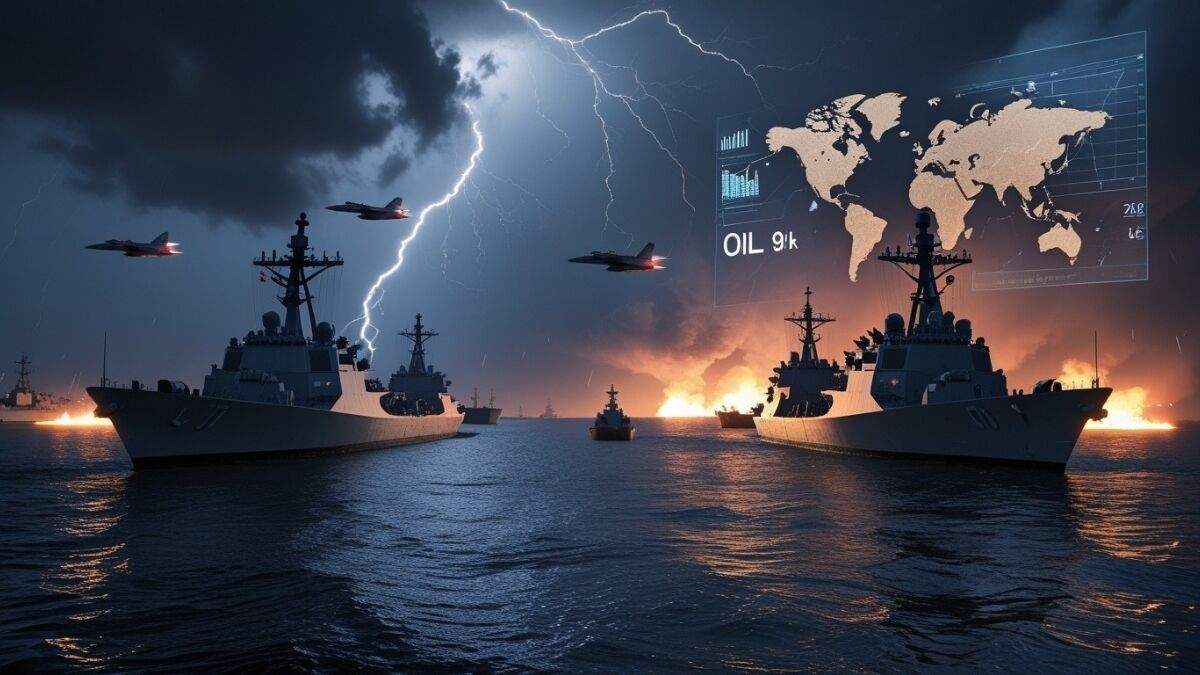
Rising tensions between the United States and Iran have intensified global concerns, with strong warnings, military risks, and oil market volatility shaping the geopolitical landscape.
As his final Tuesday deadline to reopen the Strait of Hormuz draws near, US President Donald Trump escalated his threats against Iran on Monday, saying the nation might be “taken out in one night” at a White House news conference.
Trump Escalates Threats Against Iran
“One night could eliminate the entire nation, and that night may be tomorrow night,” Trump informed reporters after threatening Tehran with “Hell” in a profanity-filled post on his Truth Social platform on Easter Sunday.
“In Iran, Tuesday will be both Bridge Day and Power Plant Day combined. Nothing like it will exist! Trump issued a dire warning over the weekend: “Open the F***** Strait, you insane b******s, or you will be living in Hell – JUST WATCH! Praise be to Allah.” He had added, “Tuesday, 8:00 P.M. Eastern Time!,” giving Iran a definite time to take action.
⚠️ Trump’s Ultimatum to Iran
- Deadline: Tuesday, 8:00 PM (ET)
- Main Demand: Reopen Strait of Hormuz
- Threat: Massive infrastructure strikes
- Targets: Bridges & power plants
- Timeframe: Within 4 hours
- Risk: Full-scale escalation
Details of the Ultimatum
Trump outlined the specifics of his ultimatum during the briefing on Monday. “Every bridge in Iran will be demolished” and “every power plant in Iran will be out of business, burning, exploding and never to be used again” if no agreement is reached, he said.
Ironically, he added that the US “may even get engaged with helping them reconstruct their nation” despite his assumption that the entire demolition would take place over the course of four hours.
Legal and International Concerns
When asked if attacking civilian infrastructure would be considered war crimes, Trump dismissed the idea, saying he was “not worried about it” and added, “I pray I do not have to do it.”
However, Iran retaliated with threats of its own, with Speaker of the Parliament Mohammad-Bagher Ghalibaf stating that “our whole area is going to burn” as a result of the US president’s careless actions.
🌍 Global Risk & Oil Impact
- Oil Price: Near $110/barrel
- Peak: Above $126 earlier
- Global Risk: War escalation
- Impact: Energy supply disruption
- Region: Middle East instability
- Concern: Inflation & trade shock
International Reaction and Diplomacy
As European Union leaders and human rights experts cautioned that attacking civilian energy grids is illegal and unacceptable under international law, Iran’s foreign ministry retaliated against the threats, pointing out that diplomatic negotiations were incompatible with ultimatums and threats to commit war crimes.
With Defense Secretary Pete Hegseth, CIA Director John Ratcliffe, and Joint Chiefs Chairman Gen. Dan Caine at his sides, Trump began his Monday press conference by describing the action-packed extraction of a crashed F-15E fighter aircraft crew member over the weekend.
US Military Operations and Rescue Mission
Trump explained his decision to approve the rescue as “risky” and “challenging,” calling it “one of the largest, most difficult, most traumatic combat searches” ever performed by the US military. He stressed that “with the US military, we leave no American behind” while asserting that Iran “got lucky” when they shot down the aircraft with a shoulder-fired heat-seeking missile.
Iran asserted that multiple US aircraft, including two military transport planes and two Black Hawk helicopters, were destroyed during the intense operation, while Trump applauded the rescue. In order to keep the stranded supply planes out of Iranian hands, US commanders purposefully destroyed them themselves, according to later confirmation from US sources.
Oil Prices Surge Amid Conflict
Oil prices are still rising sharply despite the effective closure of the vital Strait of Hormuz; on Tuesday, the benchmark Brent crude price was trading at almost $110 per barrel.
Before the conflict began, the price of Brent crude was much lower. However, since the US and Israel launched strikes against Iran on February 28, causing chaos in the Middle East, the price of Brent crude has skyrocketed. Brent crude surged beyond $126 per barrel at its peak earlier in March as a result of Iran closing off the Strait of Hormuz, a vital waterway that transports 20% of the world’s oil.
Diplomatic Efforts and Deadlock
Trump had conflicting views on diplomacy amid the exchange of threats, saying he thinks Iranian negotiators are behaving in “good faith.” He described the 45-day ceasefire framework that Pakistani mediators recently provided as a “major start,” but he said Iran’s counterproposal was “not good enough.”
The Strait of Hormuz continues to be a major source of contention. Trump stressed on Monday that any acceptable agreement must guarantee the “free movement of oil” after days of wavering on who should secure the canal. The president also suggested that, after the strait is reopened, the US should impose its own tolls or fees on ships traveling through it, in an unconventional step.
Limited Movement in Hormuz
There has been some movement in the crucial waterway despite the diplomatic deadlock. A few ships, notably a tanker controlled by Oman, have been allowed safe transit through the Strait of Hormuz in recent days, according to shipping statistics. This is in line with Iran’s strategic stance of only permitting passage for ships from nations it considers friendly.
Frequently Asked Questions
1) How did Donald Trump threaten Iran?
Donald Trump threatened to “wipe out in one night” Iran if it did not comply with American demands, which include reopening the Strait of Hormuz by Tuesday.
2) What makes the Strait of Hormuz significant?
About 20% of the world’s oil supply passes through the Strait of Hormuz, making its closure extremely disruptive to the stability of international trade and energy markets.
3) What demands did the US make of Iran?
The United States threatened to launch massive strikes on infrastructure if Iran did not comply with its demands to reopen the Strait of Hormuz and stop nuclear activities by the deadline.
4) How has Iran reacted to these dangers?
Iran refused to cooperate under duress, calling the ultimatum impossible and threatening harsh punishment. Instead, it insisted on compensation, the lifting of sanctions, and more extensive talks.
5) How does this conflict affect the world?
Fears of a wider battle and its humanitarian ramifications are swiftly spreading throughout the Middle East as a result of the intensifying conflict, which has also exacerbated regional instability, boosted oil prices, and sparked international alarm.
Conclusion
There is an urgent need for diplomacy to stop the escalation of the growing tensions between the United States and Iran over the Strait of Hormuz, which emphasize the risks of massive conflict, economic disruption, and global instability.
Disclaimer: This article is for informational purposes only and reflects rapidly evolving geopolitical developments.
