
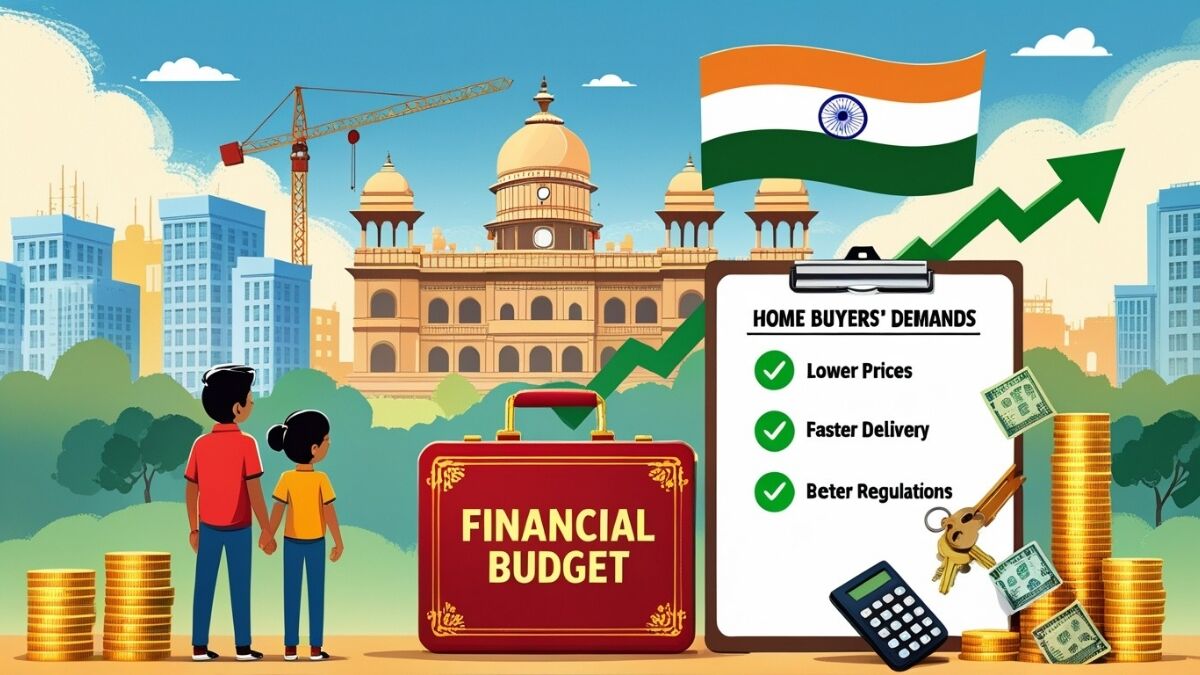
The government’s intention to maintain fiscal discipline is evident in the first Union Budget for the second quarter of the twenty-first century.
Fiscal Discipline and Budget Deficit Targets
According to the Union Finance Minister’s presentation, the Revised Estimates of the Fiscal Deficit for 2025–2026 are 4.4% of GDP, which is comparable to the Budget Estimates for the same period. According to the revised fiscal prudence path of debt consolidation, the predicted budget deficit for 2026–2027 (BE) is 4.3% of GDP.
The Central Government’s capital expenditure (capex) for the fiscal year 2026–2027 is to be increased to ₹12.2 lakh crore, a 9% increase over the current year’s budgeted request of ₹11.2 lakh crore.
Infrastructure Push and Capital Expenditure Focus
In cities with more than five lakh residents, particularly tier-2 and tier-3 cities that have developed into important growth hubs, the government will keep concentrating on building infrastructure. In keeping with ASSOCHAM’s pre-Budget report, which emphasizes the significance of prioritizing high-quality capital expenditure in logistics, transport, etc., to sustain productivity-driven growth, a number of initiatives have been launched to boost infrastructure.
🏗️ Union Budget Infrastructure & Capex Highlights
- Total Capex: ₹12.2 lakh crore for FY 2026–27
- Growth Rate: 9% increase year-on-year
- Urban Focus: Tier-2 and Tier-3 cities
- Priority Sectors: Logistics, transport, urban infrastructure
- Growth Strategy: Productivity-driven capital investment
Strengthening India’s Financial System
India’s financial system is growing more robust, diverse, and inclusive, but it still has to contend with fresh difficulties brought on by shifting dynamics. In order to maintain the reform-driven growth of this industry, it has been suggested that a High-Level Committee on Banking for Viksit Bharat be established to thoroughly examine the industry and bring it into line with India’s upcoming growth phase while preserving consumer protection, financial stability, and inclusion.
Foreign Investment and Trade Policy Direction
In line with India’s changing economic priorities, the Union Budget this year also calls for a thorough revision of the Foreign Exchange Management (Non-Debt Instruments) Rules to establish a more modern, approachable framework for foreign investments.
Future trade policy changes will be dependent on the extent and scale of uncertainties surrounding tariff trajectories. Nonetheless, it is anticipated that the taxes measures will provide the economy the much-needed boost it needs to pick up speed.
📊 Key Tax & Trade Reforms in Union Budget
- Fiscal Deficit Path: 4.4% (FY26), 4.3% (FY27)
- Export Boost: Duty-free import limits expanded
- Trade Relief: Support for global tariff disruptions
- Tax Simplification: Automated certificates for small taxpayers
- Investor Confidence: Stable and predictable tax regime
Tax Administration and Compliance Reforms
The Budget suggests creating a Joint Committee of the Ministry of Corporate Affairs and the Central Board of Direct Taxes to integrate the Income Computation and Disclosure Standards (ICDS) requirements into the Indian Accounting Standards (Ind AS) in order to improve tax administration.
A plan is put up for small taxpayers that would allow them to get a lower or zero deduction certificate using an automated rule-based approach rather than submitting an application to the assessing officer.
Minimum Alternate Tax (MAT) Overhaul
Furthermore, it is suggested that the Minimum Alternate Tax (MAT) be made a final tax in a significant modification to the MAT system. Credit accumulation will therefore cease on April 1, 2026. Final tax rates will drop from the present 15% MAT rate to 14%.
Export Sector and Industry Support Measures
ASSOCHAM suggested boosting cash flows and trade competitiveness while offering export industries experiencing global tariff or demand shocks time-bound help.
The Union Budget suggests raising the duty-free import cap for specific inputs needed to prepare seafood items for export from the existing 1% to 3% of the FOB value of the export revenue from the prior year. Furthermore, in addition to leather or synthetic footwear, shoe uppers are now eligible for duty-free imports of specific inputs. For exporters of leather or textile clothing, as well as leather and synthetic footwear, an expansion of the current six-month export period to a year has been suggested.
Services Sector and Digital Economy Incentives
As the Indian economy’s top performer, the services sector has seen a number of measures to boost its growth momentum. With a shared safe-harbor margin of 15.5%, the Union Budget allows for the grouping of services under a single category of information technology services.
There is a provision for tax holidays until 2047 for foreign businesses that use data centers in India to offer cloud services to clients throughout the world. Related companies who offer data center services from India will also get a 15% cost-safe harbor margin.
Taxation options are changing at this crucial juncture in the path to Viksit Bharat in response to new demands. Simultaneously, India’s fiscal dynamics continue to be sound, bolstered by consistent improvements in the quality of spending, increased capital expenditure allocations, and a persistent dedication to fiscal consolidation.
Frequently asked questions
1. What does the Union Budget say about budgetary restraint?
By maintaining the fiscal deficit at 4.4% of GDP for 2025–2026 and lowering it even further to 4.3% in 2026–2027, the Union Budget upholds fiscal prudence and indicates a steady path of debt consolidation without sacrificing growth.
2. In what ways does the budget encourage economic expansion?
A substantial rise in capital investment to ₹12.2 lakh crore, with a focus on infrastructure development, particularly in tier-2 and tier-3 cities, logistics, transportation, and urban expansion, supports growth.
3. What changes are suggested for the financial and banking industry?
The government suggests creating a High-Level Committee on Banking for Viksit Bharat to conduct a thorough analysis of the industry, match it with the demands of future expansion, and guarantee consumer safety, financial stability, and inclusiveness.
4. How does the budget help the commerce and exporting industries?
In order to improve cash flows and worldwide competitiveness, the Budget extends benefits to shoe uppers, increases duty-free import limits for seafood exporters, and extends export timelines for leather and textile items.
5. What significant tax-related adjustments have been made public?
The introduction of tax incentives for IT services and data center operations, the simplification of procedures for small taxpayers, the alignment of ICDS with Ind AS, and the reduction of the Minimum Alternate Tax (MAT) to a final tax at a lowered rate of 14% are some of the major changes.
Conclusion
The Union Budget combines growth-oriented measures with fiscal restraint in a way that is both forward-looking and balanced. The government has established a strong basis for long-term economic growth by prioritizing high-quality capital spending, bolstering tax administration, encouraging exports, and implementing tailored incentives for services and digital infrastructure.
The Budget highlights a strong commitment to fiscal consolidation, investor confidence, and productivity-driven growth as India moves closer to the vision of Viksit Bharat, guaranteeing resilience in the face of global challenges.
